

Gujranwala has long been known as one of Punjab’s most productive industrial cities, home to a dense concentration of small and medium manufacturing units producing everything from cookware and utensils to fans, electrical goods and sports equipment. This manufacturing base, combined with GEPCO’s rising electricity tariffs and the persistent load shedding that affects both factories and residential neighborhoods across the city, has made the solar panel price in Gujranwala a frequent search among local business owners and homeowners alike over the past several years. This guide breaks down current 2026 pricing for both residential and commercial solar in Gujranwala, why the city’s manufacturing sector has embraced solar so quickly, and what local buyers should know before committing to a system.
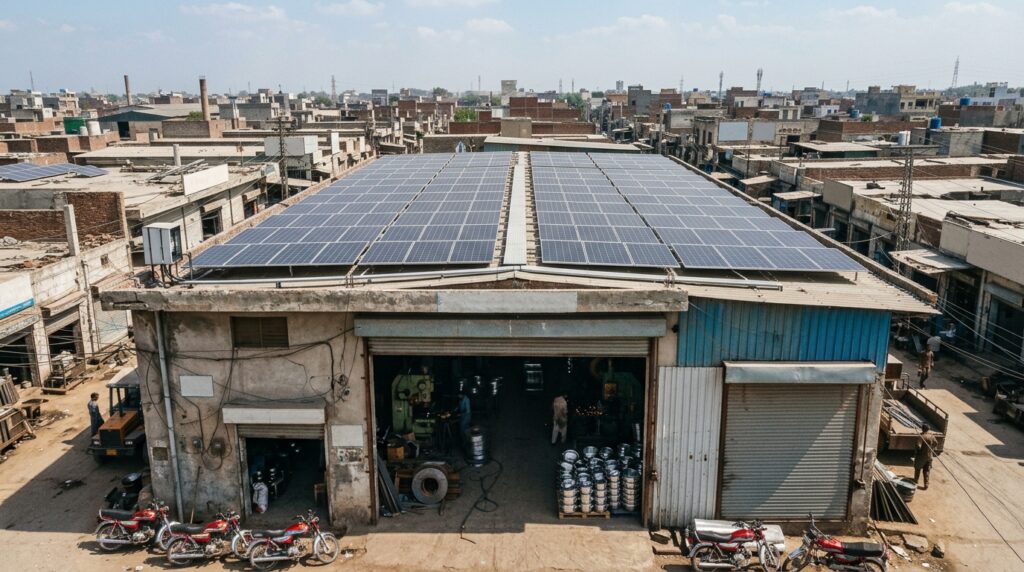
Gujranwala’s economy runs on thousands of small and medium enterprises, many operating out of comparatively modest facilities where electricity costs represent a disproportionately large share of total operating expenses compared to larger, more capital-intensive industries elsewhere in the country. Metalworking, utensil manufacturing, fan assembly, and various light engineering trades all depend heavily on continuous electrical power for machinery operation, and as GEPCO’s industrial tariffs have climbed steadily over recent years, solar has increasingly become viewed less as an optional environmental upgrade and more as a straightforward, necessary cost-control measure for staying competitive. The relatively compact, dense layout of many Gujranwala manufacturing units, often built on smaller plots than the sprawling industrial estates found in cities like Faisalabad or Karachi, has also shaped local solar demand toward efficient, space-conscious system designs that maximize output within limited available rooftop area.
As of 2026, solar equipment pricing in Gujranwala closely tracks national averages, since the same importers and Tier-1 manufacturers supply installers across all of Punjab, though local dealer competition within the city has helped keep pricing generally competitive for both residential and commercial buyers.
Solar panels in Gujranwala currently range from PKR 24 to PKR 55 per watt, depending on brand, wattage and cell technology. Standard P-Type and Mono PERC panels sit toward the lower end of this range, while premium N-Type bifacial panels from Longi and Jinko Tiger Neo occupy the higher end, offering notably better heat tolerance during Gujranwala’s long, intense summer season, a genuinely relevant factor given how much of the city’s electricity demand, both residential and industrial, spikes during these peak heat months.
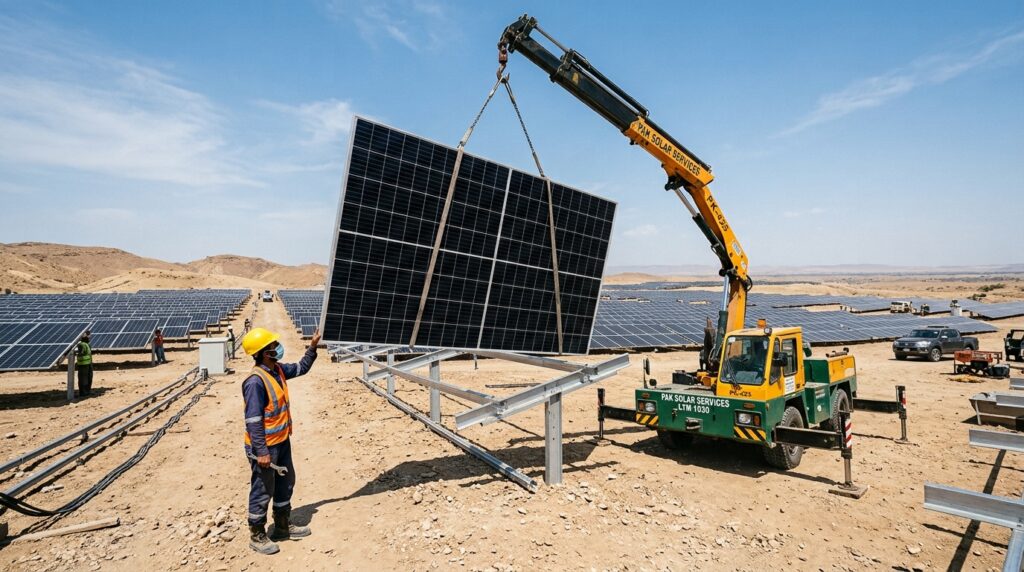
A complete, professionally installed 5 kW on-grid system in Gujranwala typically costs between PKR 650,000 and PKR 850,000, while a 5 kW hybrid system with lithium battery backup, increasingly popular given the frequency of load shedding affecting both residential neighborhoods and smaller manufacturing units across the city, ranges from PKR 850,000 to PKR 1,100,000. For manufacturing units requiring larger commercial-scale systems, typically starting around 20 kW and scaling up depending on facility size and machinery load, pricing is generally quoted individually following a proper load analysis, with larger installations above 50 kW typically achieving the most competitive cost per kWh due to economies of scale in equipment procurement and installation labor.
For a typical small to medium manufacturing unit in Gujranwala, electricity often represents one of the largest recurring operating costs after raw materials and labor, making even a moderate reduction in grid dependence financially meaningful over the operational life of a solar system. Industrial and commercial solar clients across Punjab, including a growing number in Gujranwala’s manufacturing sector, typically see a fifty to seventy percent reduction in electricity expenditure once a properly sized system is commissioned, with full return on investment often achieved within two to three years for larger installations. Beyond direct cost savings, many Gujranwala manufacturers cite improved production reliability as an equally important motivation, since a well-designed hybrid or on-grid system with net metering reduces vulnerability to unplanned grid outages that can halt production runs, damage sensitive equipment during voltage fluctuations, or cause costly delays in fulfilling customer orders. Our commercial and industrial solar solutions team has worked with manufacturing clients across Punjab’s industrial cities, managing everything from initial load-flow analysis through full NEPRA net metering documentation and commissioning.
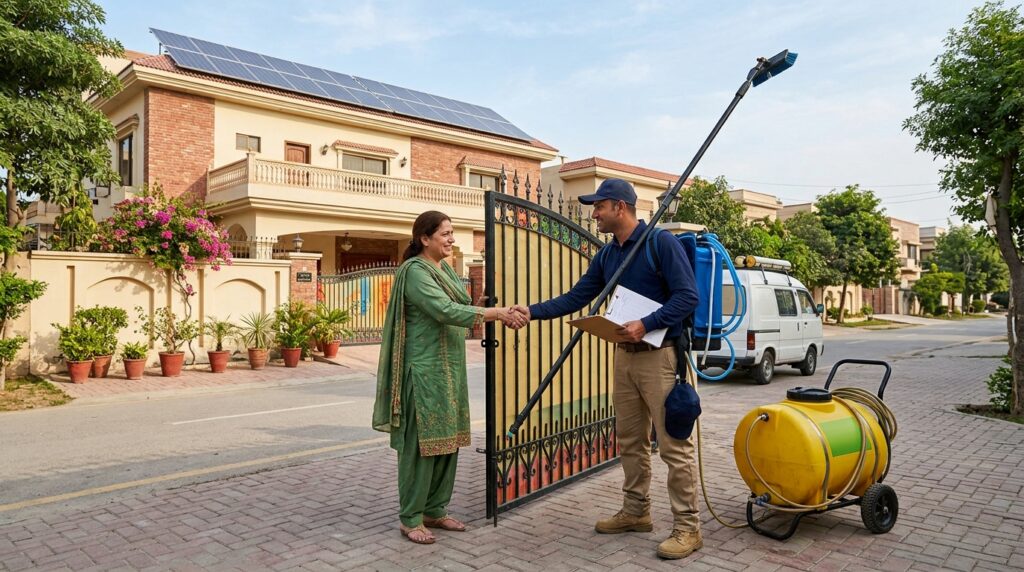
Residential solar demand in Gujranwala has grown steadily alongside the city’s industrial adoption, particularly as households face increasingly burdensome monthly electricity bills from GEPCO. A standard 5 kW system remains the most common configuration for medium-sized homes across the city, typically reducing a household’s monthly electricity bill by PKR 10,000 to 18,000 depending on baseline consumption patterns. Larger homes, particularly those running multiple air conditioners or larger appliance loads through Gujranwala’s hot summer months, often require a 7 kW to 10 kW system to meaningfully offset consumption, and our residential solar solutions team conducts a free site survey to determine the appropriate system size for each specific household’s actual consumption pattern rather than relying on generic estimates.
Net metering in Gujranwala operates through the Gujranwala Electric Power Company, following the same NEPRA-regulated framework applied consistently across all Pakistani DISCOs. Once a system is installed, a bi-directional green meter records both electricity drawn from the grid and surplus solar electricity exported back to it, with exported units credited against imported units at billing time, often bringing monthly bills close to zero or generating a rollover credit for particularly high-generation months. Eligible customers need a minimum three-phase connection and a NEPRA-approved inverter, and our net metering services handle the complete GEPCO application process on behalf of Gujranwala customers, including load-flow diagrams and PEC-certified technical documentation, which typically results in approval within two and a half to three and a half months following installation when all documentation is prepared correctly the first time.
Gujranwala experiences a fairly typical Punjab pattern of grid outages, varying by specific neighborhood and industrial zone depending on feeder capacity and local demand concentration. For customers in areas with relatively stable GEPCO supply, an on-grid solar system offers the lowest upfront cost while still delivering strong bill reduction through net metering, making it a sensible default choice for many residential customers and smaller businesses without particularly severe load shedding exposure. For customers in neighborhoods or industrial zones experiencing more frequent outages, a hybrid solar system with lithium battery backup provides continuous power regardless of grid status, a particularly valuable feature for manufacturing units where even brief power interruptions can disrupt precision machinery operations or damage in-progress production runs, and for households wanting reliable backup during Gujranwala’s frequent summer outages.
The same Tier-1 brands available nationally are actively installed throughout Gujranwala, including Longi Hi-Mo X10 and Jinko Tiger Neo for buyers prioritizing maximum efficiency and heat tolerance, particularly valuable given how many local manufacturing facilities run machinery continuously through the hottest parts of the day. JA Solar N-Type offers a strong value-focused alternative for budget-conscious residential and smaller commercial buyers, while Canadian Solar HiKu7 and Trina Vertex N remain popular choices for larger industrial installations requiring proven, established manufacturing track records. A full comparison of these brands, including efficiency ratings and warranty terms specific to different application types, is available in our guide to the best solar panels in Pakistan.
Gujranwala’s building stock includes a mix of flat concrete rooftops common in newer residential and commercial construction, alongside older industrial sheds and smaller manufacturing units that sometimes feature tin or sloped corrugated roofing, particularly in the city’s more established manufacturing zones. Flat concrete roofs offer the greatest flexibility for achieving an ideal panel mounting angle, discussed in detail in our dedicated guide to solar panel angle, since a custom mounting structure can be built to the theoretically optimal tilt without any roof pitch constraint. Older industrial sheds with tin or corrugated roofing require additional structural assessment to confirm the roof can safely bear the weight of a solar mounting structure and panel array, a consideration our engineering team evaluates as a standard part of every commercial site survey before finalizing a system design or quotation for a Gujranwala manufacturing facility.
Because final pricing depends heavily on system type, panel brand selection, specific roof or ground-mount conditions, and current USD to PKR exchange rates, any meaningful quote should be based on an actual site visit rather than a generic online price estimate applied uniformly across different properties. Pakistan Solar Solutions offers a free energy audit and site survey for Gujranwala customers, covering both residential rooftops and industrial manufacturing facilities, ensuring the final quotation accurately reflects your specific consumption pattern, roof conditions, and budget priorities rather than a one-size-fits-all package borrowed from a different property type. You can request a custom quote for your Gujranwala home or business through our contact page.
Gujranwala sits within a cluster of industrially active Punjab cities that have all seen accelerating solar adoption in recent years, and understanding how the city compares to its neighbors provides useful context for local buyers. Compared to Faisalabad, which hosts larger-scale textile manufacturing operations often requiring correspondingly larger commercial solar installations, Gujranwala’s manufacturing base tends toward smaller, more numerous individual units, resulting in a solar market weighted more heavily toward mid-sized commercial systems in the 20 to 100 kW range rather than the very large multi-hundred-kilowatt installations more common among Faisalabad’s largest textile mills. Compared to Lahore, Gujranwala generally offers somewhat more straightforward site conditions for solar installation, since the city’s building density, while significant, has not yet reached the same level of vertical, space-constrained development found in parts of central Lahore, generally allowing more flexibility in rooftop system sizing for both residential and commercial properties. This regional context helps explain why Gujranwala’s solar market has developed its own distinct character, shaped by the specific needs of its dense small and medium manufacturing base alongside a steadily growing residential adoption trend.
Given that even a modest residential system represents a significant upfront investment for many households and small business owners in Gujranwala, financing has become an increasingly important part of the local solar conversation. Several Pakistani banks now offer dedicated solar financing products, including installment plans specifically structured for renewable energy purchases, allowing buyers to spread the upfront cost of a system across a period of two to five years rather than paying the full amount at once. For small and medium manufacturing units in particular, some financing packages are structured around the expected monthly electricity savings, effectively allowing the system to be paid off using a portion of the very savings it generates, which can make the transition to solar considerably more accessible for businesses operating on tighter working capital margins. Pakistan Solar Solutions can guide Gujranwala customers through the available financing options as part of the initial consultation process, helping identify which bank products and terms best match a specific household’s or business’s cash flow situation.
Gujranwala experiences a fairly typical central Punjab climate pattern, with intense summer heat from roughly April through September, a shorter monsoon period bringing periodic heavy rainfall, and a cooler winter season from November through February. This seasonal pattern has practical implications for solar system planning beyond the angle calculations discussed in our dedicated guide to solar panel angle. During the peak summer months, when both residential air conditioning demand and industrial machinery loads are at their highest, solar generation also happens to be near its annual peak, creating a naturally favorable alignment between when electricity is most needed and when solar panels produce the most power. During the monsoon season, periodic heavy rainfall and increased cloud cover can temporarily reduce daily generation, though this is generally offset over the year by the natural cleaning effect rainfall provides, reducing the dust accumulation that otherwise affects panel performance during Gujranwala’s dry months. Winter generation, while lower than summer due to shorter days and a lower sun angle, remains meaningful given Punjab’s generally clear winter skies, meaning a properly sized system continues delivering worthwhile savings even during the cooler months of the year.
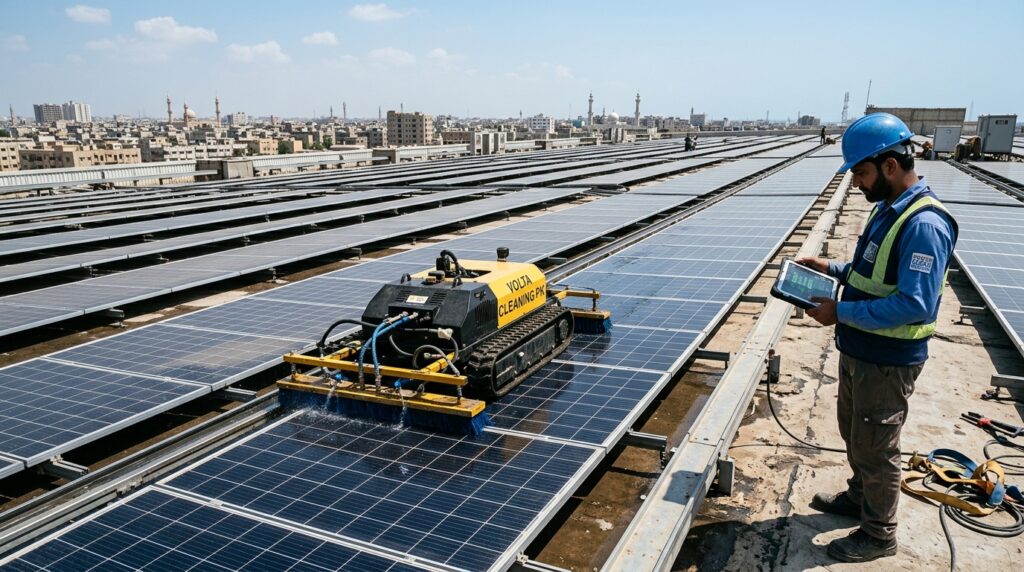
As a dense industrial city with significant manufacturing activity, Gujranwala experiences meaningful dust and particulate accumulation on outdoor surfaces, including solar panels, somewhat more than would be typical in a less industrially concentrated area. Manufacturing dust, combined with the general dry-season dust common across central Punjab, means panels installed in Gujranwala, particularly those near active industrial zones, may benefit from a somewhat more frequent cleaning schedule than the general Pakistani recommendation covered in our guide to the solar panel cleaning brush. Businesses operating solar systems on or near active manufacturing facilities should factor this into their maintenance planning, since consistent cleaning directly protects the electricity generation and corresponding cost savings that justified the initial system investment in the first place.
To illustrate how system sizing works in practice for a typical Gujranwala manufacturing scenario, consider a small utensil manufacturing unit running several pressing and polishing machines through an eight to ten hour working day. After a proper load analysis, such a facility might show an average daily consumption in the range of 150 to 250 units of electricity, translating into a recommended solar system size somewhere between 30 kW and 50 kW to meaningfully offset grid dependence during working hours. A system in this range, combined with net metering to handle any consumption beyond what solar directly covers during peak machinery operation, could realistically reduce the facility’s monthly GEPCO bill by fifty percent or more, with the specific savings percentage depending on how closely the facility’s operating hours align with peak solar generation hours during the middle of the day. This kind of scenario illustrates why a proper site-specific load analysis, rather than a generic size estimate, remains essential for any Gujranwala manufacturing unit considering solar, since actual machinery load profiles vary considerably even among businesses in the same general industry.
Given the number of solar vendors now operating in and around Gujranwala as demand has grown, a few practical checks help buyers separate reliable, established installers from less experienced or less accountable options. Confirming that the installer is PEC-certified provides assurance that the engineering team preparing net metering documentation and load-flow diagrams meets the professional standard required for smooth GEPCO approval. Requesting manufacturer datasheets for any proposed panel brand, rather than accepting a verbal wattage and efficiency claim alone, helps verify that quoted equipment matches genuine Tier-1 specifications rather than potentially mislabeled or downgraded stock. Asking for references or examples of previous installations completed in Gujranwala specifically, rather than only general company credentials, provides useful local context on how an installer has handled the specific roof types, GEPCO documentation requirements, and site conditions common in the city. Pakistan Solar Solutions brings PEC-certified engineering expertise and a demonstrated track record across Punjab’s industrial cities to every Gujranwala project, and our team is happy to provide relevant local references as part of the consultation process for any prospective customer.
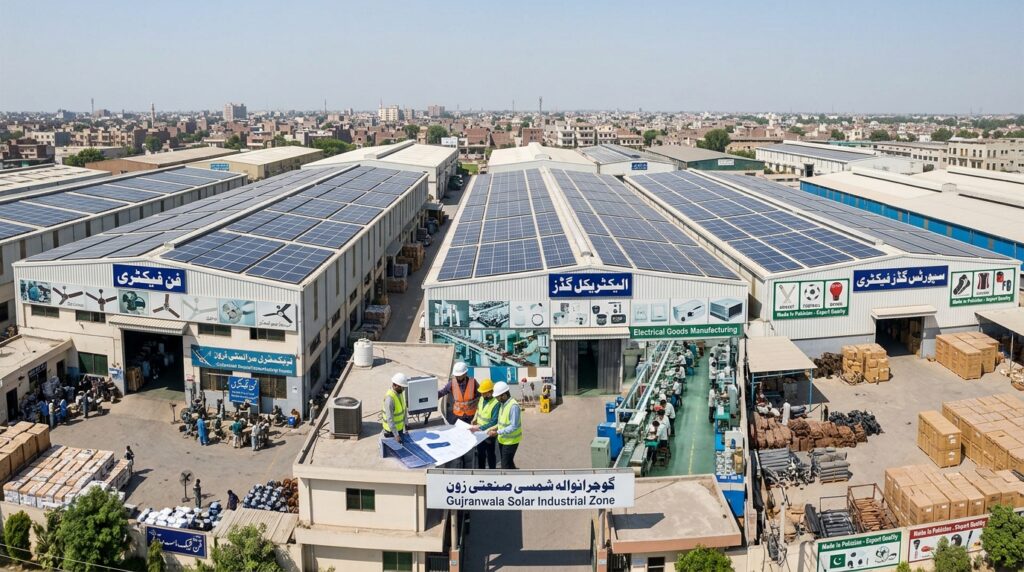
While utensil and cookware manufacturing remains one of Gujranwala’s most recognizable industries, solar adoption across the city extends well beyond this single sector. The city’s substantial fan manufacturing industry, producing both domestic and export-oriented electric fans, has seen significant solar uptake among mid-sized producers looking to offset the considerable electricity consumption involved in metal stamping, motor winding, and assembly processes. Gujranwala’s electrical goods sector, encompassing everything from switches and wiring accessories to small appliances, has similarly embraced solar as tariffs have risen, particularly among facilities running continuous production lines where electricity costs scale directly with output volume. The city’s sports goods manufacturers, producing items ranging from sporting equipment to related accessories for both domestic and export markets, represent another growing segment of commercial solar adoption, often motivated by the dual benefit of cost reduction and the increasingly important sustainability credentials that international buyers in export markets have begun to expect from their Pakistani manufacturing partners. This diversity across Gujranwala’s industrial base means our commercial engineering team regularly designs systems tailored to meaningfully different load profiles, from continuous heavy machinery operation to lighter assembly-line consumption patterns, rather than applying a single generic industrial template across every project.
For Gujranwala business owners weighing whether solar investment makes sense compared to simply continuing to pay GEPCO’s industrial tariffs indefinitely, a longer-term cost comparison often clarifies the decision more effectively than looking only at the upfront installation price. Consider a manufacturing unit currently paying approximately PKR 150,000 per month in electricity costs. Over a ten-year period, without any tariff increases at all, this represents roughly PKR 18 million in cumulative electricity spending, and given that GEPCO tariffs, like those of every Pakistani DISCO, have shown a consistent upward trajectory over the past decade, actual cumulative spending without solar would likely be considerably higher once realistic annual tariff increases are factored in. A properly sized commercial solar system capable of offsetting fifty to seventy percent of this consumption, costing perhaps PKR 4 million to PKR 6 million as a complete installed system depending on exact capacity, would typically pay back its full cost within two to three years through direct bill reduction, after which the business effectively operates with dramatically reduced electricity costs for the remaining twenty-plus years of the panels’ rated operational lifespan. This kind of long-term framing, rather than focusing purely on the initial capital outlay, is often what ultimately convinces Gujranwala business owners that solar represents sound financial planning rather than simply an optional sustainability gesture.
While cost reduction remains the primary driver for most Gujranwala solar adoption, particularly within the industrial sector, a secondary but increasingly relevant benefit involves environmental positioning and reputation, especially for manufacturers engaged in export activity. International buyers across sectors including sports goods, textiles, and light manufacturing have increasingly begun asking Pakistani suppliers about their environmental practices and energy sourcing as part of broader supply chain sustainability requirements, and a documented solar installation provides tangible evidence of environmental responsibility that can support these buyer relationships. Beyond export considerations, reduced diesel generator reliance during load shedding periods, common among Gujranwala manufacturing units without solar backup, also meaningfully reduces local air pollution and noise, contributing to a somewhat healthier working environment for factory staff, an incidental but genuinely valued benefit reported by several of our commercial clients across Punjab’s industrial cities.
Understanding the typical process from initial inquiry to a fully commissioned system helps Gujranwala buyers know what to expect and how to plan their timeline. The process begins with an initial consultation, either by phone, WhatsApp, or through our contact page, where our team gathers basic information about your property type, approximate monthly electricity consumption, and general goals for the system, whether that is bill reduction, backup power, or both. This is followed by a free, in-person site survey, during which our engineers assess your roof or ground-mount area, evaluate shading conditions throughout the day, check your existing electrical infrastructure and connection type, and take precise measurements needed for an accurate system design. Based on this survey, we prepare a detailed proposal including recommended system size, panel and inverter selection, estimated cost, and a realistic savings and payback projection specific to your actual consumption pattern rather than generic averages. Once a proposal is approved, equipment procurement begins, with all panels, inverters, and mounting materials verified for authenticity and Tier-1 quality before delivery to the installation site. Physical installation for a typical residential system in Gujranwala usually takes one to two days, while larger commercial and industrial installations may take anywhere from several days to a couple of weeks depending on system size and site complexity. Following installation, our team handles the complete GEPCO net metering application on your behalf, including all required load-flow documentation, with final green meter installation and system commissioning typically completing within two and a half to three and a half months of the original installation date.
A solar system’s value does not end once the panels are mounted and the net meter is approved. Ongoing performance depends on regular maintenance, periodic cleaning appropriate to Gujranwala’s dust and industrial air quality conditions discussed earlier in this guide, and prompt attention to any technical issues that may arise with the inverter or wiring over the system’s operational life. Pakistan Solar Solutions provides after-sales support for every system we install in Gujranwala, including guidance on cleaning schedules, monitoring system performance against expected generation figures, and troubleshooting support if a customer notices any unexpected drop in output. For commercial and industrial clients specifically, we also offer periodic performance review consultations, helping business owners understand whether their system continues delivering the expected savings as their facility’s consumption patterns evolve over time, and advising on potential system expansion if production capacity or electricity needs grow beyond what the original installation was designed to cover.
As of 2026, solar panels in Gujranwala cost between PKR 24 and PKR 55 per watt depending on brand and technology, with a complete installed 5 kW on-grid system typically costing PKR 650,000 to PKR 850,000.
Yes, small and medium manufacturers in Gujranwala typically see a fifty to seventy percent reduction in electricity expenditure after installing a properly sized solar system, with return on investment often achieved within two to three years for larger commercial-scale installations.
Net metering approval through GEPCO typically takes two and a half to three and a half months after installation, provided the load-flow diagrams and technical documentation are prepared correctly by a PEC-certified engineer from the outset.
This depends on how frequently your specific area or industrial zone experiences load shedding. Businesses in areas with relatively stable GEPCO supply often do well with a lower-cost on-grid system, while those in zones with frequent outages benefit significantly from a hybrid system with battery backup to avoid production disruptions.
Yes, we deliver solar installations across Pakistan including Gujranwala, alongside our primary offices in Karachi, Sukkur and Rawalpindi. Contact our team to arrange a free site survey for your Gujranwala property or manufacturing facility.