

A solar system is only as good as the sunlight actually reaching the cells, and in Pakistan, dust is one of the biggest silent killers of solar output. Between the dry season winds sweeping across Punjab and Sindh, construction dust in growing cities, and pollen and bird droppings that accumulate on any outdoor surface, panels here get dirty faster than in most other parts of the world. This is exactly why so many solar owners eventually search for a solar panel cleaning brush, often only after noticing their monthly savings have quietly dropped without an obvious explanation.
This guide walks through why cleaning matters so much in Pakistan’s climate, the different types of cleaning brushes available locally, current pricing, and the correct technique to clean panels without accidentally scratching the glass or damaging the anti-reflective coating that every modern Tier-1 panel relies on for peak performance.
Solar panels convert sunlight into electricity through their exposed glass surface, and anything blocking that surface, even a thin, barely visible film of dust, directly reduces the amount of usable sunlight reaching the photovoltaic cells underneath.
Independent field studies and installer observations across Pakistan consistently show that heavily dust-covered panels can lose anywhere from ten to twenty five percent of their expected output during the dry months between March and June, when rainfall is minimal and dust storms are common across Punjab, interior Sindh and much of Balochistan. For a household running a 5 kW system, this can translate into a noticeable increase in the electricity bill purely because the panels are dirty, not because anything mechanical has gone wrong with the inverter or the wiring.
Most solar installers in Pakistan recommend cleaning panels at least once every two to three weeks during the dry season, and once a month during the monsoon period when natural rainfall helps rinse away lighter dust buildup on its own. Properties located near construction sites, unpaved roads, or agricultural fields where crop dust and chaff are common will generally need more frequent cleaning than panels installed in a cleaner suburban or coastal environment.
Not all cleaning brushes are created equal, and using the wrong type can do more harm than good to the panel’s surface over time.
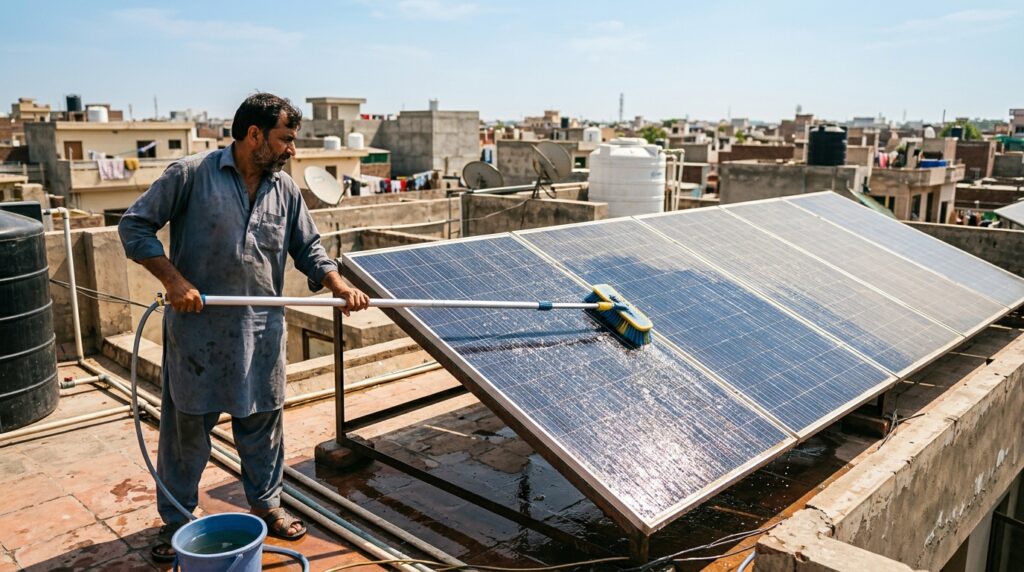
The most common type sold for residential and small commercial use in Pakistan is a telescopic extendable brush, typically ranging from four to twenty feet when fully extended, allowing panels to be cleaned safely from the ground or a lower section of the roof without climbing directly onto the panel surface. These brushes usually attach to a standard garden hose fitting, allowing water to flow through the handle directly to the bristle head while cleaning, which helps rinse away loosened dust in the same motion.
Soft, nylon or microfiber bristle brushes are strongly recommended for solar panels, since the glass surface and anti-reflective coating can be scratched by stiffer, harder bristles, particularly when dust particles trapped in the bristles act like fine sandpaper against the glass during cleaning. Hard bristle or wire brushes should never be used on solar panels under any circumstances, regardless of how stubborn the dirt appears, since even a single scratching pass can create permanent micro-abrasions that slightly reduce light transmission for the remaining lifespan of the panel.
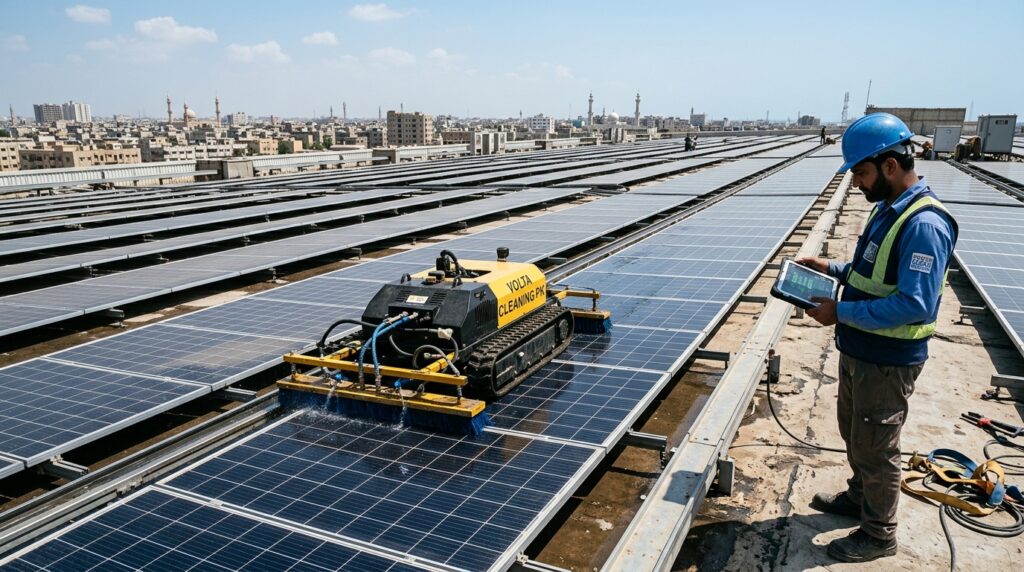
For larger residential systems and commercial rooftops, water-fed pole systems, which combine a soft rotating or static brush head with a continuous water flow through the pole itself, are increasingly common in Pakistan. These systems allow a technician to clean an entire row of panels from ground level or a single accessible point, significantly reducing both cleaning time and the safety risk associated with walking across a rooftop covered in panels.
As of 2026, a basic telescopic cleaning brush suitable for residential solar systems in Pakistan costs between PKR 1,500 and PKR 4,000, depending on the length of the pole, bristle material and whether it includes a hose attachment fitting. Mid-range brushes with adjustable angles and better quality microfiber or soft nylon bristle heads typically fall between PKR 3,000 and PKR 6,000. For larger commercial installations, professional-grade water-fed pole systems with extended reach, often twenty feet or more, along with a purified water filtration attachment to avoid mineral spotting, can range from PKR 15,000 to PKR 40,000 depending on the brand and included accessories.
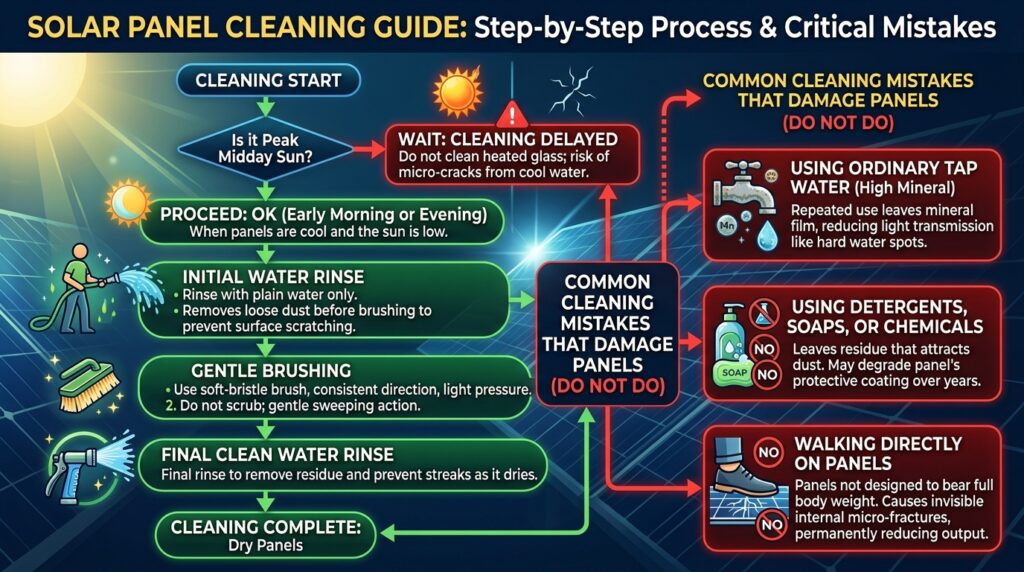
Cleaning technique matters just as much as the equipment itself, and rushing the process or using the wrong approach can shorten the effective lifespan of an otherwise well-installed system.
Cleaning should always begin early in the morning or in the evening, never during peak midday sun, since spraying cool water onto glass that has been heated by direct sunlight for hours can cause thermal shock, occasionally leading to micro-cracks in the panel surface over repeated exposure. Begin by rinsing the panel surface with plain water to loosen and remove loose dust before any brushing takes place, since brushing directly onto dry, dusty glass increases the risk of surface scratching. Using the soft-bristle brush, gently sweep across the panel surface in a single consistent direction, applying light pressure rather than scrubbing, followed by a final clean water rinse to remove any remaining residue and prevent streaking as the panel dries.
One of the most common mistakes is using ordinary tap water with high mineral content repeatedly, which can leave behind a mineral film over time that gradually reduces light transmission, similar to the effect of hard water spots on a car windshield. Using detergents, soaps or household cleaning chemicals is another frequent error, since these can leave a residue that actually attracts more dust rather than preventing it, and in some cases can degrade the panel’s protective coating over years of repeated use. Walking directly on panels to reach difficult areas is also a common and costly mistake, since even Tier-1 panels are not designed to bear a person’s full body weight and can develop internal micro-fractures in the cells that are invisible to the eye but permanently reduce output.
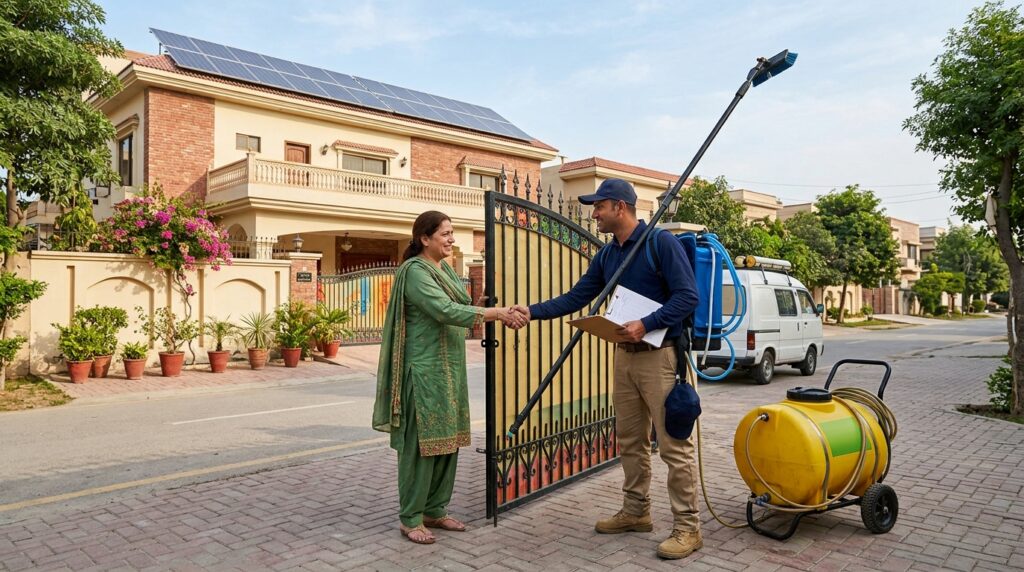
For most residential systems with easily accessible rooftops, DIY cleaning using a proper telescopic brush is a perfectly reasonable and cost-effective approach, provided the correct technique outlined above is followed consistently. However, for larger commercial and industrial installations, steeply pitched roofs, or systems installed at height where safe access is a genuine concern, professional cleaning services are the safer and often more cost-efficient option in the long run, since a professional team can clean an entire commercial array quickly using proper safety equipment and water-fed systems designed for scale. Pakistan Solar Solutions offers panel maintenance and cleaning support as part of our after-sales services for systems we install, ensuring your investment continues performing at its rated output well beyond the initial installation.
Early morning, roughly between six and eight in the morning, is generally the ideal window for cleaning in most Pakistani cities, since panels are cool, sunlight is not yet intense, and any water used evaporates naturally over the following hours without leaving streaks. During the peak dust season from March through June, a bi-weekly cleaning schedule is generally sufficient for most residential systems, while commercial installations in dustier industrial zones may benefit from weekly attention. During the monsoon months from July through September, natural rainfall typically handles much of the light dust removal on its own, though a manual clean after any particularly dusty spell, such as following a dust storm, is still worthwhile to remove settled grit that rain alone may not fully wash away.
A visible layer of dust or a dull, hazy appearance on the panel glass is the most obvious sign, but it is not always the most reliable one, since a thin, even film of dust can be difficult to spot visually while still meaningfully reducing output. A more reliable indicator is tracking your system’s daily generation figures, if your inverter or monitoring app shows, through the same clear-sky, high-sun-hour days, a noticeable drop in expected output compared to previous readings, dust buildup is one of the most common and easily fixed explanations.
Beyond installation, keeping a solar system performing at its rated capacity requires ongoing care, and Pakistan Solar Solutions supports customers with maintenance guidance and cleaning services as part of our long-term relationship with every project we complete. Whether you purchased your system through us or are simply looking for professional cleaning support for an existing installation, our team can advise on the right cleaning schedule and equipment for your specific location and roof type. For customers exploring a new system entirely, our full solar panel price in Pakistan overview covers everything from panel selection to complete turnkey installation, with maintenance support included as standard.
A soft-bristle telescopic brush with a hose attachment is the safest and most effective option for most residential systems in Pakistan. Hard bristle or wire brushes should never be used, since they can permanently scratch the glass surface and reduce panel efficiency.
A basic telescopic cleaning brush costs between PKR 1,500 and PKR 4,000, while mid-range options with better bristle quality and adjustable angles range from PKR 3,000 to PKR 6,000. Professional-grade water-fed pole systems for larger installations can cost PKR 15,000 to PKR 40,000.
Yes, a simple water rinse can remove light dust, and this is often sufficient during the monsoon season. However, for heavier dust buildup common during Pakistan’s dry months, a soft brush combined with water rinsing removes significantly more accumulated grime than water alone.
Most installers recommend cleaning every two to three weeks during the dry season between March and June, and roughly once a month during the monsoon season, when natural rainfall assists with regular dust removal.
Yes, significantly. Heavily dust-covered panels can lose ten to twenty five percent of their expected output in Pakistan’s dry season, which directly translates into lower electricity bill savings even though the system itself is functioning normally.