

Among the handful of Tier-1 solar manufacturers that dominate Pakistan’s import market, Jinko Solar has built one of the strongest reputations for combining genuinely advanced cell technology with pricing that remains accessible to mainstream residential and commercial buyers. If you have been comparing quotes and keep seeing Jinko listed alongside Longi and JA Solar, this guide breaks down exactly what the Jinko solar panels price in Pakistan looks like in 2026, what makes the Tiger Neo series worth considering, and how Jinko stacks up against the other major brands available locally.
Jinko Solar is one of the largest solar panel manufacturers in the world by production volume, and this global scale has translated into a strong, well-established supply chain into Pakistan, meaning genuine Jinko panels are widely available through authorized distributors rather than being a niche or hard-to-source brand. Installers across the country, including our team at Pakistan Solar Solutions, favor Jinko specifically for its consistent manufacturing quality, meaning the actual field performance of installed panels closely matches their published datasheet specifications, an important consideration given how much variance can exist among lesser-known manufacturers in the broader market covered in our overview of the best solar panels in Pakistan.
Jinko’s flagship product line sold in Pakistan is the Tiger Neo series, built on N-Type TOPCon cell technology combined with bifacial design, meaning the panel can generate electricity from both its front and rear surfaces. This combination allows Tiger Neo panels to achieve front-side efficiency ratings around 22.5 percent, among the highest available in the Pakistani market, with additional energy yield captured from reflected light on the rear surface when panels are mounted with appropriate ground clearance, a topic covered in more depth in our guide to high efficiency solar panels. The N-Type cell architecture also gives Tiger Neo panels a favorable temperature coefficient, meaning they retain more of their rated output during Pakistan’s intense summer heat compared to older P-Type technology, a genuinely important factor for buyers in hot regions covered in our city-specific guides for Multan, Faisalabad and Karachi.
As of 2026, Jinko panel pricing in Pakistan generally falls within the broader national range of PKR 24 to PKR 55 per watt, with Jinko’s premium Tiger Neo bifacial models typically sitting toward the mid-to-upper portion of this range given their advanced cell technology.
Jinko’s mid-range Tiger Neo panels in the 550 to 585 watt category typically cost between PKR 22,000 and PKR 28,000 per panel, translating to roughly PKR 40 to PKR 48 per watt. This wattage range remains extremely popular for standard residential rooftop installations across Pakistan, and is covered in further detail in our dedicated guide to the solar panel 550 watt price in Pakistan.
Jinko’s higher-capacity Tiger Neo panels, extending up to and beyond 600 watts, typically cost between PKR 26,000 and PKR 32,000 per panel, appealing particularly to commercial and industrial buyers looking to minimize total panel count for larger installations, as well as residential buyers with genuinely constrained roof space who want to maximize capacity within a limited footprint.
Buyers comparing Jinko against Pakistan’s other leading Tier-1 brands will find the three sit fairly close together in both price and efficiency, though each has slightly different strengths. Longi’s Hi-Mo X10 series generally edges out Jinko marginally on peak efficiency figures, often reaching just above 22.8 percent compared to Jinko’s roughly 22.5 percent, though the practical real-world difference between these figures is minimal for most residential applications. JA Solar’s N-Type panels typically come in at a somewhat lower price point than both Jinko and Longi, making JA Solar attractive for budget-conscious buyers who still want genuine N-Type technology without paying the premium commanded by the very top-tier flagship products. Jinko’s particular advantage lies in its bifacial Tiger Neo design, which gives it a meaningful edge specifically for elevated commercial and industrial mounting configurations where the rear-side energy capture can add a genuinely significant boost to total yield beyond what the front-side rating alone suggests, a benefit less pronounced or unavailable in some competing monofacial product lines.
Jinko backs its panels with the same industry-standard 25-year linear performance warranty offered by other leading Tier-1 manufacturers, guaranteeing at least 85 to 87 percent of original rated output by year 25. Buyers should always insist on official manufacturer documentation when purchasing Jinko panels in Pakistan, since counterfeit or mislabeled panels claiming to be genuine Jinko stock occasionally circulate in the open market, particularly at prices significantly below the prevailing rate for authentic Tiger Neo technology. Sourcing Jinko panels through an established, PEC-certified installer with a direct or verified distributor relationship, as Pakistan Solar Solutions maintains, provides meaningful protection against this risk and ensures any warranty claim can actually be honored through legitimate manufacturer channels if an issue arises during the panel’s operational life.
Jinko’s bifacial Tiger Neo technology makes it a particularly strong fit for specific project types across the Pakistani market. Commercial and industrial installations using elevated ground-mount or carport-style structures, common across our commercial and industrial solar solutions projects, benefit most directly from Jinko’s bifacial rear-side generation capability, since these mounting configurations create the physical clearance needed to capture meaningful reflected light. Residential rooftop systems also perform well with Jinko panels, particularly for homeowners prioritizing maximum efficiency within a limited roof footprint, discussed further in our residential solar solutions overview, though the bifacial advantage is generally less pronounced on standard flush-mounted rooftop installations compared to elevated commercial structures.
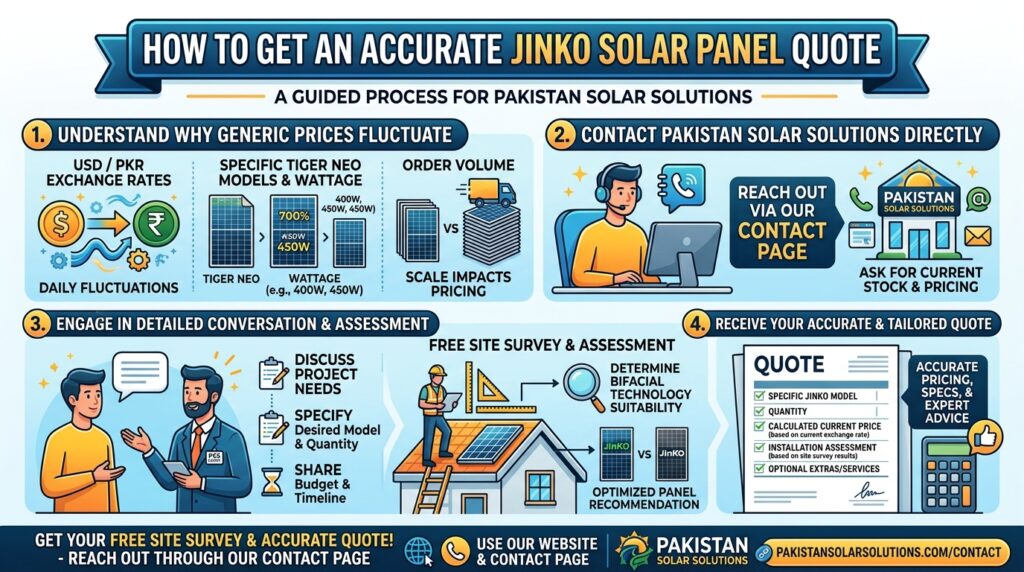
Because pricing fluctuates with USD to PKR exchange movements and varies based on the specific Tiger Neo model, wattage and order volume, any meaningful quote should come from an actual conversation with a supplier rather than relying purely on a generic online price list. Pakistan Solar Solutions maintains current Jinko stock and pricing as part of our broader solar panel price in Pakistan offering, and our free site survey process determines whether Jinko’s bifacial technology genuinely suits your specific project or whether an alternative brand from our range might better match your roof configuration and budget. You can reach our team directly through our contact page for current pricing and stock availability.
Jinko Solar consistently ranks among the top two or three solar panel manufacturers in the world by annual shipment volume, producing tens of gigawatts of panel capacity every year across multiple manufacturing facilities. This scale matters directly to Pakistani buyers in several practical ways. First, it means Jinko has the manufacturing capacity and established logistics infrastructure to maintain consistent supply into the Pakistani market even during periods of high local demand, reducing the stock shortages and price spikes that sometimes affect smaller or less established brands during peak buying seasons. Second, Jinko’s scale supports substantial ongoing research and development investment, which is part of why the company has consistently been among the first manufacturers to bring new cell technologies, including the current generation of N-Type TOPCon and bifacial design, to commercial availability. Third, and perhaps most relevant for long-term buyers, Jinko’s global scale and financial stability provide reasonable confidence that the company will remain in business and able to honor warranty claims across the full 25-year warranty period, a genuine consideration when comparing established Tier-1 manufacturers against smaller, newer entrants to the solar panel market whose long-term stability is less proven.
While Tiger Neo represents Jinko’s current flagship product line and the technology most commonly recommended for new installations in Pakistan, the company also produces other panel series that occasionally appear in the local market, including older Mono PERC product lines from previous generations. Buyers comparing quotes should pay close attention to which specific Jinko series is actually being quoted, since older Mono PERC panels, while still genuine Jinko products with reasonable quality, deliver meaningfully lower efficiency and less favorable temperature performance compared to the current Tiger Neo N-Type line discussed throughout this guide. A dealer offering a Jinko panel at an unusually low price compared to typical Tiger Neo rates may be quoting older stock or a different, lower-tier product line rather than the flagship technology, making it important to confirm the exact model and datasheet specifications rather than assuming all products carrying the Jinko name represent identical technology and performance.
Field data and installer observations across Pakistan consistently show that Jinko’s Tiger Neo panels perform particularly well in the country’s demanding climate conditions, specifically due to the combination of N-Type technology’s favorable temperature coefficient and the bifacial design’s ability to capture additional energy even during hazy or partially overcast conditions common during certain seasons. In direct comparisons conducted by installers across hot southern regions including interior Sindh and southern Punjab, Tiger Neo panels have demonstrated measurably better sustained output through peak summer afternoon hours compared to older P-Type panel technology, translating into a meaningful real-world generation advantage beyond what the headline efficiency figures alone would suggest. This performance consistency is one of the key reasons Pakistan Solar Solutions frequently recommends Jinko Tiger Neo specifically for projects in the country’s hottest regions, where every percentage point of retained efficiency during extreme heat translates directly into additional electricity generation and corresponding bill savings.
For homeowners and businesses specifically planning a system around NEPRA’s net metering framework, Jinko’s Tiger Neo panels offer a particular advantage worth highlighting. Since net metering credits are earned based on total surplus electricity exported to the grid, the combination of high front-side efficiency and additional bifacial rear-side generation can meaningfully increase the exportable surplus captured during peak sunlight hours compared to standard monofacial panels of similar wattage. This effect is most pronounced on elevated mounting structures, common in commercial net metering projects, but even standard residential rooftop installations can see a modest bifacial benefit depending on the reflectivity of the roofing surface beneath the panels. Homeowners working with our net metering services team who select Jinko panels as part of their system design often see a slightly faster payback period on their net metering investment compared to an equivalent system using older P-Type technology, purely as a function of the additional electricity generated and exported across the system’s operational life.
When evaluating the Jinko solar panel price in Pakistan, it is important to remember that panel cost represents only one component of a complete, professionally installed system. A full quote should also include the inverter, ideally sized and configured specifically to complement Jinko’s electrical output characteristics, the mounting structure appropriate for your roof type, cabling and protective devices, and installation labor. For a standard 5 kW residential system using Jinko Tiger Neo panels in the 550 to 585 watt range, panel cost typically represents somewhere between thirty and forty percent of the total installed system price, with the remainder distributed across the inverter, structure, and labor components. Buyers comparing quotes that specify Jinko panels should always request a full itemized breakdown rather than a single bundled figure, allowing a clearer comparison against quotes from other installers who may be proposing different panel brands or system configurations at varying price points.
Choosing genuine Jinko panels is an important decision, but it represents only part of what determines whether a solar system ultimately delivers strong, reliable performance over its 25-year lifespan. The quality of the overall system design, including proper string sizing to match the inverter’s input specifications, correctly calculated mounting angle appropriate to your specific city’s latitude, and careful attention to cable sizing and electrical connections, all significantly affect real-world performance regardless of how advanced the underlying panel technology happens to be. This is why Pakistan Solar Solutions approaches every Jinko installation through our complete engineering process rather than treating panel selection as the only meaningful decision in the project, ensuring that the genuine performance advantages of Tiger Neo technology are actually realized in your specific installation rather than being undermined by an otherwise poorly designed system.
As of 2026, Jinko solar panels in Pakistan range from approximately PKR 22,000 for 550 to 585 watt Tiger Neo models up to PKR 32,000 for higher-capacity 600 watt and above panels, working out to roughly PKR 40 to PKR 48 per watt.
Yes, Jinko is one of the largest and most trusted Tier-1 solar manufacturers globally, with a strong, well-established supply chain into Pakistan and a reputation for consistent manufacturing quality that closely matches published datasheet specifications in real-world field performance.
Jinko Tiger Neo panels use N-Type TOPCon cell technology combined with bifacial design, achieving higher efficiency and better heat tolerance than older P-Type panels, plus additional energy generation from the rear surface when mounted with appropriate ground clearance.
Always request the official manufacturer datasheet and confirm the seller has a verified distributor relationship with Jinko. Be cautious of panels priced significantly below the prevailing market rate for genuine Tiger Neo technology, which is one of the clearest signs of counterfeit or mislabeled stock.
Yes, Jinko backs its panels with the standard industry 25-year linear performance warranty, guaranteeing at least 85 to 87 percent of original rated output by year 25, provided the panels are purchased through a legitimate, authorized channel.
Both brands perform excellently in Pakistan’s climate, with Longi holding a marginal edge in peak efficiency and Jinko offering a distinct advantage through bifacial technology on elevated mounting structures. The better choice often depends on your specific installation type rather than one brand being universally superior.
Yes, Jinko panels work well in both on-grid and hybrid system configurations. Our hybrid solar systems service can incorporate Jinko Tiger Neo panels alongside a lithium battery bank for customers wanting continuous power during load shedding.