

When people search for a solar panel air conditioner in Pakistan, they are usually looking for one of two genuinely different things, and understanding the distinction matters before spending any money. Some buyers want to know how to run their existing, standard AC unit using a solar system through an inverter, while others are specifically asking about DC solar air conditioners, a distinct category of product built to run directly off solar panels without needing a conventional AC-to-DC inverter step in between. This guide covers both paths clearly, including how many panels each approach actually requires, what a genuine DC solar AC unit costs in Pakistan today, and which option makes more sense for your specific situation.
Before diving into specifics, it helps to separate the two main approaches buyers typically consider when combining solar power with air conditioning.
The first and more common approach involves installing a standard residential solar system, sized appropriately for your household’s total consumption including AC load, which powers your existing conventional split AC unit through a properly sized solar inverter exactly as it would run on grid electricity. This is the approach covered in comprehensive detail in our dedicated guide to the best solar system for AC in Pakistan, which walks through panel and battery sizing by AC tonnage for this conventional setup.
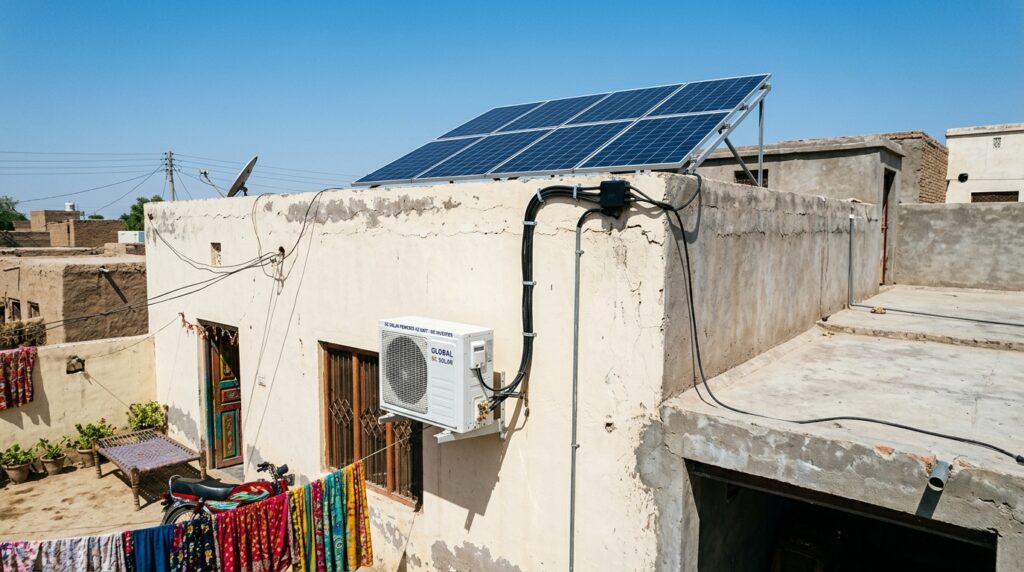
The second, less common but increasingly available approach involves purpose-built DC solar air conditioners, which connect directly to solar panels without requiring a full home inverter system, and are specifically designed to run efficiently on the variable direct current output that solar panels naturally produce throughout the day. This guide focuses primarily on this second category, since it represents a genuinely distinct product and purchasing decision that deserves its own dedicated explanation.
A DC solar air conditioner is a specialized AC unit engineered to run directly from solar panel output, either exclusively on DC power or through a hybrid design that can switch between DC solar input and standard AC grid power depending on availability. Unlike a conventional AC connected to a solar system through a full home inverter, a genuine DC solar AC unit uses an integrated or built-in controller specifically designed to handle the naturally fluctuating voltage and current that solar panels produce as cloud cover, sun angle, and panel temperature change throughout the day. This specialized design allows the unit to modulate its compressor speed in real time to match available solar power, running at reduced capacity during lower-generation periods rather than requiring a fixed, stable power input the way a standard AC unit does.
Panel requirements for DC solar air conditioners scale with unit capacity, similar to conventional ACs, though the specific DC design of these units means sizing calculations work somewhat differently than for a standard AC running through a full home inverter system.
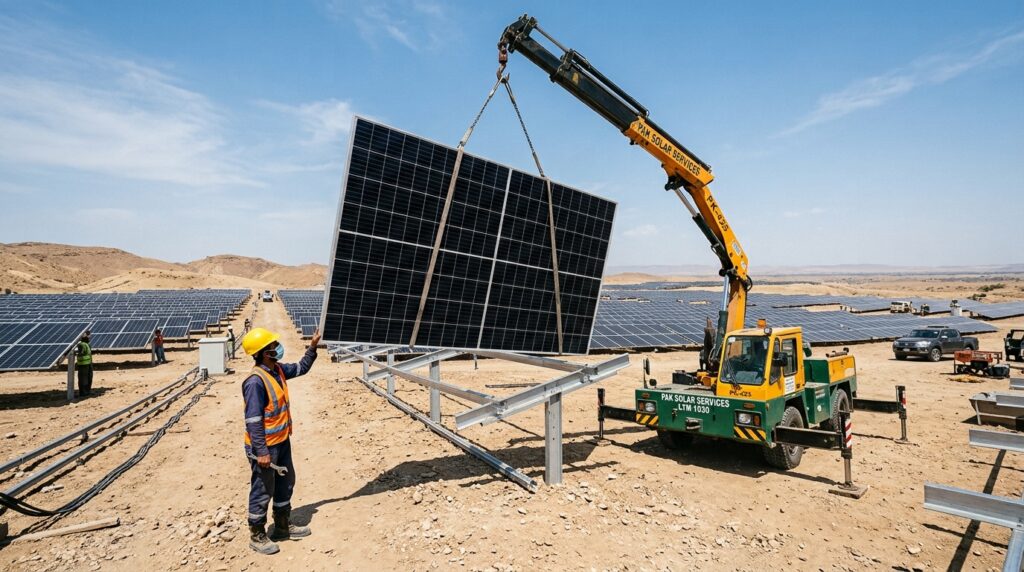
A 1 ton DC solar air conditioner typically requires a minimum of three to four panels rated around 550 to 600 watts, providing roughly 1,800 to 2,400 watts of solar capacity dedicated specifically to the unit. This dedicated sizing approach differs from a conventional inverter-based system, where panel capacity is calculated across the household’s total consumption rather than allocated to a single appliance.
A 1.5 ton DC solar air conditioner, the most common size for Pakistani homes, generally requires four to five panels in the 550 to 600 watt range, providing approximately 2,400 to 3,000 watts of dedicated solar capacity to reliably power the unit during daylight hours without needing to draw supplementary power from the grid or a battery bank.
A 2 ton DC solar air conditioner typically requires five to seven panels of similar wattage, providing roughly 3,000 to 4,200 watts of dedicated capacity, reflecting the larger unit’s higher compressor power draw during operation.
As of 2026, DC solar air conditioner units themselves, excluding the solar panels needed to power them, typically cost between PKR 150,000 and PKR 280,000 depending on tonnage and brand, generally priced somewhat higher than an equivalent standard inverter AC unit due to the specialized DC-compatible compressor and control electronics involved. Including the dedicated solar panels required to power the unit, a complete 1.5 ton DC solar AC setup, unit plus panels and mounting structure, typically totals between PKR 350,000 and PKR 500,000 depending on panel brand and installation complexity. This compares to a conventional approach of running a standard 1.5 ton inverter AC through a full 5 kW solar system, discussed in detail in our best solar system for AC in Pakistan guide, which typically costs PKR 650,000 to PKR 850,000 but also covers the household’s entire electricity consumption rather than just the AC unit alone.
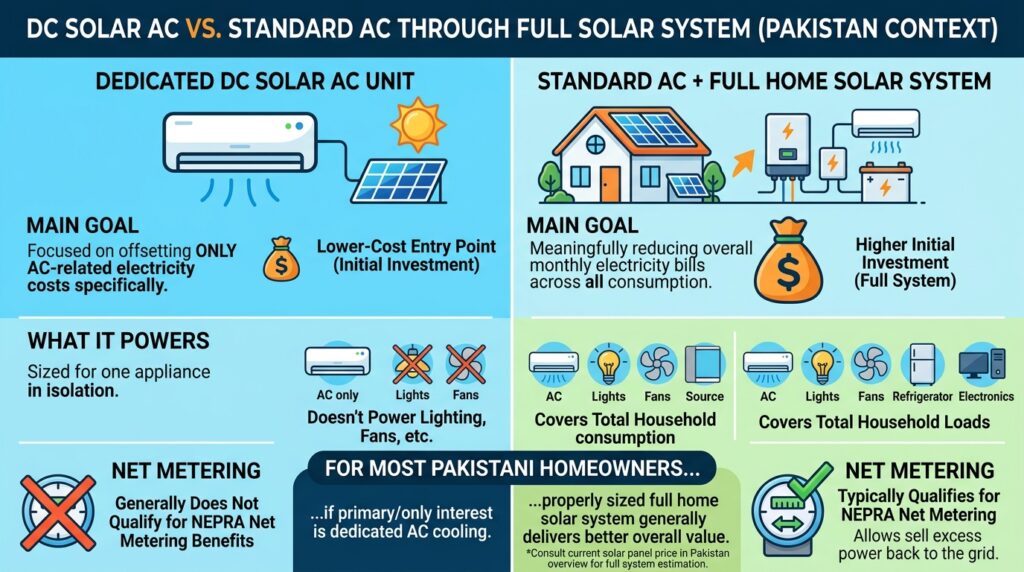
Choosing between a dedicated DC solar air conditioner and running a conventional AC through a full home solar system depends heavily on your broader electricity goals. A DC solar AC makes the most sense for buyers whose primary and perhaps only real interest is offsetting AC-related electricity cost specifically, without necessarily investing in a full system that also covers lighting, fans, and other household loads. This can represent a genuinely lower-cost entry point into solar-powered cooling for households not yet ready for a full residential system investment. However, for most Pakistani homeowners whose actual goal is meaningfully reducing their overall monthly electricity bill across all household consumption, not just AC specifically, a properly sized full home solar system covered through our solar panel price in Pakistan overview generally delivers better overall value, since it addresses total household consumption rather than a single appliance in isolation, and typically qualifies for NEPRA net metering benefits that a standalone DC solar AC setup, sized purely around one appliance, generally does not.
For readers whose actual interest lies in the more common conventional approach rather than a dedicated DC solar AC product, our comprehensive guide to the best solar system for AC in Pakistan covers exact panel counts by AC tonnage, the difference between inverter and non-inverter AC power draw, and battery sizing requirements for running AC through the evening and night on stored solar energy. As a quick summary relevant to this guide, a standard 1.5 ton inverter AC alongside typical household loads generally requires a minimum 5 kW solar system, using eight to nine panels rated around 580 to 615 watts, connected through a properly sized hybrid or on-grid solar inverter rather than running the AC directly off panel output the way a dedicated DC solar AC unit does.
Whether using a dedicated DC solar AC or a conventional AC through a full home system, running cooling through the evening and night after solar generation has stopped requires battery backup, and this represents one of the more significant cost considerations in either approach. A 1.5 ton AC running six to eight hours overnight typically requires a battery bank in the range of 10 to 15 kilowatt-hours of usable capacity, a substantial investment that meaningfully increases total system cost regardless of whether the AC itself is a dedicated DC unit or a standard model running through a hybrid inverter with battery backup, discussed further in our hybrid solar systems overview.
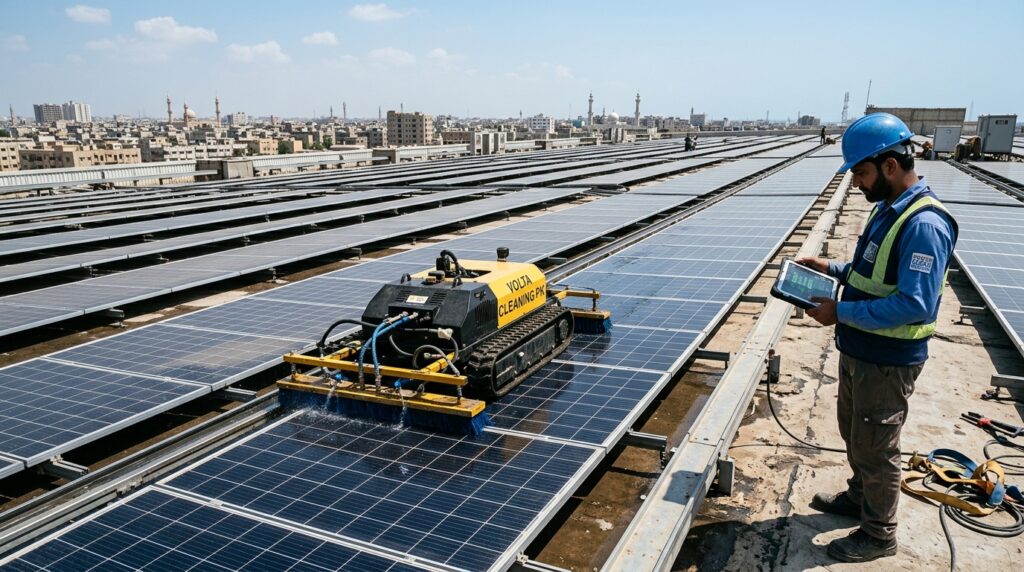
DC solar air conditioners, being a comparatively newer and more specialized product category in the Pakistani market, generally require the same basic maintenance as conventional AC units, including regular filter cleaning and periodic professional servicing of the refrigerant and compressor system. Given their reliance on direct solar panel input, keeping the connected panels clean and free of dust buildup, covered in detail in our guide to the solar panel cleaning brush, has a more immediate and noticeable effect on unit performance compared to a conventional AC running through a buffered battery-backed system, since dust-related output reduction on the panels translates almost directly into reduced cooling capacity for a purely DC-connected unit without battery buffering.
For most homeowners genuinely trying to reduce their overall electricity bill while also gaining reliable AC operation during load shedding, a properly sized full home solar system, whether on-grid or hybrid, remains the more practical and better-value choice compared to a standalone DC solar AC unit, since it addresses total household consumption and typically qualifies for net metering benefits. A dedicated DC solar AC makes more sense as a targeted, lower-upfront-cost solution specifically for cooling in situations like a single room addition, a small business or shop, or a budget-limited household not yet ready to invest in a full residential system. Pakistan Solar Solutions can advise on which approach best matches your specific situation and budget through a free consultation, available through our contact page.
The core technology that distinguishes a genuine DC solar air conditioner from a conventional unit lies in its built-in maximum power point tracking controller, a specialized electronic component that continuously monitors the voltage and current coming from the connected solar panels and adjusts the compressor’s operating speed to match available power in real time. During peak midday sun, when panel output is at its highest, the controller allows the compressor to run at or near full speed, delivering maximum cooling capacity. As cloud cover passes overhead or as the afternoon sun angle becomes less direct, the controller automatically reduces compressor speed to match the reduced available power, rather than simply cutting off entirely the way a fixed-load appliance without this intelligent regulation would. This dynamic modulation is what allows a DC solar AC to function reasonably well even under variable Pakistani sky conditions, though it does mean cooling output is not perfectly constant throughout the day the way a grid-powered or battery-backed AC would deliver, an important practical consideration for buyers evaluating whether this technology suits their comfort expectations.
Many DC solar air conditioners sold in Pakistan today are actually hybrid units, capable of running on either direct solar DC input during daylight hours or standard AC grid power when solar generation is insufficient or unavailable, such as during nighttime hours or extended cloudy periods. This hybrid capability significantly improves the practicality of these units for everyday Pakistani households, since it removes the strict dependency on sufficient sunlight that a purely DC-only unit would otherwise impose, allowing the AC to automatically fall back to grid power without any manual intervention when solar input drops below what is needed for reliable operation. When evaluating DC solar AC options, confirming whether a specific unit offers this hybrid grid-fallback capability, rather than being a strictly solar-only design, is an important practical distinction that significantly affects how usable the unit will be for consistent, year-round comfort in a typical Pakistani home.
A frequently asked question among buyers researching this topic is whether a dedicated DC solar AC is inherently more energy-efficient than simply running a standard, high-quality inverter AC through a conventional solar-powered home system. In practice, the underlying cooling efficiency, measured by how much cooling output a unit delivers per unit of electrical input, tends to be broadly similar between well-designed products in both categories, since both ultimately rely on similar compressor and refrigerant technology. The meaningful difference lies not in cooling efficiency itself but in how directly the unit uses available solar power, with a dedicated DC solar AC avoiding the small conversion losses that occur when solar-generated DC electricity is converted to AC current through a standard home inverter and then back to DC internally within a conventional AC’s own compressor electronics. This conversion loss is generally modest, typically in the range of three to seven percent depending on inverter quality, meaning the efficiency advantage of a dedicated DC unit, while real, is usually not large enough on its own to be the deciding factor in most purchasing decisions, particularly once the broader benefits of a full home solar system, including net metering eligibility, are factored into the comparison.
Several misunderstandings frequently come up when Pakistani homeowners first start researching solar-powered cooling options. One common misconception is assuming that any AC labeled as solar-compatible will run entirely for free once installed, when in reality, even the most efficient DC solar AC setup still requires an upfront investment in panels and the unit itself, with genuine savings accumulating gradually over the system’s operational lifespan rather than arriving instantly. Another frequent misunderstanding involves the assumption that a DC solar AC eliminates the need for a battery entirely and can still provide comfortable overnight cooling, when in fact, without a connected battery bank, cooling capacity drops significantly or stops entirely once the sun goes down, exactly as would happen with any solar-dependent appliance lacking energy storage. A third misconception involves conflating dedicated DC solar AC units with simply running any standard household AC unit through a general-purpose solar power system, when these represent genuinely different product categories and purchasing decisions, as this guide has aimed to clarify throughout.
The practicality of solar-powered cooling, whether through a dedicated DC unit or a conventional AC on a full solar system, varies somewhat by region given Pakistan’s diverse climate and sunlight patterns. Hot, sunny regions with long, intense summer seasons and relatively few cloudy days, including much of Punjab, interior Sindh, and Balochistan, represent the most favorable conditions for solar-powered cooling, since strong, consistent daily sunlight aligns naturally with the exact periods when cooling demand is highest. Coastal areas like Karachi, while still experiencing strong solar generation overall, occasionally see more cloud cover and humidity that can modestly affect daily generation consistency compared to drier inland regions, though this remains a relatively minor factor in the overall viability calculation for most Karachi households, as discussed in our dedicated guide to solar panel price in Karachi. Northern and higher-altitude regions, while generally cooler overall and therefore facing somewhat lower AC demand in the first place, still benefit from solar-powered cooling during the warmer months when it is needed, though system sizing calculations should account for the somewhat different seasonal sunlight patterns found at higher latitudes, covered in more detail in our guide to solar panel angle.
A DC solar air conditioner connects directly to solar panels using a built-in controller designed to handle fluctuating solar output, without requiring a full home inverter system. A normal AC running on solar instead connects through a conventional solar inverter as part of a broader home solar system covering all household electricity needs.
A DC solar AC unit alone typically costs between PKR 150,000 and PKR 280,000 depending on tonnage and brand, while a complete setup including dedicated solar panels generally totals PKR 350,000 to PKR 500,000 for a 1.5 ton system.
This depends on your goals. A dedicated DC solar AC suits buyers focused specifically on offsetting AC electricity cost at a lower upfront investment. A full home solar system, covering all household consumption and typically qualifying for net metering, generally offers better overall value for homeowners wanting to reduce their entire electricity bill.
A 1.5 ton DC solar air conditioner generally requires four to five panels rated around 550 to 600 watts, providing approximately 2,400 to 3,000 watts of dedicated solar capacity.
No. Without a connected battery bank, a DC solar air conditioner can only operate while the panels are actively generating sufficient power, meaning it will stop or reduce capacity significantly after sunset unless paired with battery storage, which adds meaningfully to the total system cost.
Generally no, since a standalone DC solar AC setup is typically sized specifically around the unit’s own consumption rather than as a grid-connected system capable of exporting surplus electricity. Net metering eligibility applies to full home solar systems designed with grid export capability in mind, covered in our net metering services guide.
Yes, this is one of the strongest use cases for a dedicated DC solar AC, since it offers a lower upfront cost entry point into solar-powered cooling for a single, specific space without requiring investment in a full home or business-wide solar system.