A solar eclipse is one of nature’s most spectacular events, but for solar panel owners in Pakistan, it is also a practical concern. When the moon passes between the earth and the sun, it blocks sunlight partially or completely, and solar panels that depend on sunlight to generate electricity are directly affected. Understanding the solar eclipse time in Pakistan, how it impacts your solar energy system, and how to prepare for it can help you avoid disruptions to your power supply.
At Pakistan Solar Solutions, we receive many questions from solar system owners about eclipses and their effect on solar panel performance. This guide gives you a complete picture of upcoming eclipse events visible from Pakistan, the science behind how eclipses affect solar generation, and practical steps to keep your home or business powered during an eclipse.
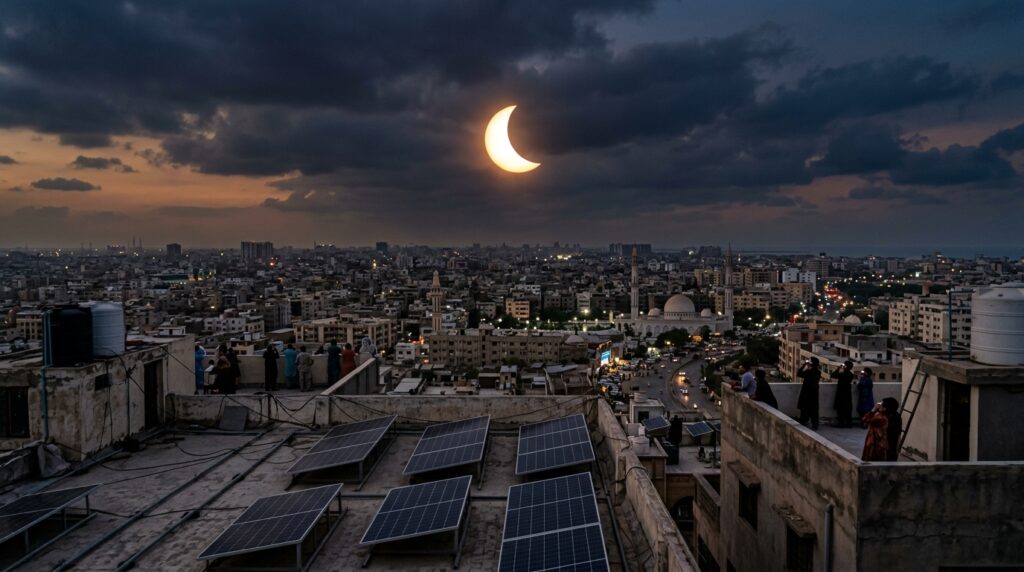
Not all solar eclipses are equal in their impact on solar panels. There are three main types of solar eclipses, and each affects solar energy production differently.
A total solar eclipse occurs when the moon completely blocks the sun. During totality, the affected area experiences near-darkness for a few minutes, and solar panels in that zone produce almost no electricity. This is the most dramatic type of eclipse in terms of solar energy impact, but the zone of totality is usually very narrow, often just a few kilometers wide, meaning most of Pakistan would only experience a partial eclipse even if totality occurs nearby.
A partial solar eclipse, which is the most common type visible from Pakistan, occurs when only part of the sun is blocked by the moon. Depending on the percentage of coverage, solar panel output can drop by ten to eighty percent. A fifty percent partial eclipse would reduce solar generation by roughly forty to fifty percent, assuming clear skies, since the remaining exposed portion of the sun still illuminates the panels.
An annular solar eclipse occurs when the moon is at its farthest point from earth and does not completely cover the sun, leaving a ring of sunlight visible. This type also reduces solar output but not as drastically as a total eclipse.
Pakistan has witnessed several notable solar eclipses in recent years, and there are upcoming events that solar panel owners should be aware of. Solar eclipses follow predictable astronomical cycles, and eclipse paths are calculated decades in advance with precision.
In 2019, a partial solar eclipse was visible from most parts of Pakistan, with coverage varying between twenty and forty percent depending on location. In 2020, an annular solar eclipse on June 21 was visible from parts of northern Pakistan, including Gilgit-Baltistan and parts of Khyber Pakhtunkhwa, where the annular ring was briefly visible. The rest of the country experienced a significant partial eclipse.
Looking ahead, Pakistan will experience partial solar eclipses in the coming years, with varying degrees of coverage depending on the specific geographic location. For the most accurate and up-to-date solar eclipse time in Pakistan, including city-specific timings for Karachi, Lahore, Islamabad, Peshawar, Quetta, and other major cities, NASA’s eclipse website and timeanddate.com are reliable sources that publish detailed eclipse maps and local timings years in advance.
Solar system owners are encouraged to bookmark these resources and check them periodically. At Pakistan Solar Solutions, we also share updates on solar events and their impact on solar panel systems through our website.
The reduction in solar panel output during a solar eclipse depends on two main factors: the percentage of solar disk coverage at your location and local weather conditions. On a perfectly clear day, if the eclipse covers fifty percent of the sun’s disk, your solar panels will produce approximately fifty percent of their normal output. If coverage reaches ninety percent, output can drop to as little as ten percent of normal.
However, Pakistan’s cloud patterns can sometimes work in the solar system owner’s favor during an eclipse. On partly cloudy days, the eclipse’s effect may be less dramatic because clouds are already reducing solar irradiance. Conversely, on a perfectly clear day with ninety percent eclipse coverage, the drop in production can be sudden and steep.
For solar systems connected to a hybrid solar inverter, as explored in our hybrid solar inverter guide at Pakistan Solar Solutions, this sudden drop is managed automatically by the battery bank, which fills the gap in power supply without any manual intervention. This is one of the strongest arguments for choosing a hybrid inverter system over a simple on-grid setup in Pakistan.
A common misconception among Pakistani solar panel owners is that a solar eclipse can damage solar panels. This is not true. Solar panels are not harmed by eclipse conditions in any way. The panels simply generate less electricity because less sunlight is available, just as they produce less on a cloudy day. There is no thermal, electrical, or physical risk to the panels during an eclipse.
However, it is dangerous for humans to look at the sun during an eclipse without proper eclipse glasses, even when the sun is mostly covered. The intense radiation from the exposed solar ring can cause permanent eye damage. This warning applies to anyone observing the eclipse, not to the solar panels themselves.
While a solar eclipse is not a damaging event for solar panels, it does cause a predictable, temporary reduction in power output. Preparing your solar system in advance helps ensure you have uninterrupted power during the eclipse.
The most effective preparation is ensuring your battery bank is fully charged before the eclipse begins. If your hybrid solar inverter’s monitoring app shows a scheduled eclipse or if you know one is coming, you can plan your heavy electricity consumption for earlier in the day before coverage begins. Running appliances like washing machines, water pumps, and water heaters during peak solar hours in the morning before the eclipse ensures your batteries are full when production drops.
It is also worth adjusting your energy consumption during the eclipse period. Avoid running high-load appliances like air conditioners, electric geysers, or heavy machinery during peak eclipse coverage. If you want to know how to optimise your solar system for different weather and astronomical conditions, our team at Pakistan Solar Solutions can provide personalised advice based on your system setup.
While specific eclipse times vary depending on the event, solar eclipse timings in Pakistan follow the country’s geographic spread from east to west. Lahore and eastern Punjab typically experience eclipse contact a few minutes earlier than Karachi and the south. Islamabad and Peshawar follow a timeline close to Lahore due to similar longitudes. Quetta in Balochistan and Gilgit-Baltistan in the north can see significantly different coverage percentages than southern cities for the same eclipse event.
For any specific upcoming eclipse, KEPCO and Pakistan Meteorological Department also release local eclipse timing advisories, particularly for annular and total eclipses where the path crosses Pakistani territory. These advisories include first contact time, maximum coverage time, and last contact time for major cities.
Solar eclipses do not just affect individual rooftop solar systems but can have measurable effects on Pakistan’s national grid, particularly as solar power becomes a larger share of the country’s electricity generation. When a large-scale partial or total eclipse passes over a region with significant solar capacity, the sudden drop and subsequent recovery in solar generation requires the grid operator to compensate using thermal or hydro reserves.
In countries like Germany and Spain, which have very high solar penetration, utility operators actively plan for eclipse events by pre-positioning reserve generation capacity. As Pakistan’s solar energy capacity grows, NEPRA and WAPDA will need to adopt similar eclipse management protocols. This is one reason why diversified solar storage, including the types of battery and hybrid solutions discussed in our solar panels for AC units article at Pakistan Solar Solutions, is important for grid stability.
Will my solar panels stop working completely during a solar eclipse? During a partial eclipse, which is most common in Pakistan, panels continue generating electricity but at reduced output proportional to the coverage percentage. Complete shutdown only occurs in the narrow path of a total eclipse.
How can I find the exact solar eclipse time for my city in Pakistan? Timeanddate.com and NASA’s eclipse portal provide city-specific eclipse timings, including first contact, maximum coverage, and end times. Pakistan Meteorological Department also issues advisories for significant eclipse events.
Should I turn off my solar system during a solar eclipse? No, there is no need to turn off your solar system during an eclipse. The inverter and system will automatically manage the reduced input from panels and compensate with battery or grid power as needed.
How long does a solar eclipse last in Pakistan? Duration varies by eclipse type and location. A partial eclipse typically lasts two to three hours from first contact to last contact, with maximum coverage occurring at the midpoint. Totality, if it occurs over Pakistan, lasts only a few minutes.
Can I use this opportunity to check my solar system’s battery backup during an eclipse? Yes, a solar eclipse is an excellent real-world test of your battery backup capacity. Monitor how long your batteries sustain your load during reduced solar input and use this data to decide if you need to expand your battery bank.