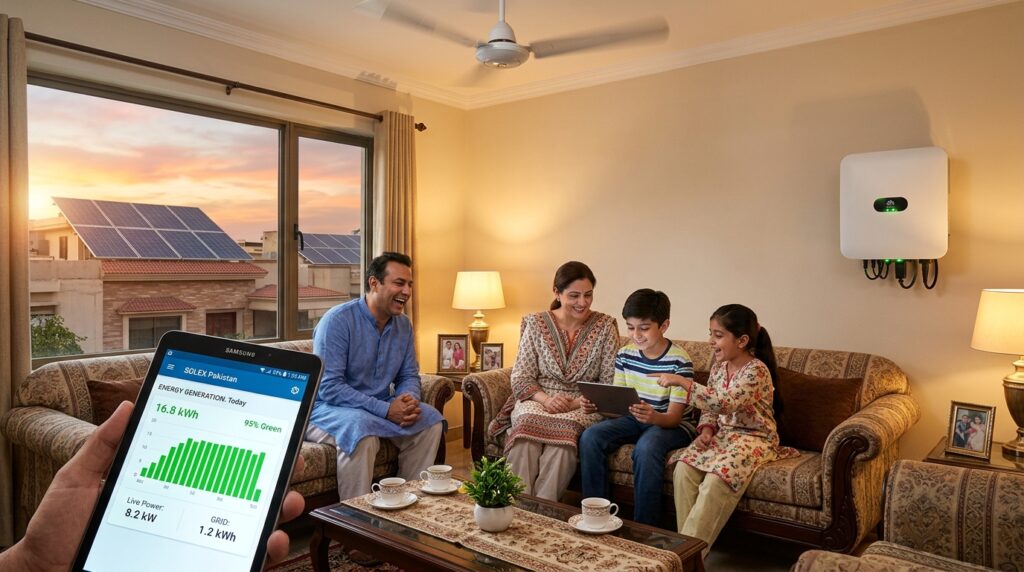


Somewhere in Pakistan tonight, millions of families are sitting in the dark or the sweltering heat because the electricity has gone off again. Load shedding has been a defining feature of Pakistani domestic life for over fifteen years, and despite promises of improvement, the fundamental structural problems of Pakistan’s electricity sector ensure that load shedding will remain a challenge for the foreseeable future. At the same time, electricity tariffs have doubled in three years, and the monthly electricity bill has become one of the largest household expenses for middle-class Pakistani families.
Solar energy for home use in Pakistan is the response to both of these problems simultaneously. It eliminates dependence on the grid during daylight hours, provides battery backup through load shedding periods, and slashes electricity bills by fifty to one hundred percent depending on system size and household consumption patterns. It is not a futuristic technology or a luxury for the wealthy. It is a practical, proven, financially justified investment that millions of Pakistani families have already made, and millions more are actively considering.
If you are at the beginning of your solar journey and wondering where to start, how solar works, what it costs, and whether it is right for your home, this guide from Pakistan Solar Solutions is written precisely for you. We walk you through every stage of understanding and deciding on solar energy for home use in Pakistan, from the basics of how it works to the complete cost picture and how to choose the right system and supplier.
Understanding the basic mechanics of a home solar energy system removes the mystery and helps you make more informed decisions about technology choices and system design.
Solar panels installed on your roof contain photovoltaic cells made from silicon semiconductor material. When sunlight strikes these cells, it excites electrons in the silicon atoms and causes them to flow as electric current. This current flows through the panel’s internal wiring and out through the junction box as direct current or DC electricity. The voltage and current characteristics of this DC electricity depend on the sunlight intensity, panel temperature, and panel specifications.
This DC electricity travels through cables from the panels on your roof down to the solar inverter installed inside your home. The inverter is the brain of the entire system. For home use in Pakistan, a hybrid solar inverter is the standard choice because it simultaneously manages three energy sources: the solar panels, the battery bank, and the national electricity grid. The inverter converts the DC electricity from the panels into AC electricity at the right voltage and frequency for your home appliances, manages battery charging and discharging, and coordinates with the grid for net metering.
The battery bank stores energy generated by the solar panels during daylight hours for use at night or during grid outages. In Pakistan’s context, the battery bank is what powers your home during load shedding, making it the component that delivers the most immediate and tangible benefit of solar energy for home use. Without batteries, a home solar system cannot provide power during load shedding, which significantly limits its value in Pakistan’s grid conditions.
The complete home solar energy system therefore consists of solar panels on the roof, a hybrid inverter inside the home, a battery bank for storage, a mounting structure for the panels, and the electrical wiring, fusing, and protection equipment connecting everything together.
Before diving into system selection and pricing, it is worth honestly assessing whether your home is suitable for solar energy installation. Most Pakistani urban homes are excellent candidates, but a few factors can affect system design and sizing.
Roof orientation and shading are the primary suitability factors. A south-facing rooftop with no shading from adjacent buildings, trees, or water tanks for most of the day is ideal for solar panel installation in Pakistan. Panels facing east or west generate less electricity than south-facing panels, typically fifteen to twenty-five percent less, but still produce significant output and can be a good solution when south-facing roof space is limited. Heavily shaded rooftops that receive direct sunlight for only two to three hours per day are not suitable for solar installation, as the system will never generate enough electricity to justify the investment.
Roof structural integrity must be sufficient to bear the additional weight of solar panels and mounting structures. A standard residential solar system of six to twelve panels weighs approximately three hundred to six hundred kilograms including the mounting structure. Most Pakistani concrete rooftops can easily bear this load, but older or structurally compromised rooftops should be assessed by a structural engineer before installation.
Available roof area determines the maximum system size you can install. A standard four hundred to five hundred watt solar panel measures approximately two by one meters. A five kilowatt system of ten to twelve panels requires approximately twenty to twenty-four square meters of unshaded roof area. Most Pakistani urban homes have adequate roof space for a five kilowatt or larger system.
Monthly electricity consumption determines the appropriate system size. Review your last twelve months of electricity bills and identify your average monthly consumption in units. A solar system that generates seventy to eighty percent of your average monthly consumption represents the optimal size for most Pakistani households. At Pakistan Solar Solutions, we review your electricity bills as part of a free system design consultation.
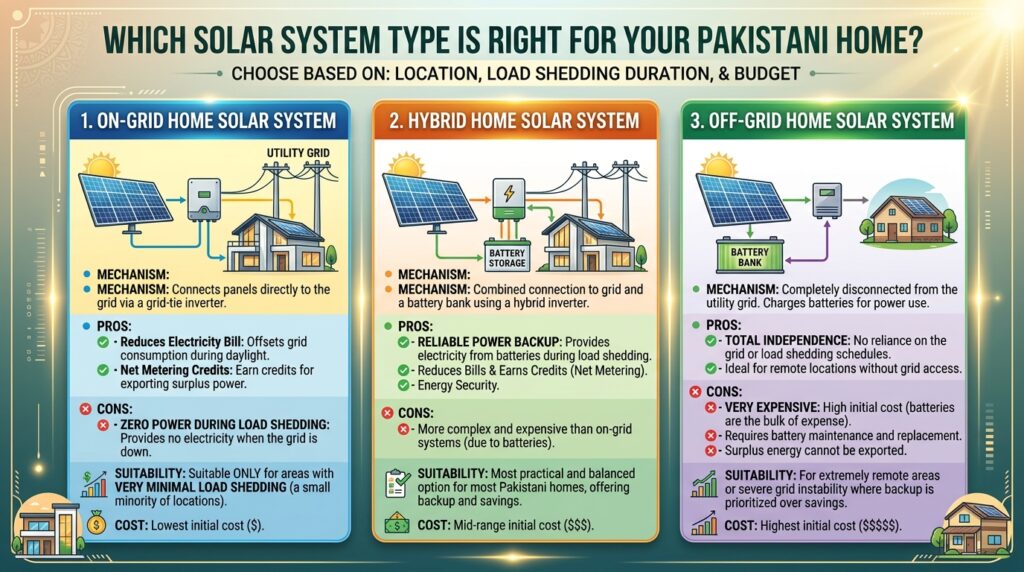
Pakistani homeowners have three main configuration options for home solar energy systems, and the right choice depends on your location, load shedding duration, and budget.
An on-grid home solar system connects your panels directly to the grid through a grid-tie inverter. It reduces your electricity bill during daylight hours by offsetting grid consumption with solar generation and earns net metering credits for surplus export. However, it provides zero power during load shedding. This option is suitable only for areas with very minimal load shedding, which represents a small minority of Pakistani locations. It is the cheapest option but the least useful for most Pakistani homes.
An off-grid home solar system is completely independent of the national electricity grid. It relies entirely on solar panels and a large battery bank to cover all electrical needs including nighttime and cloudy periods. It is the right choice for rural homes or locations where the grid is completely unavailable or so unreliable as to provide essentially no value. The complete system cost is highest among the three options because of the large battery bank required.
A hybrid home solar system is the right choice for the overwhelming majority of Pakistani urban and semi-urban households. It connects to the grid for net metering and bill reduction, includes a battery bank for load shedding coverage, and uses a sophisticated hybrid solar inverter for home management to automatically coordinate all three energy sources. For a detailed explanation of the hybrid inverter’s role, see our solar inverter for home guide at Pakistan Solar Solutions.
Understanding the full cost of home solar energy in Pakistan is essential for planning your investment. Pakistani buyers who focus only on panel prices without accounting for all system components often receive unexpected surprises when they get complete installation quotations.
For a small home solar system of three kilowatts suitable for a small household with basic loads, the complete installed cost in Pakistan ranges from two hundred and fifty thousand to four hundred thousand rupees for a hybrid system with a modest battery bank. Without batteries, the system costs one hundred and sixty thousand to two hundred and fifty thousand rupees.
For a medium home solar system of five kilowatts suitable for a medium-sized family with one air conditioner, the complete hybrid system with lithium battery bank costs four hundred and fifty thousand to eight hundred thousand rupees installed. Without batteries, five hundred thousand to six hundred thousand rupees covers a quality on-grid or simple hybrid system.
For a larger home solar system of eight to ten kilowatts suitable for larger homes with two or more air conditioners, the complete hybrid system cost ranges from seven hundred thousand to one million three hundred thousand rupees. For the detailed panel pricing component, see our solar panel watt price guide at Pakistan Solar Solutions. For the battery component, our solar battery price guide at Pakistan Solar Solutions provides current pricing for all battery types.
The solar mounting structure adds fifteen thousand to sixty thousand rupees to the system cost depending on the roof type and system size, which our solar mounting structure price guide at Pakistan Solar Solutions covers in detail.
The financial return from solar energy for home use in Pakistan is the most compelling argument for adoption, and the numbers are genuinely impressive for most Pakistani households.
For a family in Lahore with a monthly electricity bill of twenty-five thousand rupees installing a five kilowatt solar system costing five hundred and fifty thousand rupees, the electricity saving averages fifteen thousand to twenty thousand rupees per month depending on season and consumption patterns. At seventeen thousand rupees per month average saving, the system pays for itself in approximately thirty-two months, or two years and eight months. After payback, the family saves approximately two hundred thousand rupees per year for the remaining twenty-two-plus years of the system’s life. Over the full system lifespan, the net saving after subtracting the initial investment is several million rupees.
For families with higher electricity bills due to air conditioning, the savings are proportionally larger. A family spending fifty thousand rupees monthly on electricity can potentially save thirty thousand to forty-five thousand rupees per month with a ten kilowatt solar system, recovering their investment within one to two years and saving millions of rupees over the system’s lifetime.
Net metering adds another financial dimension. Pakistani homeowners registered for net metering with NEPRA can export surplus solar generation to the grid and receive credits against future bills. While NEPRA reduced the buyback rate in 2025, net metering credits still meaningfully improve the financial returns of solar energy for home owners in Pakistan.
Years of experience helping Pakistani families transition to solar energy has taught us at Pakistan Solar Solutions several practical lessons that make the transition smoother and more successful.
Always get at least three detailed quotations before committing to a solar installation. Prices vary significantly between suppliers, and so does the quality of equipment offered. Ask every supplier to specify the exact brand and model of panels, inverter, batteries, and mounting structure they are proposing, not just the system size, so you can compare what is actually being offered rather than just the price.
Prioritise supplier after-sales support over the cheapest price. A solar system is a twenty-five year investment, and you will need technical support at some point during that time. Choose a supplier with local presence, experienced installation teams, and a track record of responsive warranty and maintenance service.
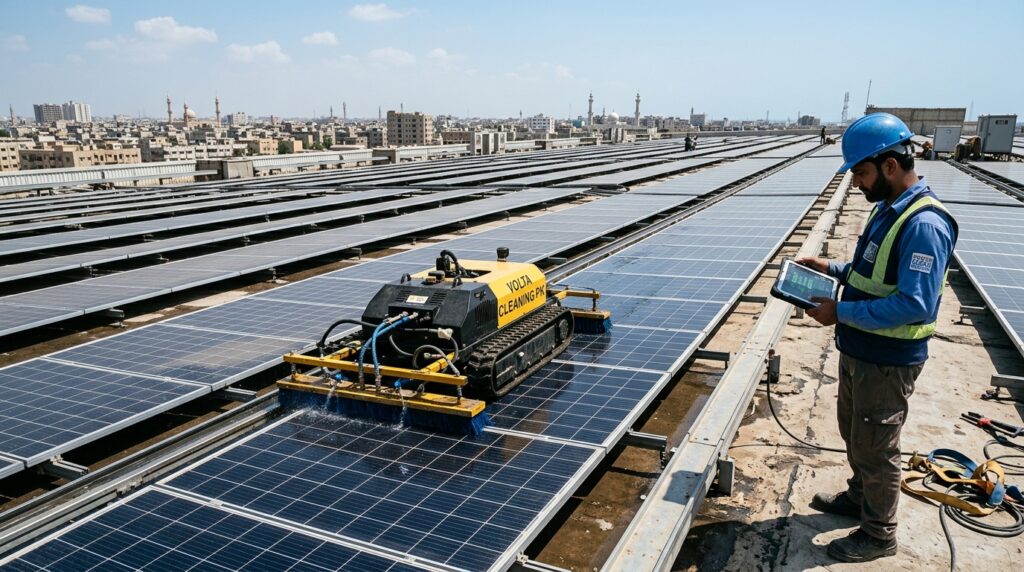
Clean your panels regularly. This single maintenance task has the biggest impact on your system’s actual electricity generation. In Pakistan’s dusty environment, panels left uncleaned for a month can lose fifteen to twenty-five percent of their output. The right cleaning tools and methods are covered in our solar panel cleaning brush guide at Pakistan Solar Solutions.
Monitor your system’s performance through the inverter app and set an alert for when daily generation falls significantly below your expected baseline. Early identification of performance issues prevents extended periods of reduced generation that waste the sun’s energy during good solar days.
Register for net metering through your local DISCO as soon as your system is installed. The process takes time, and you want to start earning net metering credits as early as possible. Pakistan Solar Solutions assists all customers with the net metering registration process.
How many hours of backup does a home solar system provide during load shedding in Pakistan?
With a well-sized lithium battery bank of five kilowatt-hours and a typical household load of five hundred watts for fans, lights, and a refrigerator, you can expect eight to ten hours of backup power. Running additional loads like air conditioners reduces this duration significantly. Most Pakistani homes size their battery bank for four to eight hours of essential load coverage during load shedding.
Does solar energy for home in Pakistan work during the monsoon season?
Yes, solar systems continue generating electricity during the monsoon season, though at reduced levels on cloudy and rainy days. Pakistan’s monsoon season lasts approximately three months in most regions, and during this period solar generation is lower than the summer peak. The battery bank stores enough energy from partially cloudy days to cover evening loads in most cases, and the grid connection provides backup on extended very cloudy periods.
What is the minimum budget for a useful home solar system in Pakistan?
For a solar system that meaningfully reduces load shedding impact and electricity bills for a small Pakistani household, a budget of approximately one hundred and fifty thousand to two hundred and fifty thousand rupees is the realistic minimum for a complete on-grid two to three kilowatt system. For a hybrid system with battery backup of the same size, the minimum is two hundred and fifty thousand to four hundred thousand rupees.
Will installing solar energy at home in Pakistan affect my property value?
Yes, positively. Properties with installed solar systems are increasingly valued higher in Pakistan’s real estate market, particularly as electricity bills have risen dramatically. A well-installed solar system with a net metering connection is now a significant selling point for residential properties in Pakistani cities.
How do I choose between different solar companies in Pakistan for my home solar installation?
Evaluate solar companies on their product quality and brand partnerships, their installation team’s experience and certification, their after-sales support track record, the transparency and detail of their quotations, and their willingness to provide references from previous customers. Pakistan Solar Solutions offers free consultations, detailed transparent quotations, and a track record of successful home solar installations across Pakistan.