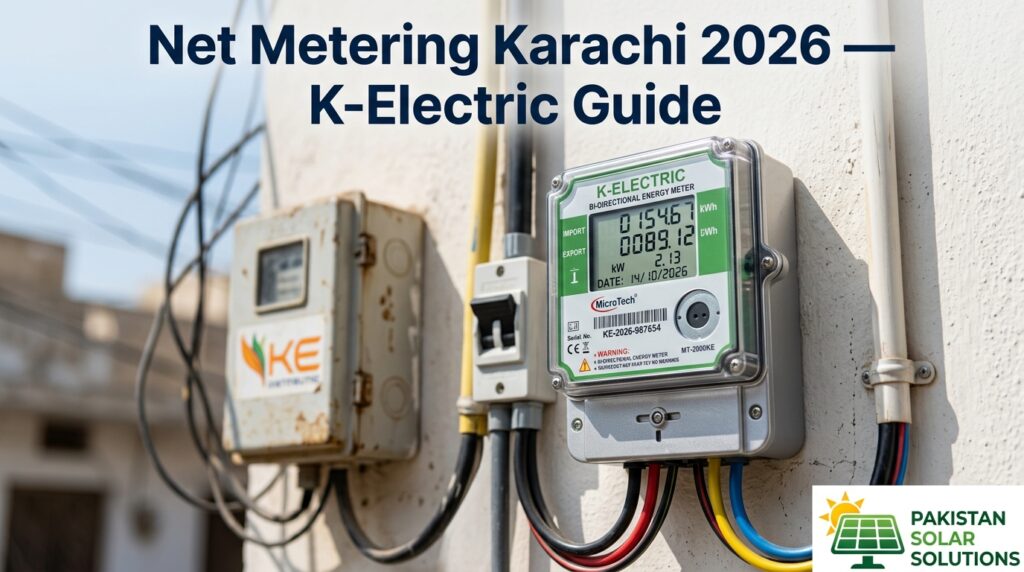


Net metering has transformed how Karachi homeowners and businesses think about electricity. Instead of paying K-Electric full tariff for every unit consumed, solar system owners in Karachi can now offset their bills by exporting surplus solar electricity to the grid, earning credits that directly reduce what they owe. With K-Electric tariffs exceeding PKR 60 to 65 per unit in 2026 and net metering export credits at PKR 19 to 21 per unit, a properly designed system can bring monthly bills to near zero. This guide covers everything a Karachi property owner needs to know about net metering in 2026, from eligibility and the application process to the financial impact on your K-Electric bill.
Net metering is a billing arrangement approved by NEPRA that allows solar system owners to supply surplus electricity to K-Electric and receive a credit in return. When your solar panels generate more electricity than your home or business consumes, typically on sunny afternoons when generation peaks, the excess units flow into the K-Electric grid through your existing connection. A bi-directional green meter installed at your premises records both electricity you import from K-Electric and electricity you export to it. At billing time, your exported units are deducted from your imported units, and you pay only for the net difference. If your exported units exceed imported units in a given month, the surplus carries forward as a credit to the following month’s bill.
Not all K-Electric customers in Karachi are immediately eligible for net metering. NEPRA and K-Electric have set specific technical and connection requirements that must be met before an application can be submitted and approved. The most important eligibility condition is having a three-phase electricity connection. Single-phase customers are not eligible under current NEPRA regulations. Your solar inverter must also appear on NEPRA’s approved inverter list. At Pakistan Solar Solutions, we exclusively install NEPRA-approved inverters from Huawei, Growatt, GoodWe, Solis, and Deye, ensuring your application is never rejected on technical grounds. The minimum system size for residential net metering is 1kW and for commercial properties is 5kW.
The net metering application process in Karachi involves several coordinated stages. Pakistan Solar Solutions manages this entire process for our clients. The first step is the free site survey during which our engineers assess your load, roof, and K-Electric connection. Once installation is complete, we prepare your full application package including PEC-certified load-flow diagrams, NEPRA-format technical documentation, K-Electric application forms, proof of property ownership, your existing K-Electric bill, and equipment certificates. We submit this package to K-Electric’s net metering division. K-Electric then conducts a physical inspection of your installation. Once inspection is approved, K-Electric arranges installation of the bi-directional green meter, which typically takes 2.5 to 3.5 months after initial submission.
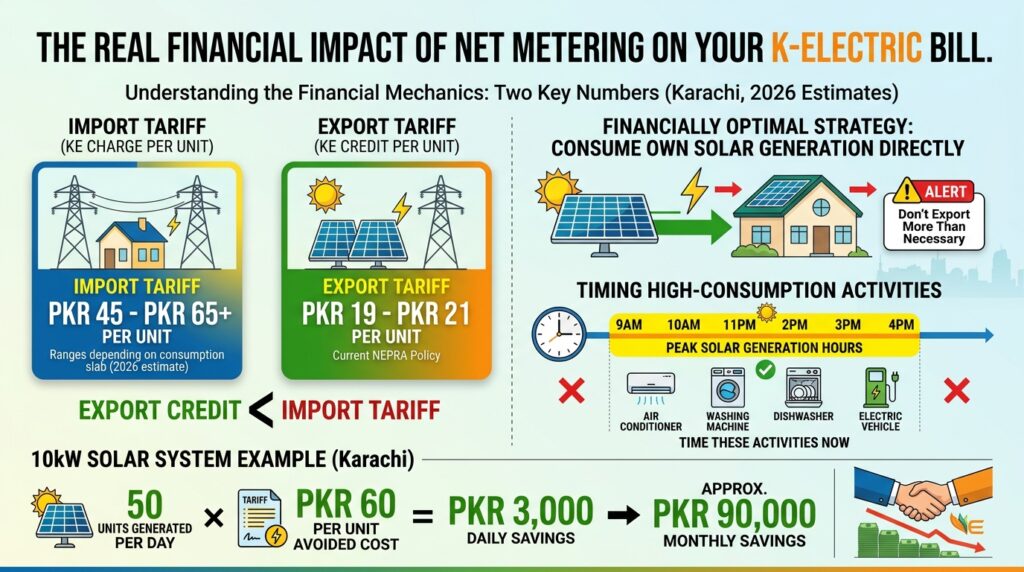
Understanding the financial mechanics of net metering in Karachi requires knowing two numbers. The import tariff is what K-Electric charges per unit you consume, which in 2026 ranges from PKR 45 to PKR 65 or more depending on your consumption slab. The export tariff is what K-Electric credits per unit you export under NEPRA policy, which is currently PKR 19 to 21 per unit. Because the export credit is lower than the import tariff, the financially optimal strategy is to consume as much of your own solar generation directly rather than exporting it. This means timing high-consumption activities like laundry, dishwashers, and air conditioning to coincide with peak solar generation hours between 9 AM and 4 PM. A 10kW solar system in Karachi generating 50 units per day saves a household spending PKR 60 per unit roughly PKR 3,000 per day in avoided electricity costs, or approximately PKR 90,000 per month.
Both on-grid and hybrid solar systems are eligible for net metering in Karachi, but they interact differently with the K-Electric grid. An on-grid system exports all surplus during the day and imports all power at night. A hybrid system stores surplus in batteries for nighttime use, exporting only what the battery cannot absorb. For households with significant evening loads, the hybrid system maximizes self-consumption and delivers higher overall savings even though both configurations qualify for net metering. To compare pricing for both system types, visit our guide on solar panels price in Karachi where current 2026 market rates are fully documented.
Many Karachi solar customers who attempt to manage their own net metering applications face delays and rejections. The most common problem is using an inverter that is not on NEPRA’s approved list. Some smaller solar companies source cheaper uncertified inverters and then discover during the K-Electric inspection that net metering cannot be approved, resulting in either inverter replacement or permanent loss of the net metering benefit. The second common problem is incomplete or incorrectly formatted documentation. K-Electric has specific requirements for load-flow diagram formats and engineer certification levels. Applications that do not meet these are returned or rejected, adding months to the timeline. Pakistan Solar Solutions has a near-perfect first-submission approval rate because our engineering team has extensive experience with K-Electric’s specific requirements.
Net metering is not only for residential customers. Commercial properties including offices, shops, warehouses, schools, hospitals, and factories in Karachi can benefit significantly from K-Electric net metering. For commercial and industrial applications, Pakistan Solar Solutions conducts a comprehensive feasibility study including a maximum demand assessment, load-flow analysis, and structural evaluation. Industrial solar clients in Karachi have seen electricity cost reductions of 50 to 70 percent within the first full year of operation. For information on large-scale solar installations, see our solar installation Karachi page for commercial EPC services.
After installation is complete and your application is submitted to K-Electric, approval and green meter installation typically takes 2.5 to 3.5 months. This timeline can vary based on K-Electric’s workload and inspection scheduling. Pakistan Solar Solutions follows up with K-Electric throughout the process to avoid unnecessary delays.
No. NEPRA net metering regulations require a three-phase electricity connection. Single-phase K-Electric customers must first upgrade to three-phase, which involves an application to K-Electric and additional costs. Pakistan Solar Solutions can advise whether upgrading your connection is financially viable given your energy load.
If your solar system exports more units to the K-Electric grid than you import in a given billing month, the excess credit balance carries forward to the next month. Your bill will show a credit that reduces the following month’s charges. Credits continue to accumulate and carry forward indefinitely under current NEPRA net metering policy.
On-grid solar systems shut down automatically during K-Electric load shedding for safety reasons, so net metering does not function during outages. However, overall monthly savings remain substantial. If you want backup power during load shedding, Pakistan Solar Solutions can install a hybrid solar system with a lithium battery bank.
Net metering is available throughout K-Electric’s service area in Karachi, subject to the three-phase connection requirement. Our team can confirm your area’s eligibility during the free site survey. Call 0333-103-1086 or visit pakistansolar.solutions to check your eligibility today.