

The 550 watt solar panel is one of the most widely installed sizes in Pakistan’s residential solar market today, sitting at the entry point of the large-format, high-output panel category that now dominates new rooftop installations across the country. If you are planning a standard net metering system for your home, the 550 watt solar panel price in Pakistan is likely one of the first numbers you need to understand clearly, since this wattage range forms the backbone of most 5 kW and 10 kW residential system quotes you will encounter. This guide breaks down current 2026 pricing, what makes 550 watt panels the default choice for so many Pakistani installers, and how they compare to the slightly larger and smaller options also available.
Panels in the 550 to 615 watt range represent the current generation of mainstream monocrystalline technology, built on large-format cell designs that became widely available as manufacturers shifted away from the smaller cell formats common just a few years ago. This wattage range strikes a practical balance for Pakistani residential installations: large enough to keep total panel count reasonable for a standard 5 kW to 10 kW system, while remaining a manageable physical size and weight for typical rooftop mounting structures without requiring the specialized heavy-duty structural considerations that the newest 700 watt panels, covered in our dedicated guide to 700 watt solar panel price in Pakistan, sometimes demand.
As of 2026, a single 550 watt solar panel in Pakistan typically costs between PKR 20,000 and PKR 26,000, depending on brand and cell technology, translating to roughly PKR 36 to PKR 47 per watt. This places 550 watt panels solidly within the broader national pricing range of PKR 24 to PKR 55 per watt covered in our overview of the best solar panels in Pakistan, with the exact price depending heavily on whether you choose a standard P-Type panel or a premium N-Type option from brands like Longi or Jinko.
Standard P-Type 550 watt panels sit toward the lower end of this pricing range, offering solid, dependable performance at a more accessible price point. Premium N-Type 550 watt panels, using the same advanced TOPCon technology discussed in our guide to high efficiency solar panels, command a modest premium but deliver noticeably better performance during Pakistan’s intense summer heat due to their more favorable temperature coefficient, along with a typically longer effective lifespan due to slower degradation rates over the panel’s 25-year warranty period.
A typical 5 kW residential system using 550 watt panels requires nine panels, totaling 4,950 watts of installed capacity, close enough to the 5 kW target for standard net metering purposes. At current pricing, this represents a panel cost of roughly PKR 180,000 to PKR 234,000, with the remainder of a complete installed system cost, generally totaling PKR 650,000 to PKR 850,000, covering the inverter, mounting structure, cabling and installation labor.
Sizing a system around 550 watt panels follows straightforward math once you know your target system capacity. A 3 kW system requires approximately five to six panels. A standard 5 kW system, the most common residential configuration across Pakistan, requires nine panels. A 7 kW system requires roughly thirteen panels, while a 10 kW system, common for larger homes or small commercial properties, requires approximately eighteen panels. These figures assume standard 550 watt panels; buyers with more constrained roof space may prefer to review our comparison against larger 700 watt options, which require fewer total panels to reach the same system capacity.
Buyers comparing 550 watt panels against slightly larger 600 watt options, and the newer 700 watt panels covered in our dedicated guide, often find the decision comes down to available roof space and per-watt cost efficiency rather than any dramatic performance difference. 550 and 600 watt panels remain the most common and widely available sizes for standard residential installations, generally offering the most competitive per-watt pricing due to high production volume and widespread market availability. The newer 700 watt panels, while offering a genuine advantage for space-constrained or large-scale commercial projects, are a comparatively newer product category with somewhat less price competition currently, though this gap is expected to narrow as the technology becomes more widely adopted across the Pakistani market over the coming years. For most standard residential net metering projects with reasonably available roof space, 550 watt panels remain a thoroughly practical and cost-effective choice.
The full range of Tier-1 brands active in Pakistan produce panels in the 550 watt category, including Longi’s Hi-Mo series, Jinko’s Tiger Neo line covered in our dedicated Jinko solar panels price in Pakistan guide, JA Solar’s N-Type offerings, and similar products from Canadian Solar and Trina. Since 550 watt represents such a mainstream, high-volume production size for these manufacturers, buyers generally have the widest selection of specific models and price points to choose from within this wattage category compared to either smaller niche sizes or the newest, less widely available large-format panels.
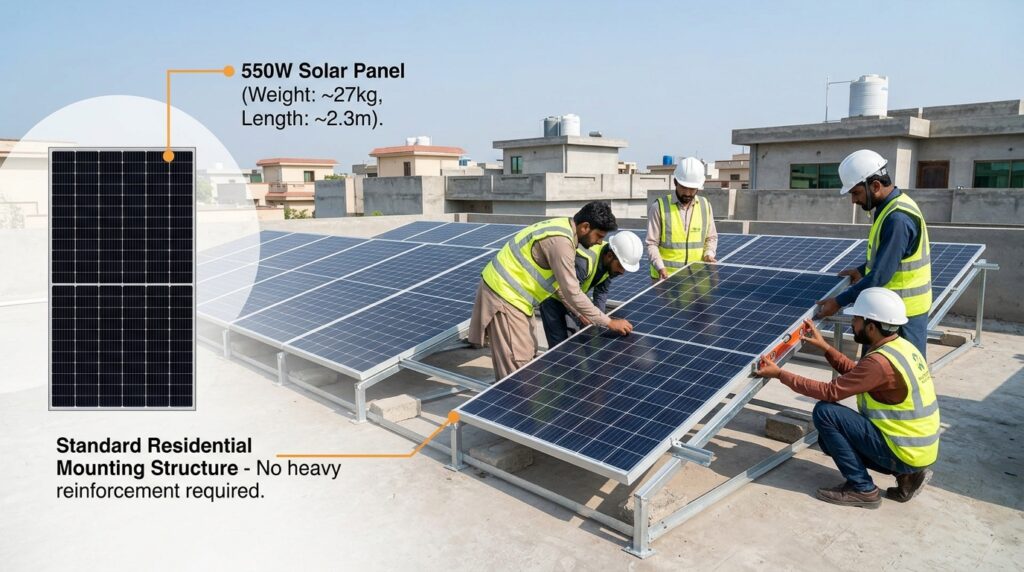
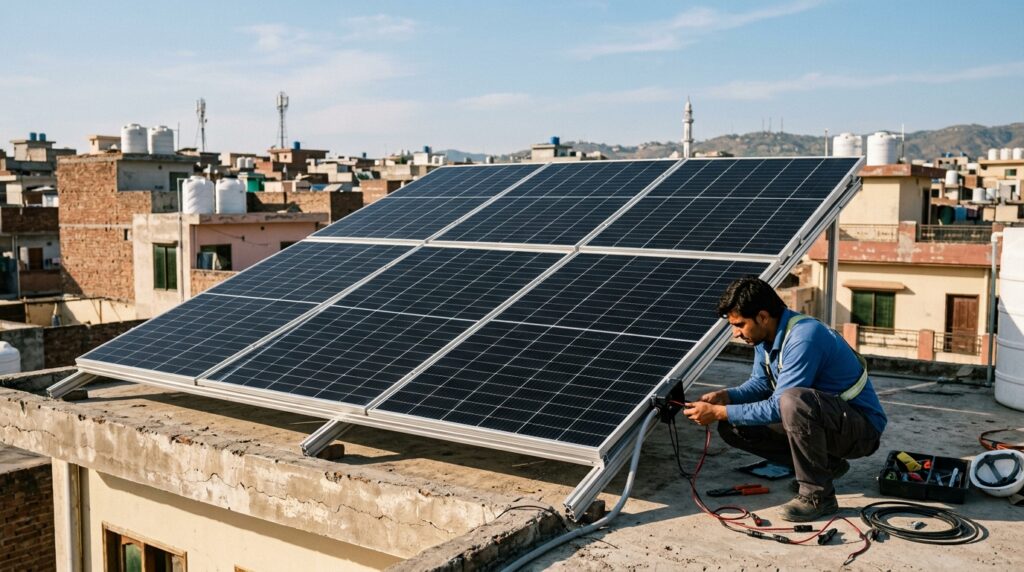
At roughly 550 watts, panels in this category typically weigh between 25 and 28 kilograms each and measure approximately 2.3 to 2.4 meters in length, dimensions that standard residential mounting structures across Pakistan are well suited to handle without requiring the additional structural reinforcement sometimes necessary for the larger, heavier 700 watt panels used in commercial-scale projects. Flat concrete roofs, common across Pakistani residential construction, comfortably support 550 watt panel installations using standard mounting hardware, while our engineering team calculates the appropriate mounting angle for your specific city as a standard part of every site survey, covered in more detail in our guide to solar panel angle.
Because 550 watt pricing varies by brand, cell technology and current USD to PKR exchange rates, any meaningful quote should come from an actual conversation with a supplier rather than a generic online estimate. Pakistan Solar Solutions maintains current stock and pricing across the full range of Tier-1 550 watt panels as part of our broader solar panel price in Pakistan offering, and our free site survey determines the exact panel count, brand recommendation and total system cost specific to your roof and consumption pattern. Reach our team through our contact page for current availability and a tailored quote.
For homeowners specifically planning a system to qualify for NEPRA net metering, 550 watt panels offer a particularly convenient sizing advantage, since nine panels land almost exactly at the common 5 kW target size that represents the most frequently installed residential net metering configuration in Pakistan. This close alignment means installers can design a system using round, easy-to-source panel quantities without needing to oversize or undersize the array to hit a specific target capacity, simplifying both the initial system design and the subsequent net metering application process handled through our net metering services. For homeowners targeting a slightly larger 7 kW or 10 kW system, the same convenient scaling applies, with panel counts of roughly thirteen and eighteen respectively landing close to these common target capacities without awkward fractional panel counts.
Given how central 550 watt panels are to the current Pakistani residential market, their real-world summer performance deserves specific attention. Premium N-Type 550 watt panels typically carry a temperature coefficient around negative 0.29 to negative 0.34 percent per degree Celsius above the standard 25-degree test condition, meaning that even during Pakistan’s punishing summer afternoons, when rooftop surface temperatures regularly exceed 55 degrees Celsius, these panels retain a meaningfully higher proportion of their rated output compared to older P-Type technology carrying a less favorable coefficient closer to negative 0.40 to negative 0.45 percent per degree. For buyers in particularly hot regions covered in our city guides for Multan and Faisalabad, this temperature performance difference within the 550 watt category specifically is worth weighing carefully when comparing P-Type and N-Type options at this wattage, since the practical generation difference across a full summer season can be meaningful even among panels of identical rated wattage.
As of 2026, a 550 watt solar panel in Pakistan typically costs between PKR 20,000 and PKR 26,000 per panel, translating to roughly PKR 36 to PKR 47 per watt depending on brand and cell technology.
A standard 5 kW residential system requires nine 550 watt panels, providing 4,950 watts of installed capacity, close enough to the 5 kW target for standard net metering eligibility.
Both sizes perform similarly on a per-watt basis, with the choice generally coming down to specific brand availability and pricing at the time of purchase rather than any significant performance difference between the two closely spaced wattages.
A complete, professionally installed 5 kW system using 550 watt panels typically costs between PKR 650,000 and PKR 850,000, including the panels, inverter, mounting structure, cabling and installation labor.
Yes, 550 watt panels are one of the most common and well-suited sizes for standard residential rooftops across Pakistan, with a manageable weight and size that standard mounting structures handle comfortably without requiring additional structural reinforcement.
Yes, a system built using 550 watt panels, typically nine panels for a standard 5 kW configuration, comfortably meets NEPRA’s net metering requirements provided the installation includes a compliant inverter and proper three-phase connection.