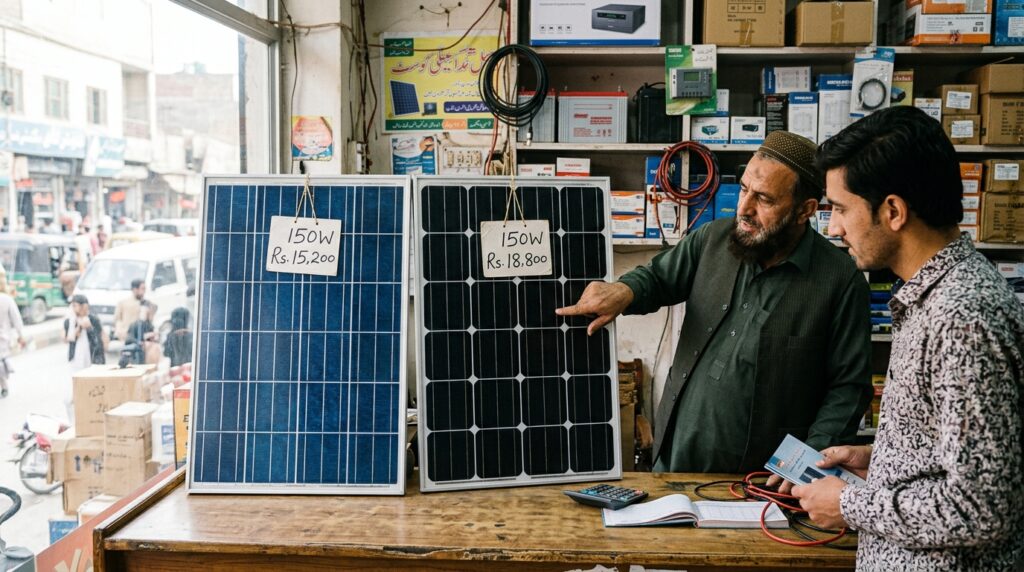


Searching simply for 150 watt solar panel price usually means you already have a rough idea of what you want and are now trying to figure out whether the numbers you are seeing from different sellers actually make sense. Prices for this popular small panel size can vary surprisingly widely across dealers, online listings and local markets in Pakistan, and without a clear reference point, it is easy to either overpay for a basic panel or underpay for something that will not perform close to its labeled output. This guide is built specifically as a comparison and sanity-check resource, helping you evaluate any 150 watt quote you have already received or are about to receive.
As of 2026, a genuine 150 watt solar panel in Pakistan should generally fall between PKR 7,000 and PKR 11,000, regardless of whether you are buying from an electronics market stall, an online retailer, or a dedicated solar company. If a quote you have received sits meaningfully below this range, treat it as a signal to ask more questions rather than an automatic bargain, since panels priced unusually low relative to this benchmark are more likely to be mislabeled, understocked on genuine cells, or simply not capable of producing their claimed output under real sunlight conditions. Our full breakdown of this category, including use cases and technical detail, is available in our comprehensive guide to the 150 watt solar panel price in Pakistan, which this comparison guide complements rather than repeats.
At the 150 watt size, the price gap between polycrystalline and monocrystalline versions is usually modest, generally a difference of PKR 1,000 to PKR 2,500 depending on the seller. Polycrystalline panels sit toward the lower end of the fair price range outlined above, while monocrystalline panels, offering somewhat better efficiency and a slightly more compact physical size for the same wattage, sit toward the upper end. For a panel this small, the practical performance difference between the two cell types is less dramatic than it would be at larger residential scale, meaning the decision often comes down to whichever is more readily available and competitively priced from a trustworthy seller at the time you are buying, rather than one type being a clearly superior choice in every case.
A meaningful portion of the price variation buyers encounter when comparing 150 watt panel quotes comes down to where the panel is actually being sourced from. Panels sold through established solar companies with verified supply chains and manufacturer documentation tend to sit at the higher, more reliable end of the fair pricing range, reflecting genuine quality assurance behind the product. Panels sold through informal electronics markets or unverified online listings can sometimes undercut this range significantly, but often without any way to confirm the panel’s actual tested output matches its printed label, or without any meaningful recourse if the panel underperforms or fails shortly after purchase. Before choosing based on price alone, it is worth asking any seller directly whether they can provide a specification sheet, whether the panel has been independently tested, and what, if any, warranty applies, since these questions quickly separate more reliable sellers from less accountable ones.
Before finalizing a purchase based purely on price, it is worth briefly confirming that 150 watts is actually the right size for your intended use, since this comparison guide assumes you have already settled on this wattage but a quick check can save money either way. If your goal is genuinely small and portable, such as charging devices or running a single light, a smaller panel in the mini solar panel category might serve your needs at a lower cost. If your goal is somewhat larger, such as running a small shop or home office setup, stepping up to the 280 watt or 300 watt category might deliver meaningfully more practical capacity for a price increase that is often smaller, proportionally, than the jump in usable output. And if your actual underlying goal is reducing your household electricity bill through a proper net metering system, a 150 watt panel will not get you there at all, and it is worth reviewing our full solar panel price in Pakistan overview instead.
A short list of practical questions can help you evaluate any specific 150 watt quote with confidence. Ask whether the panel comes with a printed and, ideally, laser-etched serial number, since panels without any identifying markings are considerably harder to trace back to a manufacturer if a warranty issue arises later. Ask what warranty period applies, since even a basic one or two-year warranty on a budget panel provides meaningfully more protection than no warranty at all. Ask whether the seller can share the panel’s actual open-circuit voltage and short-circuit current specifications, since a seller who can readily provide this detailed information is generally more likely to be dealing in genuinely tested, properly labeled stock compared to one who can only quote the wattage figure without further detail.
Buyers researching 150 watt solar panel price across different purchase channels in Pakistan will typically encounter a fairly consistent pattern. Dedicated solar equipment retailers and established solar companies generally quote prices toward the middle to upper end of the PKR 7,000 to PKR 11,000 range, reflecting verified stock and available warranty support. General electronics markets in major cities often show a wider spread, sometimes dipping below this range for unbranded stock or rising above it for panels bundled with additional accessories like a basic charge controller or connecting cables. Online marketplaces tend to show the widest variation of all, making it particularly important to check seller ratings, review history, and product specification detail before purchasing, since the convenience of online shopping does not eliminate the same quality and authenticity risks present in physical markets.
Many sellers offer 150 watt panels as part of a bundled kit, including a small charge controller, cabling, and sometimes a basic battery, marketed as a ready-to-use complete solution rather than requiring buyers to source these components separately. These bundled kits typically cost somewhat more than the panel alone but can represent good value for buyers without the technical background to confidently match compatible components themselves. For buyers who already own a compatible charge controller or battery from a previous setup, purchasing the 150 watt panel as a standalone unit and reusing existing components is usually the more cost-effective route, provided the electrical specifications are properly matched.
Given how much variation exists across the 150 watt panel market, the most reliable way to get an accurate price for your specific situation is to request a direct quote from a verified seller rather than relying purely on scattered online listings that may not reflect current stock, genuine specifications, or accurate pricing. Pakistan Solar Solutions can provide verified 150 watt panel pricing and stock availability as part of our broader product range, alongside guidance on whether this wattage genuinely fits your intended use case or whether a different size would serve you better. Reach our team through our contact page for a straightforward, verified quote.
A genuine 150 watt solar panel should generally cost between PKR 7,000 and PKR 11,000 in 2026. Quotes significantly below this range are worth questioning carefully before purchasing.
Price variation largely comes down to sourcing and verification. Established solar companies with verified supply chains and manufacturer documentation tend to price toward the higher, more reliable end of the fair range, while informal market or unverified online sellers can undercut this significantly, often without reliable quality assurance behind the lower price.
The price difference at this size is usually modest, PKR 1,000 to PKR 2,500. Monocrystalline offers slightly better efficiency and a more compact size, while polycrystalline is generally the more budget-friendly option. Both are reasonable choices depending on availability and price at the time of purchase.
A bundled kit, including a charge controller and cabling, can be good value for buyers without existing compatible components or technical experience matching specifications. Buyers who already own compatible components are usually better off purchasing the panel alone at a lower cost.
Ask whether the panel has a printed serial number, what warranty applies, and whether the seller can provide detailed electrical specifications beyond just the wattage figure. Sellers who can confidently answer these questions are generally more reliable than those offering only a bare price with no supporting detail.