

Across much of Pakistan, solar panels are commonly referred to as solar plates, a term used interchangeably in local markets, electronics bazaars and everyday conversation from Karachi to Peshawar. If you have been asking around about the solar panel plate price in Pakistan, you have likely noticed that quotes can vary wildly depending on who you ask, what size plate you are looking at, and whether the seller is dealing in genuine Tier-1 stock or unbranded, lower-cost alternatives. This guide breaks down exactly what drives solar plate pricing in Pakistan today, what to expect across different plate sizes, and how to avoid the common pitfalls that lead buyers to overpay or, worse, end up with a plate that never delivers its labeled output.
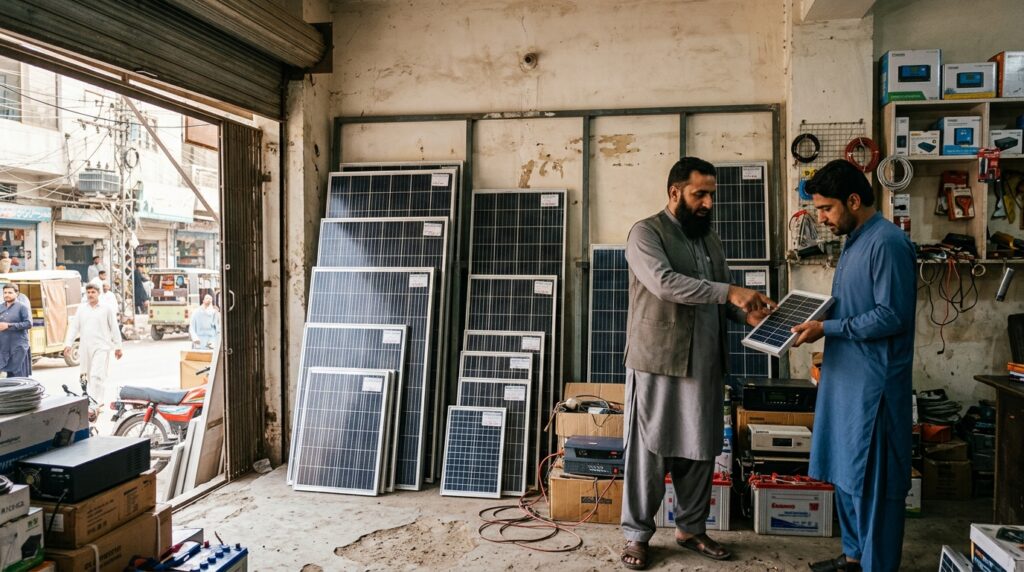
The term solar plate refers to the same product as a solar panel, a flat photovoltaic module made up of individual solar cells encased in glass and an aluminum frame. The word plate is simply the common local terminology, used far more often in everyday buying and selling conversations than the more formal term panel, particularly in open markets, electronics bazaars such as Hall Road in Lahore or Sadar in Karachi, and among smaller regional dealers. Understanding this is useful when comparing prices, since online searches, local shop signage and WhatsApp price lists may use plate and panel interchangeably, sometimes within the same conversation.
Solar plate pricing in Pakistan is generally structured around wattage, with cost per watt decreasing somewhat as plate size increases, a pattern consistent with global solar manufacturing economics.
Small solar plates in the 100 to 200 watt range are the most commonly purchased category for basic backup needs, typically costing between PKR 5,000 and PKR 12,000 depending on exact wattage and whether the plate is polycrystalline or monocrystalline. These smaller plates are popular for standalone applications such as basic lighting, phone charging, or small fan setups, a use case we cover in more detail in our dedicated guide to the 150 watt solar panel price in Pakistan.
Medium-sized plates in the 250 to 400 watt range generally cost between PKR 12,000 and PKR 22,000, and represent a common middle-ground choice for small shops, home offices, and buyers building a modest multi-plate backup system without committing to a full rooftop installation. Our guide on the 280 watt solar panel price in Pakistan covers this segment in detail, including realistic expectations for what a set of medium plates can actually power.
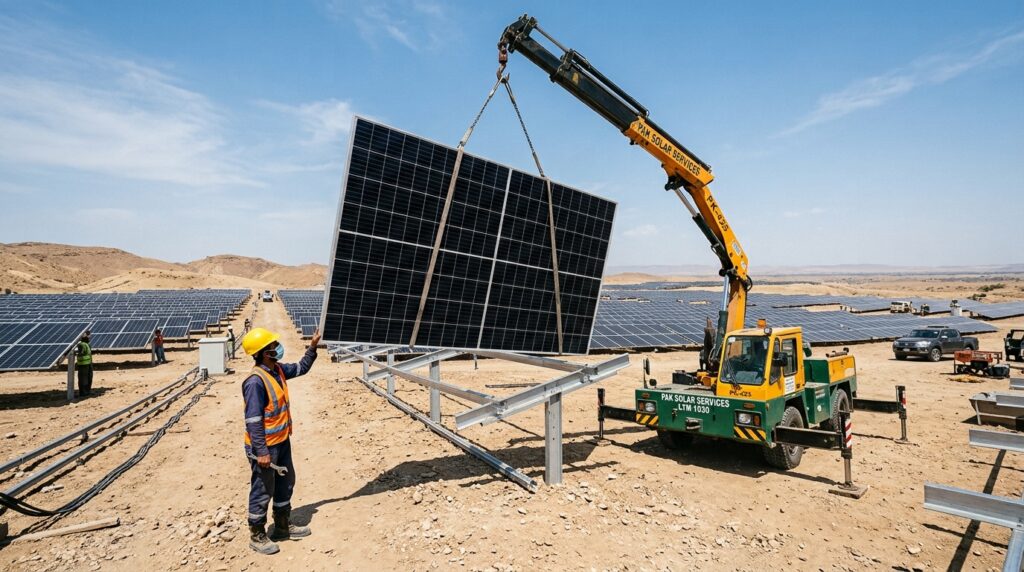
Large-format plates, ranging from 500 watts up to the newer 700 watt panels now entering the Pakistani market, are the standard choice for full residential rooftop systems, commercial installations and net metering projects. These typically cost between PKR 20,000 and PKR 34,000 per plate depending on wattage and cell technology, translating to roughly PKR 24 to PKR 48 per watt. Buyers planning a full system in this category should review our complete breakdown of the best solar panels in Pakistan, which covers Tier-1 brands specifically suited to large-scale installations.
Several variables influence why two plates of the same labeled wattage can carry noticeably different price tags in the Pakistani market.
N-Type monocrystalline plates, now the standard for premium installations, cost more per watt than older P-Type polycrystalline plates, but deliver measurably better performance in Pakistan’s extreme summer heat due to their lower temperature coefficient. Plates manufactured or assembled by internationally recognized Tier-1 companies also command a price premium over smaller, less established manufacturers, reflecting more consistent quality control and genuine long-term warranty backing.
The aluminum frame and tempered glass covering used in a solar plate directly affect both its durability and its price. Thicker, corrosion-resistant frames and higher-grade anti-reflective glass coatings add to manufacturing cost but also extend the plate’s usable lifespan and help maintain output over the full 25-year warranty period, particularly in coastal or high-humidity regions where lower-quality frames can corrode noticeably faster.
Nearly all solar plates sold in Pakistan, regardless of the seller, ultimately trace back to imported components or fully assembled panels, meaning pricing is directly tied to the US dollar to Pakistani rupee exchange rate at the time of import, along with applicable customs duties and general sales tax. This is why solar plate prices can shift noticeably within the same year even without any change in the underlying manufacturing cost, and why any price quoted today should be treated as a snapshot rather than a fixed, permanent figure.
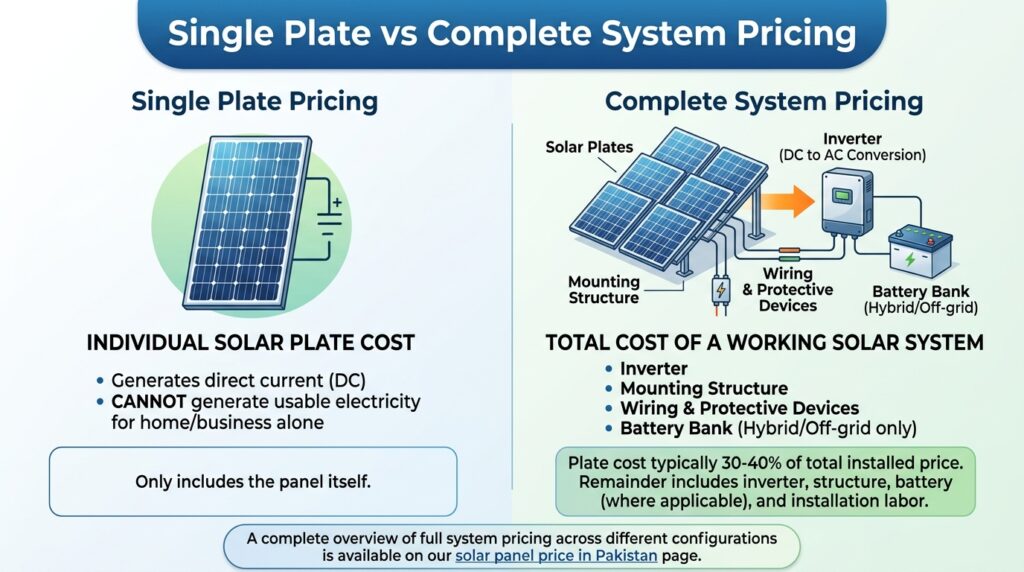
It is important to distinguish between the price of an individual solar plate and the total cost of a working solar system, since a plate alone cannot generate usable electricity for your home or business. A complete system requires an inverter to convert the direct current generated by the plates into usable alternating current, a mounting structure to securely hold the plates in place, wiring and protective devices, and in the case of hybrid or off-grid systems, a battery bank as well. For a full residential system, plate cost typically represents thirty to forty percent of the total installed price, with the remainder split between the inverter, structure, battery where applicable, and installation labor. A complete overview of full system pricing across different configurations is available on our solar panel price in Pakistan page.
Counterfeit and significantly downgraded solar plates remain a real risk in Pakistan’s open market, particularly for buyers focused purely on finding the lowest possible price. A genuine Tier-1 plate will always include a printed and often laser-etched serial number, a manufacturer datasheet specifying exact electrical characteristics, and documentation that can be verified directly with the manufacturer or an authorized local distributor. Buyers should be cautious of plates sold significantly below prevailing market rates for their claimed wattage, since this is one of the clearest warning signs of either counterfeit branding or a plate that has been deliberately mislabeled with a higher wattage than it can actually produce. Purchasing from an established, PEC-certified solar company rather than an unverified open-market seller remains the most reliable way to avoid this risk entirely.
Solar plates are sold through a wide range of channels in Pakistan, from dedicated solar equipment markets in major cities to individual EPC companies that supply plates as part of a complete installation package. Buying a single plate for a small standalone project can often be done through local electronics markets, though verifying authenticity becomes the buyer’s own responsibility in these settings. For anyone planning a proper rooftop system, whether residential or commercial, sourcing plates directly through an established installer such as Pakistan Solar Solutions ensures the plates are genuine, correctly rated, and backed by manufacturer warranty documentation that the installer can help enforce if any issue arises during the warranty period.
Selecting the correct plate size ultimately comes down to your actual electricity requirement rather than simply choosing whatever size seems most commonly advertised. Small plates suit standalone backup applications such as lighting and phone charging, medium plates work well for shops and home offices needing moderate daily power, and large plates are the correct choice for any full residential or commercial system aiming to meaningfully reduce grid electricity dependence through net metering. Our team offers a free site survey and energy audit to help determine the right plate size and total system configuration based on your actual WAPDA or K-Electric consumption, which you can arrange through our contact page.
As of 2026, solar plate pricing ranges from roughly PKR 5,000 for small 100 to 150 watt plates up to PKR 34,000 for large 700 watt plates, with per-watt cost generally falling between PKR 24 and PKR 55 depending on brand, size and cell technology.
Yes, solar plate and solar panel refer to the exact same product. Plate is simply the more commonly used term in everyday conversation and local markets across Pakistan.
Pricing differences usually come down to cell technology, brand reputation, frame and glass quality, and whether the seller is offering genuine Tier-1 stock with manufacturer warranty backing versus unbranded or counterfeit plates sold at a lower price without reliable performance guarantees.
Check for a printed and laser-etched serial number, request the manufacturer datasheet, and be cautious of plates priced significantly below the prevailing market rate for their claimed wattage, which is one of the clearest signs of counterfeit or mislabeled stock.
No, the price of an individual plate typically covers only the plate itself. A complete installed system also requires an inverter, mounting structure, wiring and installation labor, all of which add to the total project cost beyond the plate price alone.