

Not every solar buyer in Pakistan is looking to power a whole house. A huge number of people search for the 150 watt solar panel price in Pakistan because they simply want to run a few fans and lights during load shedding, charge phones and small appliances at a roadside shop, or keep a security camera and router running through a power cut. The 150 watt panel occupies a very specific and useful niche in the Pakistani solar market, and understanding exactly what it can and cannot do will save you from either overspending on capacity you do not need or underbuying and ending up frustrated with a system that cannot keep your basic loads running.
This guide covers current 2026 pricing for 150 watt panels across the brands available in Pakistan, realistic expectations for what this size of panel can actually power, and the additional components you will need to build a functional small-scale system around it.
A 150 watt solar panel is one of the smaller panel sizes still commonly manufactured and sold in Pakistan, sitting well below the 550 to 700 watt panels used in modern residential and commercial rooftop systems. It is not designed to replace your WAPDA or K-Electric connection or to qualify for net metering, since NEPRA’s net metering eligibility generally starts at a minimum system size of 1 kW. Instead, a 150 watt panel is built for standalone, small-load applications where portability, low cost, or a very limited budget matters more than total output.
Under good sunlight conditions with five to six peak sun hours, a 150 watt panel typically generates between 600 and 750 watt-hours of usable energy per day, before accounting for losses in the charge controller, battery and wiring. In practical terms, that is enough to keep a couple of LED bulbs, a small fan, and phone charging running for several hours each evening, particularly during Pakistan’s frequent load shedding periods. It is important to set expectations correctly here, since a single 150 watt panel is not going to run a refrigerator, an air conditioner, or multiple heavy appliances simultaneously.
The 150 watt solar panel is popular among shopkeepers who need to keep a fan and a few lights running during a few hours of daily load shedding, small tube well or livestock watering setups in rural areas, roadside food stalls needing to charge phones and run a small speaker or light, and homeowners who want a basic emergency backup for essential loads like a router, a few bulbs and a fan, without committing to a full rooftop solar system.
As of 2026, the 150 watt solar panel price in Pakistan generally ranges between PKR 7,000 and PKR 11,000 for a standalone panel, depending on the manufacturing technology, brand reputation, and whether it is a polycrystalline or monocrystalline model. This is a considerably lower entry point than the Tier-1, higher-wattage panels used in full rooftop installations, which is exactly why this segment appeals to budget-conscious buyers and small-load applications.
Polycrystalline 150 watt panels remain the most affordable option in this wattage category, typically priced toward the lower end of the range, and they perform adequately for basic load requirements. Monocrystalline 150 watt panels cost somewhat more but offer slightly better efficiency and a more compact physical footprint, which matters if you have very limited installation space, such as a small shop awning or the roof of a rickshaw stand.
Local and semi-branded manufacturers dominate the 150 watt panel category in Pakistan, since Tier-1 international brands like Longi and Jinko generally focus their production on the higher-wattage panels used in rooftop and commercial installations. When comparing quotes for a 150 watt panel, it is worth asking specifically about the actual measured output rather than relying solely on the labeled wattage, since quality control in this smaller, lower-cost segment can vary more than it does among premium Tier-1 brands. For buyers who want the reliability of certified manufacturing without the higher cost of a full-size Tier-1 panel, our team at Pakistan Solar Solutions can advise on trusted suppliers as part of a broader consultation.
Understanding realistic load capacity is the single most important factor in deciding whether a 150 watt panel actually fits your needs, or whether you should be looking at a larger system instead.
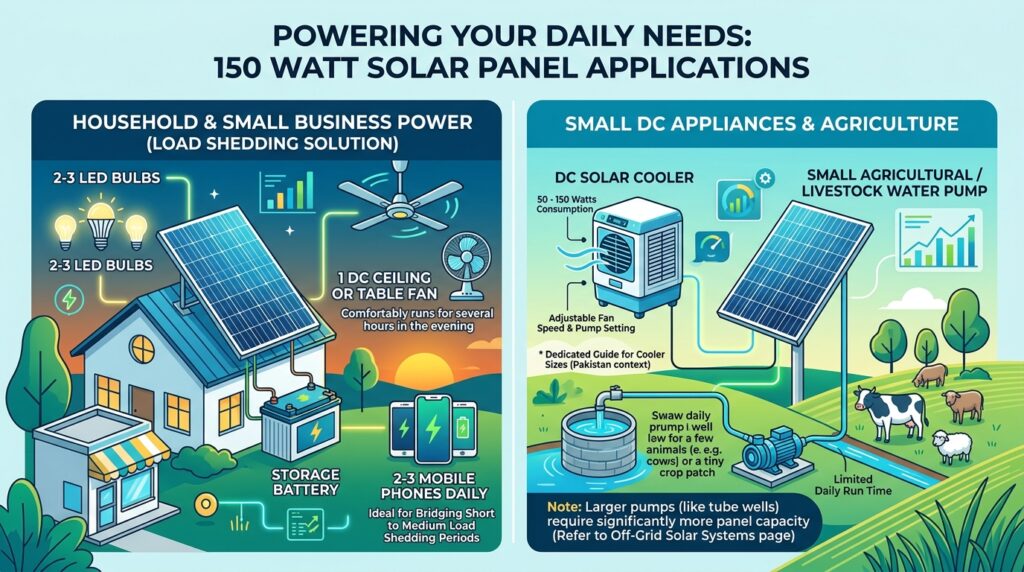
A 150 watt panel paired with an appropriately sized battery can comfortably run two to three energy-efficient LED bulbs and one DC ceiling or table fan for several hours in the evening, along with charging two or three mobile phones daily. This makes it a genuinely useful solution for households or small businesses that primarily need to bridge short to medium load shedding periods rather than achieve full energy independence.
A 150 watt panel is also commonly paired with small DC solar coolers, which typically consume between 50 and 150 watts depending on fan speed and pump setting. We cover this pairing in more detail in our dedicated guide on the solar cooler price in Pakistan, which explains exactly how many panels are needed for different cooler sizes. A 150 watt panel can also power a very small agricultural or livestock water pump for limited daily run time, though larger tube well pumps require significantly more panel capacity, which we discuss further on our off-grid solar systems page.
For buyers whose real goal is to reduce or eliminate their monthly electricity bill, a 150 watt panel is generally not the right starting point, since it operates far below the scale needed for meaningful bill reduction or net metering eligibility. Instead, it makes the most financial sense when treated as a dedicated, standalone solution for a specific small load, such as a shop counter, a security setup, or basic backup lighting, rather than as the first building block of a larger home system. Buyers who initially purchase a 150 watt panel intending to expand later often find it more cost-effective in the long run to plan directly for a proper 1 kW to 3 kW system from the start, since panel, inverter and structural costs scale more efficiently at higher wattages. If your actual goal is bill reduction, it is worth reviewing our complete solar panel price in Pakistan overview to understand where a full rooftop system would fit your budget.
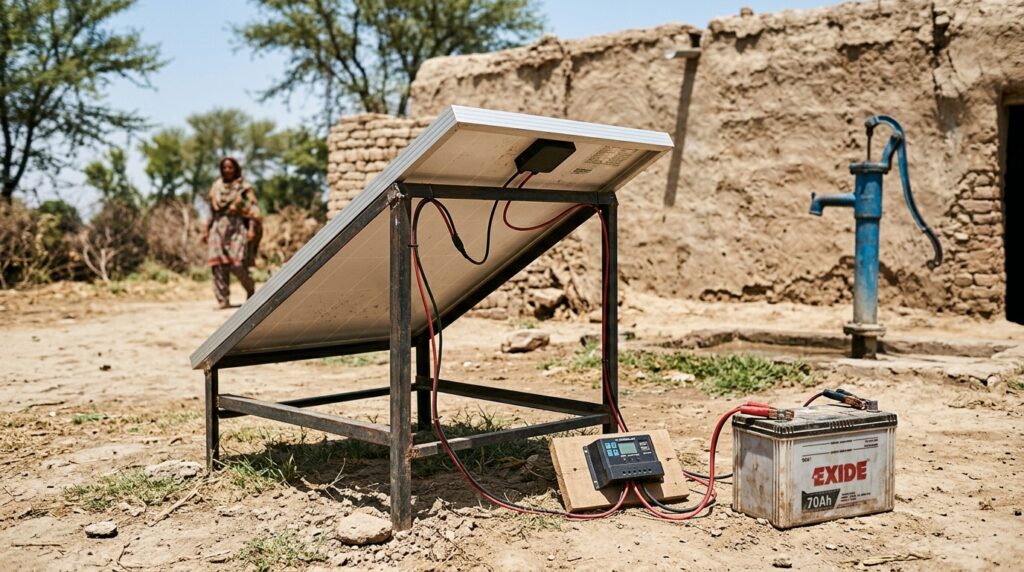
A solar panel alone does not power anything. To build a working system around a 150 watt panel, several additional components are required, and their combined cost often exceeds the price of the panel itself.
A basic PWM charge controller rated for at least 10 amps is sufficient for a single 150 watt panel, and typically costs between PKR 1,500 and PKR 3,500 depending on the brand and build quality. A charge controller regulates the flow of electricity from the panel into the battery, preventing overcharging and extending battery lifespan significantly.
Most 150 watt panel setups are paired with a 100 to 150 amp-hour deep cycle or lead-acid battery, which stores the energy generated during the day for use in the evening or during outages. Battery cost varies considerably by brand and chemistry, with standard lead-acid batteries being the most affordable option and lithium batteries offering longer lifespan at a higher upfront cost. For anyone considering a larger battery bank down the line, our hybrid solar systems service uses lithium LiFePO4 batteries designed for far more demanding daily cycling than a small standalone setup requires.
The small-panel market in Pakistan includes a wide range of sellers, from established solar retailers to informal electronics markets. Buying from a source that can verify actual tested output, rather than simply trusting the printed wattage label, is important, since mislabeled panels are more common in this budget segment than among Tier-1, higher-wattage panels used in full rooftop systems. Pakistan Solar Solutions supplies genuine, tested small-format panels alongside our full range of residential and commercial systems, and our contact page is the fastest way to get current stock and pricing for your specific requirement.
Even a small 150 watt panel performs significantly better when installed correctly. The panel should face south for most locations in Pakistan and be tilted at an angle that roughly matches your city’s latitude for optimal year-round performance, a topic we cover in detail in our dedicated guide on solar panel angle. Avoiding shade from walls, trees or nearby structures during peak sunlight hours between ten in the morning and four in the afternoon is critical, since even partial shading on a single small panel can disproportionately reduce total output. Keeping the panel surface clean and free of dust buildup, which accumulates quickly in Pakistan’s dry climate, also meaningfully improves daily generation, and a simple wipe-down every one to two weeks using a soft brush is generally sufficient for a panel of this size.
A standalone 150 watt solar panel in Pakistan currently costs between PKR 7,000 and PKR 11,000, depending on whether it is polycrystalline or monocrystalline and the manufacturing brand. This price does not include the charge controller, battery or wiring needed to build a complete working system.
No. A 150 watt panel produces far too little power to reliably run a refrigerator or air conditioner. It is best suited for small loads such as LED lighting, a fan, mobile charging, or a small DC solar cooler.
Most 150 watt panel setups use a single 100 to 150 amp-hour battery, which is sufficient to store the panel’s daily output for evening use. Larger battery banks are unnecessary unless you plan to run loads for extended periods after sunset.
A 150 watt panel is too small to meaningfully reduce a household electricity bill or qualify for NEPRA net metering, which requires a minimum system size of 1 kW. It is better suited as a standalone backup solution rather than a bill-reduction system.
A 280 watt panel produces roughly double the daily energy output of a 150 watt panel, making it suitable for slightly larger loads such as multiple fans, lights and small appliances. You can compare the two in detail in our guide to the 280 watt solar panel price in Pakistan.