

Among all the components of a solar energy system, the solar charge controller is one of the most misunderstood and most frequently underestimated. Many Pakistani buyers focus their research and budget on panels and inverters, treating the charge controller as a minor afterthought. This is a serious mistake. A poorly chosen or low-quality charge controller can damage your battery bank, waste significant amounts of solar energy, and shorten the lifespan of your entire solar system.
Understanding the solar charge controller price in Pakistan, the two main technologies available, how to size a controller for your system, and which brands offer reliable performance in Pakistani conditions is essential for anyone building or upgrading a solar system. At Pakistan Solar Solutions, we see the consequences of poorly selected charge controllers regularly, and this guide is designed to help Pakistani buyers make the right choice the first time.
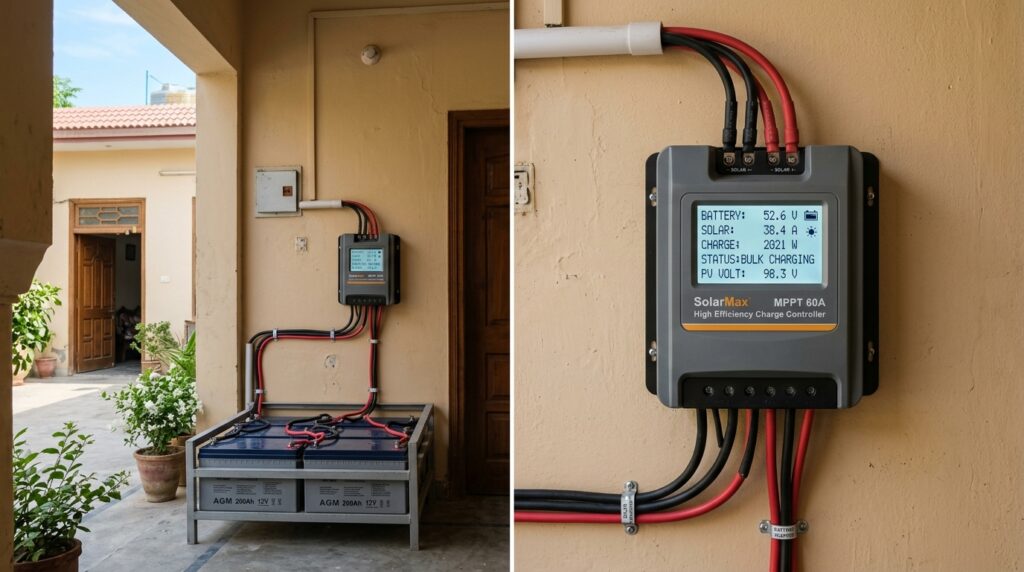
A solar charge controller is an electronic device that sits between your solar panels and your battery bank. Its primary function is to regulate the voltage and current flowing from the panels into the batteries to prevent overcharging. Without a charge controller, solar panels would push current into the batteries regardless of their state of charge, leading to overheating, electrolyte loss in lead-acid batteries, and potentially irreversible damage to lithium batteries.
A charge controller also prevents reverse current flow from the batteries back through the panels at night, which would drain the batteries when no solar energy is being generated. This protection function is critical for extending battery lifespan.
Beyond these basic protection functions, modern MPPT charge controllers also optimise the power drawn from your solar panels using Maximum Power Point Tracking technology, which we cover in detail below. This optimisation can increase the amount of energy harvested from your panels by fifteen to thirty percent compared to basic charge controllers, directly increasing the electricity available for your loads and charging.
It is important to note that charge controllers are a component of off-grid and some hybrid solar systems. In fully grid-tied on-grid solar systems without battery storage, the solar inverter manages the solar panel output directly and no separate charge controller is used. If your solar system includes batteries and a separate solar inverter that does not have an integrated MPPT controller, a standalone charge controller is required. For systems using a modern hybrid solar inverter with built-in MPPT, the inverter already incorporates charge controller functionality, which you can verify in our hybrid solar inverter guide at Pakistan Solar Solutions.
When researching the solar charge controller price in Pakistan, the first distinction you will encounter is between PWM and MPPT controllers. This is the most important technical decision you will make about your charge controller and it significantly affects both the solar charge controller price in Pakistan you pay and the performance of your solar system.
PWM stands for Pulse Width Modulation. A PWM charge controller connects your solar panels directly to the battery and regulates charging by rapidly switching the connection on and off in pulses, reducing the average current as the battery approaches full charge. PWM controllers are simple, reliable, and inexpensive. The solar charge controller price in Pakistan for PWM models is the lowest available, starting from two thousand five hundred rupees for small twenty-amp units and reaching fifteen thousand rupees for sixty-amp units.
However, PWM controllers have a fundamental limitation. They require the solar panel voltage to closely match the battery voltage for efficient operation. Modern solar panels are typically rated at thirty to forty volts open circuit voltage, while twelve or twenty-four volt battery systems need charging voltages of fourteen to twenty-nine volts. A PWM controller essentially wastes the difference between the panel’s higher voltage and the battery’s lower voltage, harvesting only the current at the battery voltage level. For a panel rated at four hundred watts but operating in a twelve-volt system with a PWM controller, only a fraction of the rated output is captured.
MPPT stands for Maximum Power Point Tracking. An MPPT charge controller uses sophisticated electronics to continuously find and operate at the voltage and current combination that extracts maximum power from the solar panels, then converts that power to the voltage and current required by the battery. This conversion process, like a DC-to-DC transformer, captures the full power available from the panel regardless of the mismatch between panel voltage and battery voltage. In practical terms, an MPPT controller harvests fifteen to thirty percent more energy from the same panels compared to a PWM controller.
The solar charge controller price in Pakistan for MPPT models is higher than PWM, starting from eight thousand rupees for small ten-amp units and reaching eighty thousand rupees or more for high-capacity one hundred amp units from premium brands. However, the additional energy harvested by MPPT technology typically repays the price difference many times over during the system’s operational life. For any solar system in Pakistan beyond the most basic small-scale application, MPPT is always the recommended choice.
The amperage rating of a solar charge controller determines how much current it can handle from your solar panels. Matching the controller’s amperage to your system is critical for both safety and performance.
To calculate the required charge controller amperage, divide your total solar panel wattage by your battery bank voltage and multiply by one point twenty-five as a safety factor. For a two thousand watt solar array and a twenty-four volt battery bank, the required controller amperage is two thousand divided by twenty-four multiplied by one point twenty-five, which gives approximately one hundred and four amps. You would therefore need a one hundred amp controller.
For small solar systems of five hundred to eight hundred watts used for basic home lighting and fan loads, a thirty to forty amp MPPT controller is typically sufficient. The solar charge controller price in Pakistan for this range is eight thousand to twenty thousand rupees from quality brands.
For medium systems of one to three kilowatts running on twelve or twenty-four volt battery banks, a sixty to eighty amp MPPT controller is needed. The solar charge controller price in Pakistan for sixty amp MPPT controllers ranges from fifteen thousand to forty-five thousand rupees depending on brand and features.
For larger systems of three kilowatts and above, forty-eight volt battery banks are typically used because higher voltage systems are more efficient and require less copper in the wiring. A forty-eight volt one hundred amp MPPT controller handles up to approximately four to five kilowatts of solar input and is priced between thirty-five thousand and eighty thousand rupees from established brands.
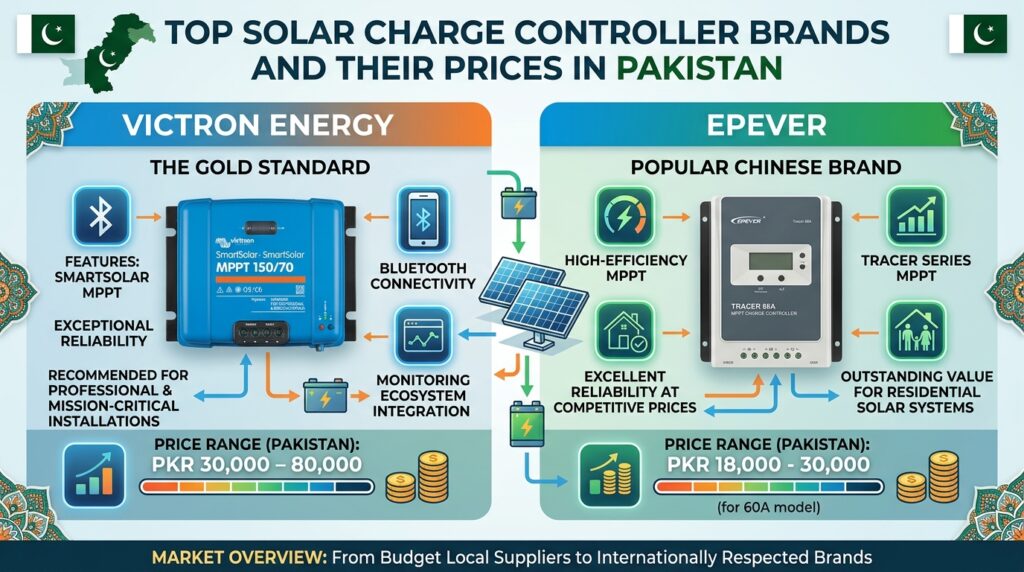
The solar charge controller market in Pakistan includes products from budget local suppliers all the way to internationally respected professional brands. Knowing which brands are reliable is essential given the critical role a charge controller plays in protecting your battery investment.
Victron Energy is widely considered the gold standard for solar charge controllers globally and is available in Pakistan through specialist suppliers. Their SmartSolar MPPT controllers offer Bluetooth connectivity, integration with Victron’s comprehensive monitoring ecosystem, and exceptional reliability. Victron MPPT controllers in Pakistan are priced from thirty thousand to eighty thousand rupees depending on amperage rating and are recommended for professional and mission-critical installations.
Epever is a popular Chinese brand with an excellent reputation for reliability at competitive prices. Their Tracer series MPPT controllers are very widely used in Pakistan’s solar market and offer excellent MPPT efficiency at accessible prices. A sixty amp Epever Tracer MPPT controller is available in Pakistan for eighteen thousand to thirty thousand rupees and represents outstanding value for residential solar systems.
Midnite Solar is a premium American brand known for exceptional build quality and advanced features including arc fault protection. Their Classic series controllers are priced at the premium end of the market but offer the best technical specifications available. The solar charge controller price in Pakistan for Midnite Solar units ranges from sixty thousand to over one hundred thousand rupees for their top models.
Renogy offers reliable MPPT controllers popular in Pakistan’s mid-range market segment. Their controllers are competitively priced at fifteen thousand to forty thousand rupees and offer solid performance with good monitoring features. Renogy controllers are available through solar equipment retailers and online platforms across Pakistan.
Budget Chinese brands including SunMaxx, Phocos, and numerous unbranded products are available from as little as three thousand to ten thousand rupees for small MPPT units. While some of these perform adequately for small low-priority applications, their quality control and actual MPPT efficiency claims should be verified before entrusting them with an expensive battery bank. At Pakistan Solar Solutions, we recommend verified brands for any system protecting a significant battery investment.
The type of batteries in your solar system is a critical factor in selecting the right charge controller. Different battery chemistries require different charging profiles, and using the wrong profile can permanently damage batteries that cost far more than the controller itself.
Flooded lead-acid batteries require a three-stage charging profile with bulk, absorption, and float stages. The absorption voltage for a twelve volt flooded lead-acid battery is typically fourteen point four to fourteen point eight volts. PWM controllers support this profile adequately for small simple systems.
Sealed lead-acid, AGM, and gel batteries have slightly different charging requirements with lower absorption voltages to prevent gassing. A quality MPPT controller allows you to program the exact charging profile for your specific battery type, protecting the battery and maximising its lifespan.
Lithium iron phosphate batteries, which we cover comprehensively in our lithium ion solar battery guide at Pakistan Solar Solutions, have the strictest charging requirements. LFP batteries must not be overcharged under any circumstances as this can permanently damage cells. They require precise charge termination at their specified cell voltage limit. Many modern MPPT controllers offer a dedicated lithium charging mode that manages this correctly. However, the best practice for lithium battery systems is to use a controller that communicates directly with the battery’s BMS through a data interface, allowing the BMS to signal the controller to stop charging when the battery is full. Always verify lithium compatibility when purchasing a charge controller for an LFP battery system.
Pakistani solar buyers frequently make several avoidable mistakes when selecting and installing charge controllers that result in poor system performance or early equipment failure.
Undersizing the charge controller is the most common mistake. Buyers sometimes purchase a controller rated for less current than their solar array can produce, causing the controller to clip the solar output or overheat. Always size your controller at a twenty-five percent safety margin above the calculated maximum current.
Using a PWM controller with modern high-voltage panels is a mistake that wastes significant solar energy, as explained above. If your panels have an open circuit voltage significantly higher than your battery voltage, only an MPPT controller captures the full available energy.
Installing the charge controller in a hot location reduces its efficiency and lifespan. Electronic components in charge controllers degrade faster at high temperatures. In Pakistan’s summer heat, installing the controller in direct sunlight or in a poorly ventilated space can cause it to derate its output to protect itself or fail prematurely. Always install in a cool, shaded, ventilated location.
Skipping the battery temperature sensor included with many quality controllers is another mistake. Battery charging voltage requirements vary with temperature, and in Pakistan’s climate where ambient temperatures range from below zero in winter in northern areas to above forty-five in summer, the difference is significant. Using the temperature sensor allows the controller to automatically adjust the charging voltage for optimal battery health throughout the year.
For a complete solar system designed correctly from panels through batteries including a properly sized charge controller, visit Pakistan Solar Solutions for professional system design support.
What is the minimum solar charge controller price in Pakistan for a quality MPPT unit?
A quality entry-level MPPT controller from a reliable brand starts from approximately eight thousand to twelve thousand rupees in Pakistan for ten to twenty amp units. For thirty amp units, prices start from twelve thousand to twenty thousand rupees. Budget further for larger amperage requirements.
Do I need a charge controller if I have a hybrid solar inverter?
Most modern hybrid solar inverters include built-in MPPT charge controllers, meaning a separate standalone controller is not required. Always check your inverter’s specifications to confirm whether it has integrated battery charging MPPT. If it does, adding a separate charge controller creates conflicts and should be avoided.
What is the difference between a thirty amp and sixty amp solar charge controller in Pakistan?
The amperage rating determines how much solar current the controller can handle. A thirty amp controller supports approximately three hundred and sixty watts of panels on a twelve volt system or seven hundred and twenty watts on a twenty-four volt system. A sixty amp controller handles double these figures. Always match the controller rating to your actual solar array size with a twenty-five percent safety margin.
Can a solar charge controller work with both lithium and lead-acid batteries in Pakistan?
Many quality MPPT controllers offer selectable charging profiles for different battery types, allowing them to work with both lead-acid and lithium iron phosphate batteries by selecting the correct profile. Always verify lithium compatibility and check that the controller supports your specific LFP battery’s voltage requirements before purchasing.
How long does a solar charge controller last in Pakistan?
A quality MPPT charge controller from a reputable brand typically lasts eight to fifteen years in Pakistan with proper installation in a cool, ventilated environment. Budget controllers may fail within two to four years particularly if subjected to Pakistan’s heat extremes. The cost difference between a quality controller and a budget unit is small compared to the battery bank it protects.