

Pakistan is facing a water heating crisis that most households experience every winter morning. Natural gas pressure drops to unusable levels from December through February across major cities including Lahore, Islamabad, Peshawar, and Faisalabad, leaving millions of Pakistani families without hot water for bathing, cooking, and cleaning precisely when they need it most. At the same time, electricity-powered geysers drive electricity bills to painful levels during winter months when solar panel generation is also at its seasonal low.
The solar geyser offers a genuine solution to this crisis. Using Pakistan’s abundant sunlight to heat water directly and store it in an insulated tank, a solar geyser provides reliable hot water throughout the day and into the evening without consuming gas or significant amounts of electricity. As Pakistani consumers have recognised this advantage, interest in the solar geyser price in Pakistan has surged, and the market has expanded significantly with a wider range of options, technologies, and price points than ever before.
At Pakistan Solar Solutions, we have seen the solar geyser become an increasingly important product for Pakistani households seeking comprehensive energy independence beyond just electricity generation. This guide covers everything you need to know about the solar geyser price in Pakistan, from entry-level models to premium systems.
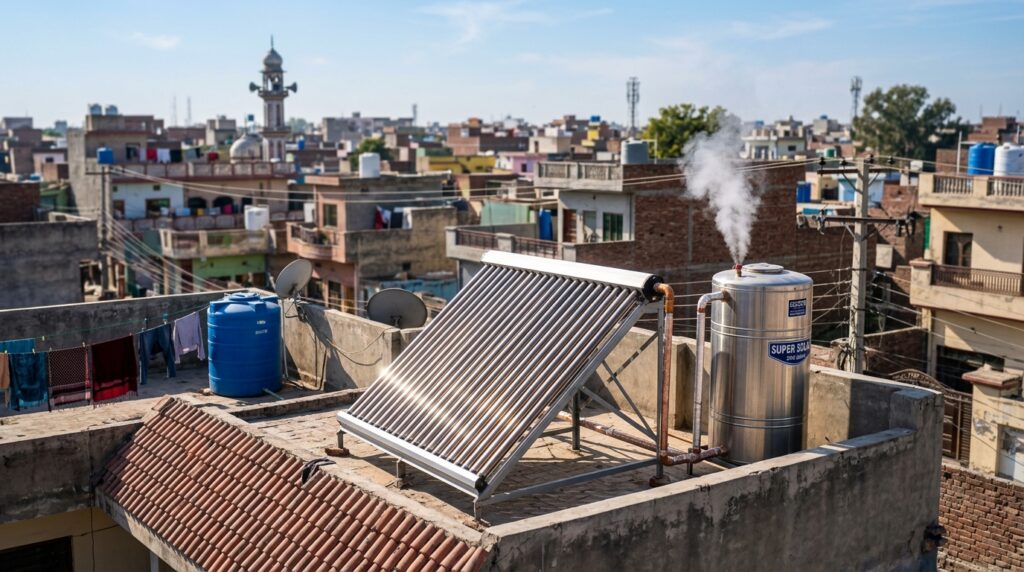
A solar geyser, also known as a solar water heater, works by using solar collectors mounted on the rooftop to absorb heat from sunlight and transfer it to water stored in an insulated tank. Unlike photovoltaic solar panels that convert sunlight into electricity, solar geysers convert sunlight directly into heat, which is a more efficient use of solar energy for the specific purpose of heating water.
Pakistan is exceptionally well-suited for solar water heating. The country receives an average of five to eight hours of strong direct sunlight throughout the year, with even winter months in most regions providing adequate solar radiation for effective water heating. The efficiency of solar thermal collectors for water heating is also significantly higher than the efficiency of photovoltaic cells for electricity generation, meaning a relatively small solar collector area can heat a substantial volume of water.
A typical solar geyser in Pakistan heats water to sixty to eighty degrees Celsius on a clear day, hot enough for bathing, dishwashing, and domestic cleaning. The insulated storage tank maintains water temperature for twelve to twenty-four hours after heating, meaning hot water heated during the afternoon sun is still warm enough for a shower the following morning. This thermal storage aspect distinguishes solar geysers from photovoltaic systems, which require battery storage to deliver electricity at night.
Pakistan’s solar geyser market offers two primary collector technologies, each with distinct advantages and suited to different use cases and budgets.
Evacuated tube solar collectors are the more efficient and more popular technology in Pakistan. An evacuated tube collector consists of rows of glass tubes, each containing an inner absorber tube surrounded by a vacuum. The vacuum insulates the absorber from heat loss, allowing the collector to reach very high temperatures even on cold winter days. In Lahore or Islamabad during December and January when ambient temperatures are low and sunshine is reduced, an evacuated tube solar geyser still heats water effectively because the vacuum insulation prevents the heat absorbed by the collector from escaping back into the cold air.
Evacuated tube collectors are available in Pakistan with forty-seven millimetre and fifty-eight millimetre tube diameters, with the larger tubes offering marginally better heat absorption. Systems ranging from ten tubes for small households to thirty or more tubes for large families or commercial applications are available. The solar geyser price in Pakistan for evacuated tube systems is higher than flat plate systems but the superior winter performance makes them the recommended choice for most Pakistani households.
Flat plate solar collectors are the older and simpler technology, consisting of a flat metal absorber plate coated in a heat-absorbing material, enclosed in an insulated frame, and covered with a glass sheet. They are less efficient than evacuated tubes, particularly in cold weather, because the absorber plate is exposed to ambient air temperature through the glass cover and loses heat on cold days. However, flat plate collectors are cheaper to manufacture and have a longer track record of reliability. In warmer regions of Pakistan like Karachi and interior Sindh where winter temperatures remain mild, flat plate collectors perform acceptably and at a lower solar geyser price in Pakistan than evacuated tube systems.
The solar geyser price in Pakistan varies significantly based on the collector type, storage tank capacity, and brand. Here is a realistic breakdown of current market pricing for 2025.
For small household evacuated tube solar geysers with one hundred litre storage capacity suitable for a family of two to three people, the solar geyser price in Pakistan starts from thirty-five thousand to sixty-five thousand rupees for locally assembled or budget imported systems. Quality imported Chinese and local branded systems in this capacity range cost fifty thousand to one hundred and twenty thousand rupees installed.
For medium household evacuated tube systems with one hundred and fifty to two hundred litre capacity, ideal for a family of four to six people, the solar geyser price in Pakistan ranges from sixty thousand to one hundred and fifty thousand rupees depending on brand, tube count, and whether the system includes pressurised or non-pressurised tank configuration.
For large household systems with two hundred and fifty to three hundred litre capacity or for guest houses, small hotels, and commercial applications, evacuated tube solar geysers are priced from one hundred thousand to two hundred and fifty thousand rupees or more depending on the scale and specifications.
For flat plate solar geysers of comparable capacities, prices are typically twenty to thirty percent lower than evacuated tube systems of the same capacity, though with reduced winter performance.
Hybrid electric-solar geysers, which include an electric heating element as backup for cloudy or cold periods, are available at all the above capacity points with an additional cost of ten thousand to twenty thousand rupees for the hybrid functionality. These are strongly recommended for Pakistani households in northern cities like Islamabad, Peshawar, and Abbottabad where winter cold and cloud cover can sometimes prevent sufficient solar heating.
The solar geyser market in Pakistan includes both locally assembled systems using imported components and branded systems from established manufacturers.
Apricus is one of the most respected evacuated tube solar water heater brands available in Pakistan. Their systems use high-quality borosilicate glass tubes and stainless steel tanks and are known for long service life and excellent winter performance. Apricus solar geysers in Pakistan are priced at a premium but deliver outstanding reliability.
Rheem, the international water heater giant, offers solar water heating systems in Pakistan through local distributors. Their flat plate and evacuated tube systems are premium priced but backed by strong warranty support and brand reputation.
Locally assembled evacuated tube systems using imported Chinese evacuated tube collectors and locally fabricated stainless steel tanks are the most common and affordable option in Pakistan’s market. Brands like Solar Tech, Sun Power, and various regional assemblers offer systems starting from forty thousand rupees. Quality varies significantly between assemblers, and buyers should verify the tube count, tank material, insulation quality, and warranty before purchasing.
Super Asia and similar Pakistani home appliance brands have begun entering the solar-compatible geyser market with electric geysers that are specifically optimised for connection to solar inverter systems. While these are not solar collectors in the traditional sense, they allow electric water heating at very low cost during peak solar hours when solar electricity is essentially free. Their solar geyser price in Pakistan starts from twenty thousand rupees.
For guidance on which solar geyser is compatible with your existing solar system, visit Pakistan Solar Solutions where we can advise on both standalone solar water heaters and electric geysers integrated with photovoltaic solar systems.
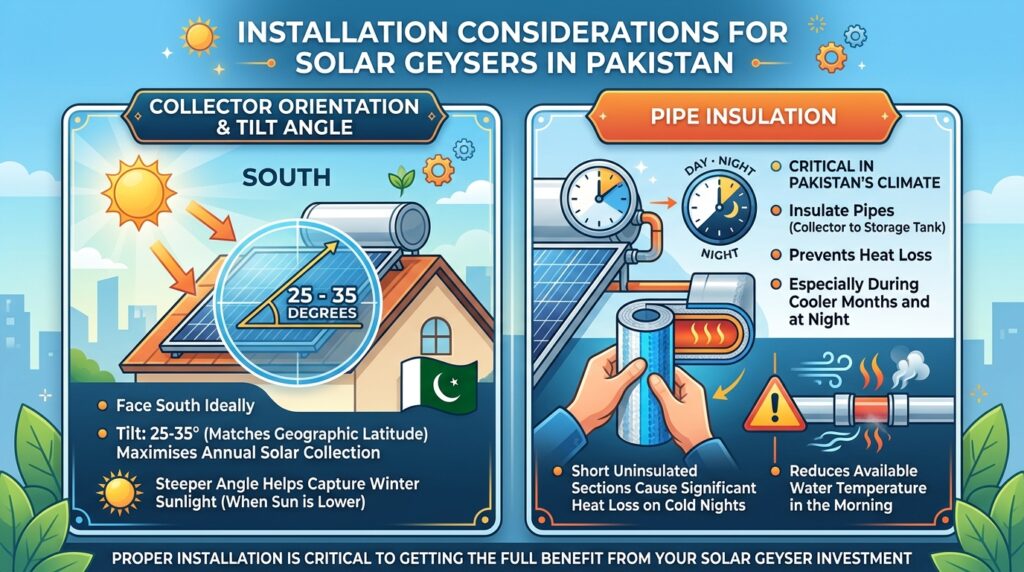
Proper installation is critical to getting the full benefit from your solar geyser investment. Several Pakistan-specific factors affect how your system should be installed.
Collector orientation and tilt angle directly affect how much solar radiation the collector captures. In Pakistan, solar collectors should ideally face south and be tilted at an angle of twenty-five to thirty-five degrees from horizontal, matching the country’s geographic latitude. This orientation maximises annual solar collection, with the slight preference toward a steeper angle helping capture winter sunlight when the sun is lower in the sky.
Pipe insulation is critical in Pakistan’s climate. The pipes connecting the solar collector to the storage tank must be well-insulated to prevent heat loss, particularly during the cooler months and at night. Even short sections of uninsulated pipe can cause significant heat loss on cold nights, reducing the water temperature available in the morning.
Tank placement affects thermal performance. The storage tank should be placed indoors or in a sheltered location to minimise overnight heat loss. Many Pakistani installations place the tank on the roof alongside the collector for simplicity, but indoor placement with well-insulated connecting pipes reduces overnight temperature drop significantly.
Integration with your existing photovoltaic solar system is also worth considering. If you already have a hybrid solar inverter and want to add electric water heating powered by solar electricity, your system may already have sufficient capacity during midday hours to run an electric geyser at no effective cost. This approach avoids the need for a separate solar collector installation while still benefiting from free solar energy for water heating.
The financial case for a solar geyser in Pakistan is compelling, particularly for households that currently rely on gas geysers or electric geysers for water heating.
For a household using a gas geyser and paying current gas tariffs in Pakistan, a solar geyser eliminates ninety to one hundred percent of water heating gas consumption during the eight months of good solar availability, May through October in particular. During winter, particularly in northern cities, the gas saving is reduced but still significant. On an annualised basis, a family of four switching from a gas geyser to a solar geyser in Lahore might save eight thousand to twenty thousand rupees per year on gas bills depending on their hot water consumption.
For a household using an electric geyser connected to the grid, the savings from switching to solar water heating are even more dramatic. A typical electric geyser of three to four kilowatts running for two to three hours daily consumes six to twelve units of electricity per day, costing three hundred and sixty to eight hundred and forty rupees at sixty to seventy rupees per unit. A solar geyser eliminates virtually all of this consumption, saving eleven thousand to twenty-five thousand rupees per month during peak usage months.
At a solar geyser price in Pakistan of sixty thousand to one hundred and twenty thousand rupees installed for a medium-capacity system, the payback period for households replacing electric geysers is as short as six to twelve months. For gas geyser replacement, payback takes longer but is still typically achieved within two to five years. After payback, the system continues delivering free hot water for fifteen to twenty-five years with minimal maintenance costs.
A well-installed solar geyser requires minimal maintenance but a few regular tasks extend its lifespan significantly in Pakistan’s conditions.
The evacuated glass tubes should be inspected visually every three to six months for cracks or breakage. Pakistan’s temperature extremes, from near zero in northern regions in winter to above forty-five degrees in summer, can stress glass tubes over time. A cracked or broken tube loses its vacuum insulation and becomes ineffective at collecting heat. Replacement tubes are available from suppliers and are straightforward to swap out.
Scale buildup from Pakistan’s typically hard water is a common maintenance issue. Dissolved minerals in the water gradually deposit on the inner walls of the storage tank and heat exchanger, reducing heat transfer efficiency. In areas with very hard water, annual descaling using an acidic solution is recommended to maintain system performance.
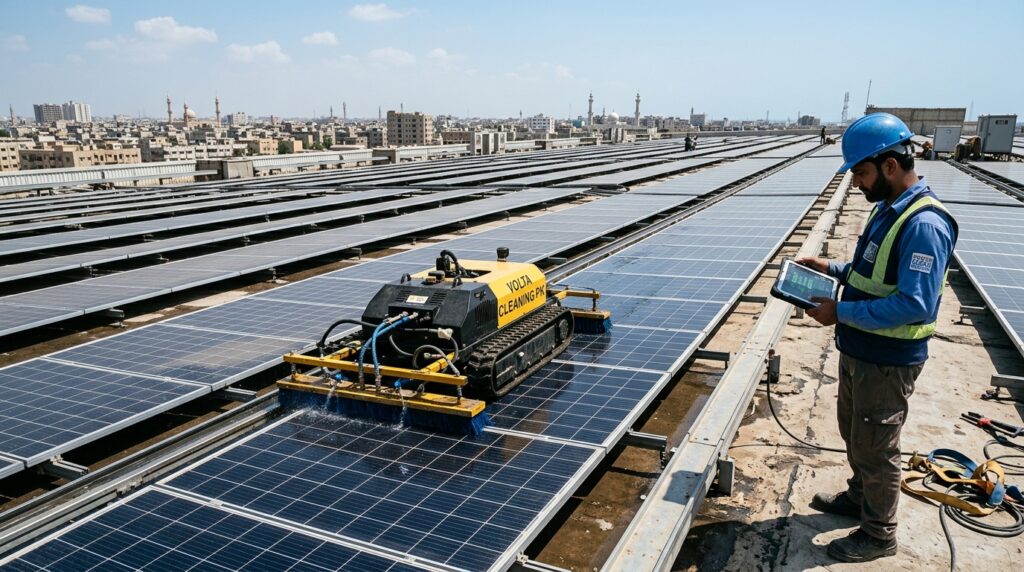
The external surfaces of the collectors should be cleaned periodically to remove dust, which accumulates quickly in Pakistan’s environment. The same principle that applies to photovoltaic solar panels, detailed in our solar plate cleaning guide at Pakistan Solar Solutions, applies to solar geyser collectors. Dust on the collector glass reduces solar radiation reaching the absorber tubes, directly reducing hot water output.
Quality solar geysers from established brands in Pakistan have an expected service life of fifteen to twenty years for the collector tubes and twenty to twenty-five years for the stainless steel storage tanks, making them an excellent long-term investment when properly maintained.
What is the average solar geyser price in Pakistan for a family of five?
For a family of five in Pakistan, a two hundred litre evacuated tube solar geyser is typically the right size. The solar geyser price in Pakistan for this capacity from a reliable supplier is between seventy-five thousand and one hundred and fifty thousand rupees installed, depending on the brand and system quality.
Does a solar geyser work in Pakistan during winter smog season?
In cities like Lahore that experience heavy smog from November to January, solar geyser performance is reduced but not eliminated. Evacuated tube collectors perform better in diffuse light conditions than flat plate collectors. During the worst smog days, water may be heated to forty-five to fifty degrees rather than sixty-plus degrees. A hybrid system with electric backup ensures hot water availability on these days.
Can I connect a solar geyser to my existing solar panel system in Pakistan?
Yes, if you have a hybrid or off-grid solar system with sufficient capacity, you can run an electric water heater from your solar electricity during peak generation hours at near-zero cost. Alternatively, a separate solar thermal collector system is completely independent of your photovoltaic system and heats water without using your solar-generated electricity at all.
How long do solar geyser tubes last in Pakistan’s climate?
Quality borosilicate glass evacuated tubes typically last ten to fifteen years in Pakistan’s climate. The extreme temperature differentials in northern Pakistan between hot summers and cold winters can stress tubes over time, but regular visual inspection and prompt replacement of any broken tubes maintains system performance throughout the collector’s lifespan.
Is a solar geyser a better investment than a solar panel system for water heating in Pakistan?
For households whose primary energy problem is hot water availability and gas shortage, a solar geyser is often the more cost-effective and faster-payback solution than adding solar photovoltaic capacity for electric water heating. However, a solar photovoltaic system provides electricity for all appliances, not just water heating, making it a more versatile investment. Pakistan Solar Solutions can help you determine which investment delivers better value for your specific situation.