

No component of a solar energy system generates more confusion and more regret among Pakistani buyers than the battery bank. People ask about the solar battery price in Pakistan, find a cheaper option, buy it without understanding the full picture, and then discover within one to two years that their cheap batteries have degraded to a fraction of their original capacity, leaving their solar system unable to power their home through the night. At the same time, some buyers spend far more than necessary on battery technology that exceeds their actual requirements.
Getting the solar battery decision right requires understanding not just the upfront solar battery price in Pakistan but the total cost of ownership over the battery’s lifespan, the technology differences between battery types, how to match battery capacity to your actual energy needs, and which brands offer genuine quality in Pakistan’s challenging climate.
At Pakistan Solar Solutions, helping Pakistani buyers understand solar battery options correctly is one of our most important responsibilities. This guide covers every dimension of the solar battery price in Pakistan landscape so you can make a decision you will not regret five years from now.
The solar battery is the only component in your solar system that has a definite and limited lifespan. Solar panels last twenty-five to thirty years. A quality inverter lasts ten to fifteen years. But batteries, depending on their chemistry and how they are used, last between one and fifteen years. This means that over the life of your solar system, you may purchase multiple battery banks, and the cumulative cost of batteries is often the largest expense in a solar system over its full operational lifetime.
This reality makes the solar battery price in Pakistan a more nuanced calculation than it first appears. A battery that costs forty thousand rupees but lasts only two years before needing replacement has a higher real cost than a battery costing one hundred thousand rupees that lasts eight years. Understanding cost per cycle rather than just sticker price is the framework that leads Pakistani buyers to the best long-term battery decision.
The battery also has the greatest influence on the day-to-day usefulness of your solar system. An undersized or degraded battery leaves you without power after just a few hours of load shedding. An appropriately sized, high-quality battery provides twelve or more hours of household power with complete reliability. No other component affects your daily solar experience as directly.
Pakistan’s solar battery market offers several distinct battery technologies, each with different characteristics, price points, and suitability for different applications.
Flooded lead-acid or wet cell batteries are the oldest battery technology still used in solar applications. They require regular maintenance in the form of distilled water top-ups and are susceptible to sulfation if not properly charged. However, they are inexpensive and widely understood. The solar battery price in Pakistan for flooded lead-acid batteries suitable for solar use, in the one hundred to two hundred ampere-hour twelve volt range, is between twelve thousand and thirty thousand rupees per battery. Their cycle life is typically one hundred and fifty to three hundred cycles at fifty percent depth of discharge, translating to less than one year of daily cycling in most Pakistani solar applications.
Tubular lead-acid batteries are an improved form of flooded lead-acid technology specifically designed for cyclic applications like solar storage. They use tubular positive plates instead of flat plates, which dramatically improves their cycle life compared to standard flooded batteries. The solar battery price in Pakistan for tubular batteries in the one hundred and fifty to two hundred ampere-hour twelve volt range is between twenty-five thousand and fifty thousand rupees per battery. Quality tubular batteries from established brands like Phoenix, Osaka, AGS, and Exide achieve five hundred to eight hundred cycles at fifty percent depth of discharge, giving them a useful life of two to three years in daily cycling applications.
AGM, or Absorbent Glass Mat batteries, are sealed lead-acid batteries that use glass mat separators to hold the electrolyte. They are maintenance-free, can be mounted in any orientation, and offer better performance in high temperatures than flooded batteries. The solar battery price in Pakistan for AGM batteries is higher than tubular at thirty thousand to sixty thousand rupees for one hundred to two hundred ampere-hour twelve volt units. Their cycle life is similar to good tubular batteries at four hundred to seven hundred cycles.
Gel batteries are similar to AGM but use a silica gel electrolyte that makes them extremely tolerant of deep discharge and high temperatures. They are popular in Pakistan’s hot climate for their durability. Gel battery prices in Pakistan range from thirty-five thousand to sixty-five thousand rupees for standard solar storage sizes. Their cycle life of five hundred to eight hundred cycles is comparable to AGM.
Lithium iron phosphate batteries are the premium option and increasingly the preferred choice for Pakistani solar systems. Their pricing, advantages, and selection criteria are covered extensively in our dedicated lithium ion solar battery guide at Pakistan Solar Solutions. At a glance, LFP batteries are priced from forty thousand rupees for small one kilowatt-hour units to two hundred thousand rupees and above for five kilowatt-hour units, but their three thousand to six thousand cycle life means their cost per cycle is the lowest of all battery types.
Knowing the actual market prices for specific brands helps you evaluate supplier quotes and avoid overpaying.
Among tubular lead-acid batteries, Phoenix is the most trusted and widely used brand in Pakistan’s solar market. Their solar-rated tubular batteries offer consistent quality and reliable cycle life. Phoenix one hundred and fifty ampere-hour twelve volt tubular batteries are priced at approximately twenty-eight thousand to thirty-five thousand rupees in Pakistan. Their two hundred ampere-hour equivalent is priced at thirty-five thousand to forty-five thousand rupees.
AGS batteries are another strongly established Pakistani brand with widespread service network. AGS offers both tubular and AGM solar batteries at competitive prices, typically slightly below Phoenix at the same capacity. Osaka batteries are also popular in Pakistan’s market, particularly in urban centres of Punjab.
Exide is an international battery brand with local manufacturing presence in Pakistan. Their solar-rated batteries offer reliable quality and a strong warranty, typically priced at a slight premium to local brands.
For lithium iron phosphate batteries, Pylontech remains the gold standard in Pakistan. Their US2000 five kilowatt-hour battery module is priced at approximately one hundred and twenty thousand to one hundred and sixty thousand rupees in Pakistan, while their Force series is available for one hundred and thirty thousand to one hundred and eighty thousand rupees. BYD lithium batteries are available in Pakistan at similar price points through authorised distributors.
For the most current solar battery prices in Pakistan across all brands and chemistries, visit Pakistan Solar Solutions where we maintain verified and updated pricing for all battery types we stock and recommend.
Choosing the right battery capacity is as important as choosing the right battery type. An undersized battery bank leaves you without power too quickly, while an oversized bank wastes money on capacity you never use.
The starting point is calculating your daily evening energy consumption. List all appliances you want to run during load shedding or after sunset, estimate their wattage, and multiply by the hours you want to run each. A typical Pakistani household running three fans at sixty watts each for eight hours, LED lighting at sixty watts for six hours, a refrigerator at eighty watts running twelve hours per day, and a television at sixty watts for four hours daily needs approximately two thousand and eight hundred watt-hours or two point eight kilowatt-hours of evening energy.
Now account for battery efficiency and usable capacity. Lead-acid batteries should only be discharged to fifty percent of their rated capacity to protect their longevity. Lithium iron phosphate batteries can safely use eighty to ninety percent of their rated capacity. To store two point eight kilowatt-hours of usable energy in a lead-acid system, you need a total battery capacity of five point six kilowatt-hours. In a lithium system with eighty-five percent usable capacity, you need only three point three kilowatt-hours total capacity.
Also account for the number of days of autonomy you want. If you want your battery bank to power your home for two days of zero solar generation, double the calculated single-day requirement. For most Pakistani urban households, one day of autonomy is sufficient since solar panels recharge the batteries fully every clear day.
Finally, match your battery bank voltage to your inverter’s input voltage. Most residential hybrid inverters in Pakistan accept forty-eight volt battery banks. A forty-eight volt battery bank is assembled from four twelve-volt batteries connected in series, or two twenty-four volt batteries in series, or from a single multi-volt lithium battery module designed for the purpose.
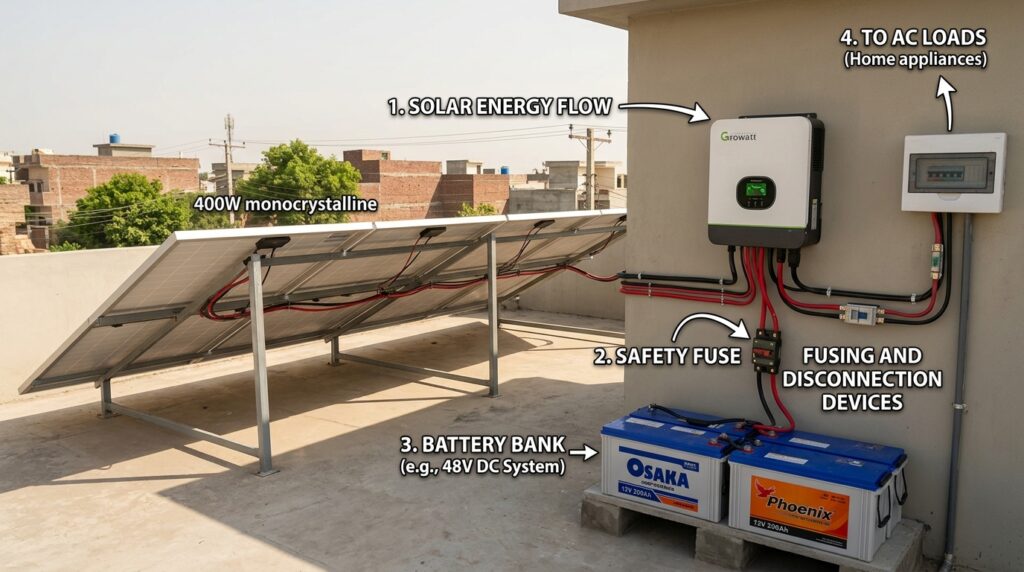
The solar battery does not operate in isolation. It is part of a complete system that includes solar panels, a charge controller or hybrid inverter, and the connected loads. Understanding how these components interact helps you make better battery decisions.
The charge controller or inverter’s built-in MPPT regulates how solar panel energy flows into the battery. For a detailed understanding of this component, see our solar charge controller price guide at Pakistan Solar Solutions. The controller must be sized to handle the total solar panel output current and must be programmed with the correct charging profile for your specific battery chemistry.
The battery must be protected by fusing and appropriate disconnection devices. A battery bank storing significant energy is a potential fire and electrical safety risk if not properly protected. Correctly sized fuses or circuit breakers between the battery and all connected equipment are non-negotiable safety requirements.
In a hybrid solar inverter system, the inverter manages both charging from panels and discharging to loads automatically. The inverter must be compatible with your chosen battery chemistry and voltage. Our hybrid solar inverter guide at Pakistan Solar Solutions provides detailed inverter-battery compatibility information to help you build a system where all components work together seamlessly.
Pakistan’s climate presents specific challenges for solar battery maintenance that Pakistani system owners should understand to protect their battery investment.
High temperatures accelerate chemical degradation in all battery types. Lead-acid batteries lose approximately half their rated cycle life for every ten degree Celsius increase above their rated operating temperature. In Pakistan where summer temperatures in battery storage rooms can reach forty-five to fifty degrees Celsius, this accelerated degradation can reduce a battery rated for five hundred cycles to only two hundred to three hundred cycles, effectively halving its service life.
Storing batteries in the coolest available location, ideally an air-conditioned room during summer, is the single most effective measure for extending lead-acid battery life in Pakistan’s climate. For lithium iron phosphate batteries, which are significantly more temperature-tolerant, the impact of Pakistan’s heat is less severe but still relevant and the same cool-storage principle applies.
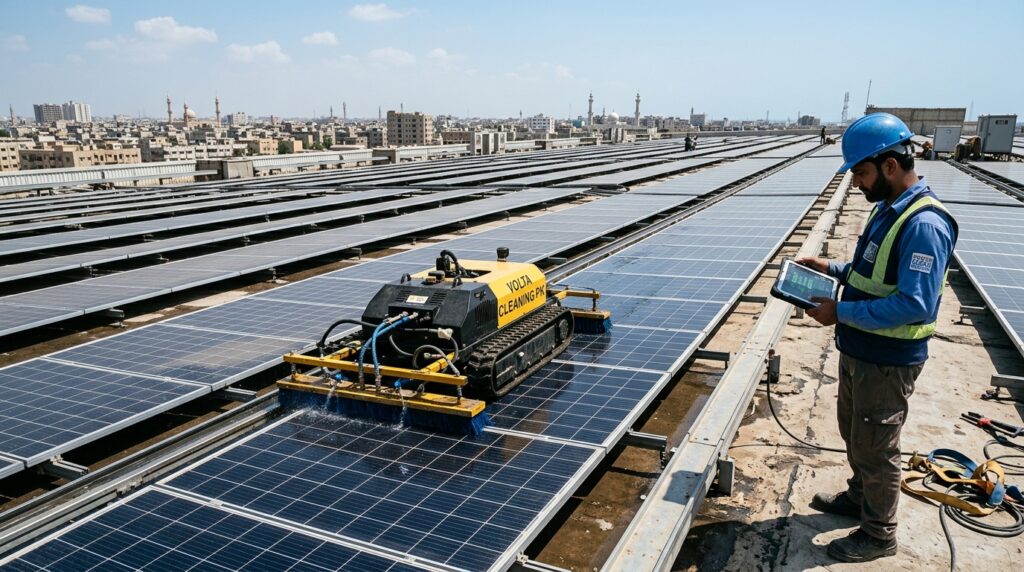
Keeping your solar panels clean ensures the battery receives a full charge every sunny day, which is important for battery health. Regularly cleaning your panels, as detailed in our solar plate cleaning guide at Pakistan Solar Solutions, prevents the partial cycling and chronic undercharging that damages lead-acid batteries over time.
For flooded and tubular batteries, checking electrolyte levels monthly and topping up with distilled water as needed is essential in Pakistan’s heat. Evaporation is rapid in high temperatures and an exposed plate due to low electrolyte level causes immediate and permanent damage to battery plates.
What is the most affordable solar battery price in Pakistan that still offers decent quality?
Phoenix or AGS tubular batteries at twenty-five thousand to thirty-five thousand rupees per unit represent the best value entry point for Pakistani solar buyers on a tight budget. For a forty-eight volt system you need four of these in series, totalling one hundred thousand to one hundred and forty thousand rupees for an eight hundred to one thousand watt-hour usable capacity bank.
How many batteries do I need to run my home through a full night in Pakistan?
For a typical Pakistani household load of two thousand to three thousand watt-hours per night, you need a battery bank of four to six kilowatt-hours usable capacity. In lithium terms, a five kilowatt-hour LFP battery covers this comfortably. In lead-acid terms, you need eight to twelve kilowatt-hours of rated capacity in tubular batteries to get the same usable energy. See our lithium battery guide at Pakistan Solar Solutions for a full comparison.
Which solar battery lasts the longest in Pakistan’s hot climate?
Lithium iron phosphate batteries last significantly longer than lead-acid alternatives in Pakistan’s climate, both in terms of cycle count and calendar years. LFP chemistry is also more tolerant of high temperatures than other lithium types. Among lead-acid options, tubular gel batteries generally outlast standard tubular flooded batteries in Pakistan’s heat.
Can I mix old and new batteries in my solar system in Pakistan?
Mixing batteries of different ages, brands, or capacities in a battery bank is strongly discouraged. In a series or parallel battery bank, the weakest battery limits the performance of the entire bank, effectively reducing your usable capacity to that of your oldest or most degraded battery. Always replace the entire battery bank simultaneously with matched batteries.
Does the solar battery price in Pakistan include installation and connection?
Most battery retailers in Pakistan quote the battery price separately from installation. Professional installation of a battery bank including proper wiring, fusing, and connection to the inverter typically costs five thousand to fifteen thousand rupees depending on the system size and complexity. Pakistan Solar Solutions offers complete installation services with all components properly specified and safely installed.