

Not every solar need in Pakistan involves a rooftop installation, a net metering application, or a six-figure investment. A large and growing number of buyers are searching specifically for a mini solar panel, something small, portable and inexpensive enough to charge a phone during a camping trip, keep a security camera running, or power a small gadget without any of the complexity of a full residential system. This segment of the market is often overlooked in typical solar buying guides, which tend to focus almost entirely on rooftop systems, yet it represents a genuinely useful and frequently searched category in its own right.
This guide covers exactly what qualifies as a mini solar panel, the different size categories available in Pakistan, realistic pricing for 2026, and how to match a mini panel to the specific small-scale task you actually have in mind.
There is no single official definition, but in the Pakistani market, the term mini solar panel is generally used to describe panels ranging from as small as 5 watts up to around 100 watts, distinguishing them from the slightly larger 150 watt panels typically used for basic home backup applications. Mini panels are usually designed with portability and low-power charging in mind rather than serving as building blocks for a full electrical system, and many models in this category are specifically built to be lightweight, foldable, or compact enough to fit in a backpack or attach easily to a vehicle, tent, or small structure.
Mini solar panels come in several common size tiers, each suited to a different category of small electronic devices and use cases.
At the smallest end of the mini solar panel category, 5 to 20 watt panels are typically used for extremely low-power applications such as trickle charging a car or motorcycle battery to prevent it from draining during periods of non-use, powering a single small LED light, or running a basic solar-powered garden or security light. These tiny panels are often built into standalone products, such as solar garden lights or small solar chargers, rather than sold purely as a standalone panel for a custom project, though standalone versions are also widely available through electronics markets and online retailers across Pakistan.
The 20 to 60 watt range represents the most versatile and commonly purchased mini panel category, striking a balance between genuine portability and enough power output to be practically useful for charging power banks, running small DC fans, or supplementing a basic solar setup for very light loads. This size range is popular among students, hobbyists and small business owners looking for an affordable entry point into solar power without committing to a larger, more permanent installation.
Panels toward the upper end of the mini category, between 60 and 100 watts, begin to overlap with the lower end of what many sellers classify as small residential backup panels, and can meaningfully power a couple of LED bulbs, charge multiple devices simultaneously, or run a small DC solar cooler for a few hours. This size is a common choice for buyers who want more capability than a purely portable charger but still want to avoid the cost and complexity of a full 150 watt or larger backup setup, covered in more detail in our guide to the 150 watt solar panel price in Pakistan.
As of 2026, mini solar panel pricing in Pakistan varies considerably by wattage, build quality and whether the panel is a rigid fixed-frame model or a foldable, portable design. Small 5 to 20 watt panels typically cost between PKR 1,500 and PKR 4,500, making them one of the most affordable entry points into solar technology available anywhere in the market. Mid-range 20 to 60 watt panels generally range from PKR 4,000 to PKR 9,000, depending on cell technology and build quality, while larger 60 to 100 watt mini panels typically cost between PKR 8,000 and PKR 14,000. Foldable and portable designs, which use more sophisticated manufacturing and durable fabric or polymer backing to allow repeated folding without damage, generally carry a premium of twenty to forty percent over an equivalent rigid panel of the same wattage.
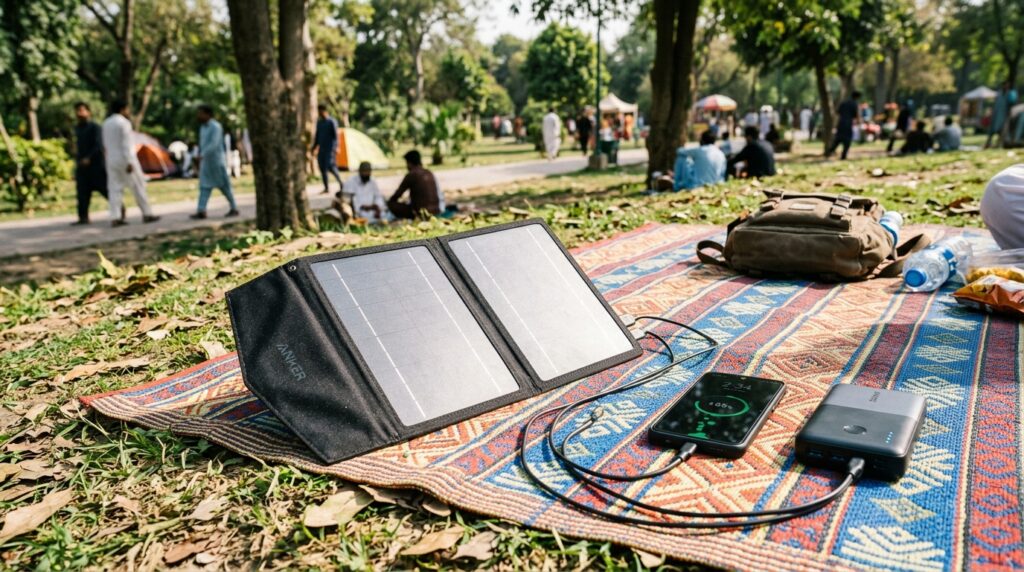
Foldable mini solar panels have become increasingly popular in Pakistan over the past few years, particularly among outdoor enthusiasts, delivery riders, and small business owners who need power on the move rather than at a fixed location. These panels typically fold into a compact case roughly the size of a large book or small laptop, unfolding into a two, three or four-panel array that can generate anywhere from 20 to 100 watts depending on the specific model. The fabric or semi-rigid backing used in foldable panels is generally more durable than buyers initially expect, designed to withstand repeated folding, moderate impact, and outdoor exposure, though these panels typically carry a shorter realistic lifespan than rigid glass panels, since the flexible backing and connection points experience more physical wear over repeated use compared to a fixed rooftop installation that is rarely touched after initial setup.
Mini solar panels serve a genuinely wide range of practical purposes across Pakistan, well beyond what many buyers initially expect from such a small piece of equipment.
For camping, hiking and outdoor travel across Pakistan’s northern areas and beyond, a foldable mini solar panel paired with a power bank or small portable battery pack allows travelers to keep phones, GPS devices, and small lights charged without needing access to grid electricity, which is frequently unavailable or unreliable in remote trekking and camping locations. A 20 to 60 watt foldable panel is generally the sweet spot for this use case, offering enough charging capacity for multiple devices while remaining light enough to carry comfortably in a backpack.
Beyond dedicated outdoor use, many buyers purchase mini solar panels specifically to charge power banks and small electronics during Pakistan’s frequent load shedding periods, allowing essential devices like phones and small lights to stay charged even during extended outages without needing a full backup system. This is a particularly popular use case among students and small business owners who need reliable device charging but do not have the budget or roof access for a larger system.
Pakistan has a growing community of hobbyists and students working on DIY electronics and renewable energy projects, and mini solar panels are a common component in these builds, ranging from simple solar-powered fans and lights to more elaborate Arduino and microcontroller-based projects that incorporate solar charging as part of a larger system. The relatively low cost and widespread availability of mini panels through electronics markets across Pakistan makes them accessible for educational and experimental purposes without a significant financial commitment.
An increasingly common application for mini solar panels in Pakistan is powering standalone security cameras, motion sensors, and small monitoring equipment installed in locations without convenient access to grid electricity, such as farm boundaries, warehouse perimeters, or remote gates. A 20 to 60 watt mini panel paired with a small battery and charge controller can keep a low-power security camera running continuously without requiring any wired electrical connection, which significantly simplifies installation in hard-to-reach locations.
The decision between a mini solar panel and a larger residential-scale panel comes down entirely to the specific task at hand rather than any general rule about which is objectively better. If your goal is reducing your household electricity bill or achieving meaningful backup power for lighting and fans during load shedding, a mini panel will almost always disappoint, since it simply does not generate enough electricity to meaningfully offset typical household consumption, a task better suited to a proper rooftop system covered in our solar panel price in Pakistan overview. However, if your actual need is genuinely small and portable, such as charging devices on a camping trip, powering a single security camera, or supporting a hobby electronics project, a mini panel is precisely the right tool, and purchasing a larger, more expensive panel for these tasks would represent unnecessary spending without any corresponding practical benefit.
Given the wide range of quality among mini solar panels sold through open markets and online retailers in Pakistan, a few practical checks help ensure you are getting a panel that actually performs close to its labeled wattage. Checking whether the panel includes a printed specification label showing voltage, current and wattage ratings is a basic first step, since panels without any labeling at all are far more likely to be significantly mislabeled or of inconsistent quality. For foldable panels specifically, examining the build quality of the folding hinges and connection points, and checking customer reviews where available, helps avoid panels that may look fine initially but fail after a handful of folding cycles. It is also worth confirming what connector type the panel uses, since compatibility with your intended charging device, power bank, or charge controller varies between models, and mismatched connectors are one of the most common frustrations reported by first-time mini panel buyers.
Setting realistic expectations before purchasing a mini solar panel prevents the common disappointment that comes from overestimating what a small panel can actually deliver. A 20 watt panel under good sunlight conditions generates roughly 80 to 100 watt-hours of usable energy across a full day, enough to fully charge a smartphone several times over or provide a meaningful boost to a power bank, but nowhere near enough to run any appliance beyond very light electronic charging. A 60 watt panel scales this up proportionally, generating roughly 240 to 300 watt-hours daily, sufficient for charging multiple devices, running a very small DC fan for a few hours, or supporting a basic security camera setup continuously. Buyers expecting a mini panel to meaningfully power household appliances, run a refrigerator, or replace even a small portion of their grid electricity consumption will find these panels fundamentally unsuited to that purpose, since they are designed and priced specifically for genuinely small, portable and low-power applications rather than as an entry point into whole-home solar.
Some buyers choose to combine two or three mini panels together to create a slightly larger charging setup without committing to a single larger panel purchase, particularly useful for camping groups or small business setups needing somewhat more capacity than a single mini panel provides. When combining panels this way, it is important to ensure the panels share matching voltage and current specifications, since connecting mismatched panels in series or parallel without a properly rated charge controller can lead to inefficient charging or, in some cases, damage to the panels or connected battery. For buyers considering this route who anticipate needing more than roughly 100 to 150 watts of combined capacity, it is often more cost-effective and electrically simpler to purchase a single larger panel in the 150 watt category rather than combining several smaller mini panels together, a comparison covered in greater detail in our guide to 150 watt solar panel options.
Most mini solar panel setups benefit from pairing with a small charge controller and battery, even for simple device charging applications, since direct connection without any regulation can occasionally lead to inconsistent charging performance or minor damage to sensitive electronics over repeated use. For panels above roughly 20 watts, a small PWM charge controller rated appropriately for the panel’s voltage and current output, combined with a small sealed lead-acid or lithium battery, creates a more stable and genuinely useful standalone power system, allowing charged energy to be stored and used later in the evening rather than only being available while the sun is actively shining. Many commercially available mini solar kits in Pakistan now include a small integrated controller and battery pack bundled with the panel itself, which is often a more convenient and reliably compatible option for buyers who do not want to source and match these components individually.
An emerging use case across Pakistan involves mounting small mini solar panels onto motorbikes, rickshaws, and delivery vehicles to trickle charge a small battery used for lighting, phone charging, or powering a small speaker while on the move. Riders and small transport operators, particularly those working long hours delivering food or goods across cities like Lahore and Karachi, have started adopting compact 10 to 30 watt panels mounted on cargo boxes or vehicle roofs specifically for this purpose. While this application remains a fairly small niche compared to the broader mini panel market, it illustrates just how flexible and adaptable this category of solar equipment has become as buyers find creative, genuinely useful applications well beyond the more obvious camping and device-charging use cases.
Unlike full-size Tier-1 residential panels, which typically carry a 25-year linear performance warranty, mini solar panels sold in Pakistan generally come with much shorter warranty periods, often ranging from six months to two years depending on the manufacturer and seller. This shorter warranty window reflects both the lower price point of these products and the more varied manufacturing quality found in this segment of the market. Buyers should treat a mini solar panel as a lower-cost, shorter-lifespan product category rather than expecting the same multi-decade durability associated with a properly installed rooftop system, and should factor potential replacement cost into their overall budgeting if the panel will see frequent, heavy use such as regular camping trips or continuous outdoor exposure as part of a permanent small installation like a security camera power source.
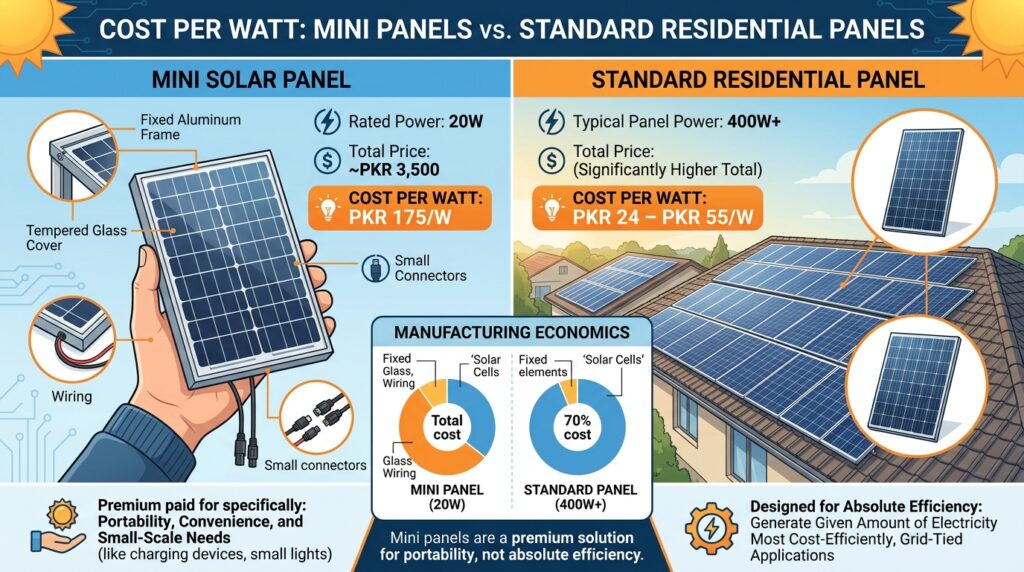
One important consideration buyers often overlook is that mini solar panels almost always carry a significantly higher cost per watt than standard residential-scale panels, despite their much lower total price tag. A 20 watt mini panel priced around PKR 3,500 works out to roughly PKR 175 per watt, dramatically higher than the PKR 24 to PKR 55 per watt typical of full-size residential panels covered in our guide to the best solar panels in Pakistan. This is not a flaw or a sign of poor value, but simply a reflection of how manufacturing economics work at small scale, where the fixed costs of frame, glass, wiring, and connectors represent a much larger proportion of the total cost on a small panel compared to a large one. Buyers should understand this pricing reality clearly before purchasing, since it means mini panels are never the most cost-efficient way to generate a given amount of electricity in absolute terms, but rather a premium paid specifically for portability, convenience, and the ability to serve a genuinely small-scale need that a larger panel could not practically address in the same way.
Several misunderstandings frequently come up among first-time mini solar panel buyers in Pakistan, and addressing them helps set accurate expectations. One common myth is that stacking enough small mini panels together eventually becomes a cost-effective way to build a full home backup system, when in reality, as covered earlier, the cost per watt for mini panels is substantially higher than standard residential panels, making this approach considerably more expensive than simply purchasing appropriately sized larger panels for a genuine home backup need. Another frequent misconception is that a panel’s rated wattage represents what it will reliably produce throughout an entire day, when in fact, like all solar panels, mini panels only approach their rated output during a few peak sunlight hours around midday, with meaningfully lower output during morning, evening, and any period of cloud cover or partial shading. A third myth involves foldable panels specifically, with some buyers assuming that because a panel folds compactly, it must be significantly less durable or capable than a rigid panel of the same wattage, when in practice, quality foldable panels from established manufacturers deliver comparable electrical performance to rigid alternatives, differing mainly in physical durability expectations over very long-term, heavy daily use rather than in raw power output.
Mini solar panels are widely available through electronics markets in every major Pakistani city, online marketplaces, and increasingly through dedicated solar equipment retailers who have expanded their product range to include this smaller category alongside full residential systems. For buyers purchasing a single mini panel for a straightforward application like device charging or a small hobby project, a reputable electronics market vendor or online retailer with clear product specifications and customer reviews is generally sufficient. For buyers integrating mini panels into a slightly more involved setup, such as a permanent security camera installation or a small business charging station, working with an established solar company that can advise on proper charge controller and battery pairing offers more reliable long-term results. Pakistan Solar Solutions can advise on mini panel selection and proper system pairing as part of a broader consultation, and our contact page is the fastest way to reach our team with specific questions about your intended application.
Just as with full-size residential panels, mini solar panels are available in both monocrystalline and polycrystalline cell technology, and the choice between them matters somewhat differently at this smaller scale. Monocrystalline mini panels generally deliver ten to fifteen percent better efficiency than polycrystalline equivalents of the same physical size, which translates into a meaningfully more compact panel for a given wattage, an important consideration for genuinely space-constrained applications like a small backpack-mounted charger. Polycrystalline mini panels, while slightly less efficient and correspondingly larger for the same wattage, are generally more affordable, making them a reasonable choice for buyers whose primary constraint is budget rather than physical size or weight, such as a stationary application like a garden light or a fixed security camera installation where the panel does not need to be carried or transported regularly.
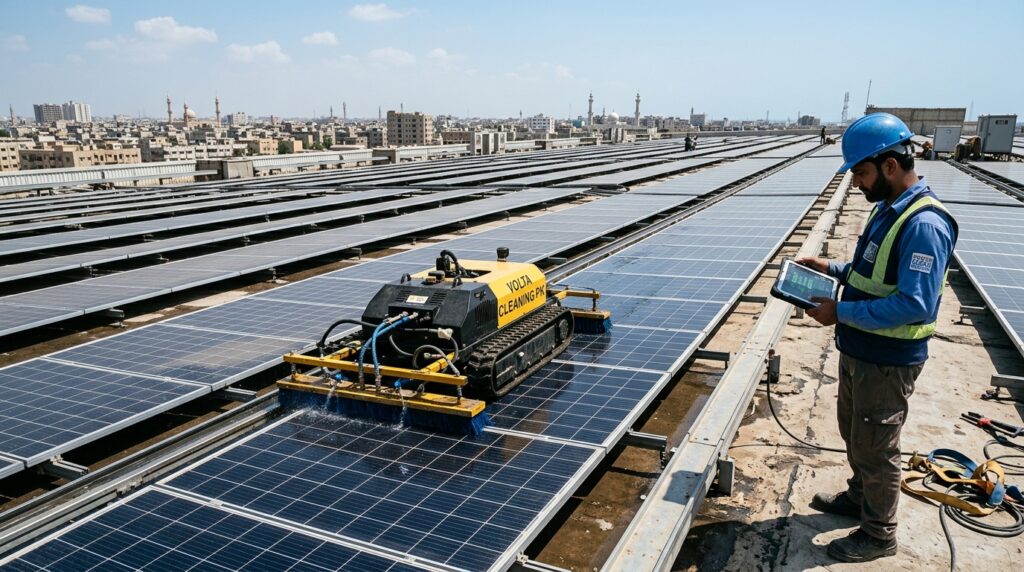
Mini solar panels used outdoors in Pakistan face many of the same environmental challenges as full-size rooftop panels, including dust accumulation, intense summer heat, and monsoon rainfall, though their smaller size and often more exposed mounting locations can make these factors more noticeable in day-to-day performance. A mini panel mounted permanently outdoors, such as one powering a security camera or garden light, will experience a similar dust-related efficiency loss to a full-size panel during Pakistan’s dry season, and periodic wiping down with a soft cloth or the same gentle technique covered in our guide to the solar panel cleaning brush helps maintain consistent output. Heat exposure during summer months can also affect mini panels, particularly foldable models with polymer or fabric backing, which may experience slightly accelerated material aging when left in direct, prolonged summer sun compared to glass-and-aluminum rigid panels. During monsoon season, most mini panels sold in Pakistan carry at least a basic level of water resistance suitable for rain exposure, though buyers should check the specific IP rating of any panel intended for permanent outdoor use, since not all budget mini panels are rated for full weather exposure, and some foldable models are specifically designed for occasional outdoor use rather than continuous exposure to the elements.
Before finalizing a mini solar panel purchase in Pakistan, it helps to walk through a short mental checklist to ensure the panel actually matches your intended use case. First, clearly define the specific devices or loads you intend to power, and calculate their approximate daily energy requirement in watt-hours, since this determines the minimum panel wattage genuinely needed rather than simply buying based on price or panel size alone. Second, consider whether portability matters for your use case, since a rigid panel is generally more durable and often cheaper per watt for stationary applications, while a foldable panel makes more sense for anything involving regular transport or travel. Third, verify the connector type and confirm compatibility with whatever device, power bank, or charge controller you intend to pair the panel with, since connector mismatches are one of the most common sources of buyer frustration in this category. Finally, check whether the panel includes any warranty or return policy, however short, since even a basic six-month warranty provides some protection against manufacturing defects that might not be immediately apparent at the time of purchase.
Many retailers in Pakistan now sell complete mini solar kits that bundle a panel, small charge controller, battery, and sometimes a USB charging module or basic LED light together as a single package, marketed toward buyers who want a ready-to-use solution without sourcing and matching individual components themselves. These kits generally cost somewhat more than buying an equivalent panel alone, but the premium often reflects genuine convenience and guaranteed component compatibility, which can be particularly valuable for buyers without technical experience matching voltage and current specifications across separately purchased parts. For buyers who already understand basic solar system components or who want to reuse an existing battery or controller from a previous project, purchasing a standalone panel and sourcing other components separately is usually the more cost-effective route, though it does require more research and care to ensure everything works together correctly. Pakistan Solar Solutions can advise on whether a complete kit or a component-based approach makes more sense for your specific application, particularly for slightly more involved use cases like permanent outdoor security camera installations where long-term reliability matters more than upfront cost savings.
Mini solar panels in Pakistan range from approximately PKR 1,500 for small 5 to 20 watt panels up to PKR 14,000 for larger 60 to 100 watt models, with foldable portable designs typically costing twenty to forty percent more than equivalent rigid panels of the same wattage.
Most standard laptops require significantly more power than a typical mini solar panel can reliably deliver, particularly under real-world, non-peak sunlight conditions. While some specialized higher-wattage foldable panels in the 60 to 100 watt range with the right connector can charge certain laptops, this is not a reliable primary charging method and should be treated as a supplementary option at best.
Quality foldable panels from established brands are generally durable enough for regular outdoor and camping use, designed to withstand repeated folding and moderate weather exposure. However, they typically have a shorter realistic lifespan than rigid glass panels used in permanent rooftop installations, since the flexible material and folding mechanism experience more physical wear over time.
A 10 to 20 watt mini solar panel under good sunlight conditions can typically charge a smartphone from empty to full in roughly one and a half to three hours, depending on the phone’s battery capacity and the exact panel output at the time of charging.
A mini panel in the 60 to 100 watt range, paired with a small battery, can run a low-power DC fan for a limited period, but is not a substitute for a proper backup system if consistent fan operation through extended load shedding is your primary goal. For that purpose, a 150 watt panel setup, covered in our dedicated guide, generally offers more practical and reliable performance.
Mini solar panels typically carry much shorter warranties than full-size residential panels, usually ranging from six months to two years depending on the manufacturer and seller, reflecting both their lower price point and generally shorter expected lifespan under regular use.