

Choosing the best solar panels in Pakistan is no longer a simple decision. A decade ago, buyers had two or three panel types to pick from and the biggest question was how many watts they needed. Today, the Pakistani market is flooded with brands from China, imported N-Type technology, bifacial designs, and dozens of local assemblers offering panels at wildly different price points. For a homeowner in Lahore, a factory owner in Sialkot, or a farmer running a tube well in interior Sindh, picking the wrong panel can mean years of lower output, early degradation, or a warranty claim that never gets honored.
This guide breaks down exactly what makes a solar panel worth buying in Pakistan’s climate, which brands are genuinely reliable in 2026, and how to match a panel to your specific rooftop, budget and energy goals. Pakistan Solar Solutions has been designing and installing solar systems since 2017, and the recommendations below reflect what actually performs well after three or four summers of 45-degree heat, not just what looks good on a spec sheet.
Not every panel that performs well in Europe or the Gulf performs equally well here. Pakistan’s climate is uniquely demanding: extreme summer heat across Punjab and Sindh, heavy dust accumulation in dry months, and voltage fluctuations from an aging grid that stress inverters and panels alike. The best solar panels in Pakistan are the ones engineered specifically to handle these conditions without a meaningful drop in output.
Panel efficiency tells you how much sunlight a panel converts into usable electricity per square meter. In Pakistan, where roof space is often limited, especially on smaller residential plots, a higher efficiency panel lets you generate more power without needing extra roof area. Most Tier-1 panels sold in Pakistan today fall between 21 percent and 22.5 percent efficiency, with newer N-Type cells consistently outperforming older P-Type and polycrystalline designs.
Every solar panel loses some output as temperatures rise, a property known as the temperature coefficient. In cities like Multan, Bahawalpur and interior Sindh, where surface temperatures on a rooftop can exceed 60 degrees Celsius in June, this coefficient matters enormously. Panels with a lower temperature coefficient, typically the newer N-Type TOPCon and bifacial models, retain more of their rated output during Pakistan’s peak summer months, which is exactly when electricity demand and grid tariffs are highest.
The Pakistani solar market is dominated by a handful of Tier-1 Chinese manufacturers whose panels have a proven track record locally. Below are the brands that consistently deliver on their warranty promises and hold up under real-world Pakistani conditions.
Longi is one of the most recognized solar panel names in Pakistan, and the Hi-Mo X10 series represents their latest N-Type monocrystalline technology. These panels typically range between 585 and 615 watts, deliver efficiency above 22 percent, and come with a 25-year linear performance warranty. Longi panels are a favorite among installers because of consistent quality control and strong resale value if a system is ever upgraded.
Jinko’s Tiger Neo series uses N-Type bifacial cells, meaning the panel can capture reflected sunlight from both the front and rear surface. This makes it particularly effective on elevated mounting structures common in commercial and industrial installations across Pakistan. Efficiency sits around 22.5 percent, among the highest available in the local market today.
JA Solar’s N-Type TopCon panels have become popular for mid-size residential and commercial projects because they offer a strong balance between price and performance. With efficiency above 21.5 percent and the same 25-year linear warranty structure as premium brands, JA Solar panels are frequently specified for net metering projects where budget discipline matters.
Canadian Solar’s HiKu7 series, built on Mono PERC technology, remains a dependable option for buyers who want an established global brand with a long operating history. While slightly behind N-Type panels on raw efficiency, these panels have an excellent field reliability record in Pakistan’s dusty, high-heat environments.
Trina’s Vertex N series rounds out the list of Tier-1 options commonly installed in Pakistan. These N-Type panels are well suited to larger commercial and industrial rooftops where consistent output over 25 years is the priority.
This is one of the most common questions buyers ask when researching the best solar panels in Pakistan. P-Type panels, which include the older polycrystalline and Mono PERC designs, were the industry standard for over a decade and remain widely available at a lower upfront cost. N-Type panels, using TOPCon or bifacial cell architecture, represent the current generation of solar technology and have become the standard choice for new installations in Pakistan as of 2026.
The core advantage of N-Type technology in Pakistan’s context is heat tolerance. Because P-Type cells degrade faster under high temperatures, a P-Type panel installed on a Karachi or Multan rooftop can lose more of its rated output during the hottest months of the year compared to an N-Type panel of the same wattage. Over a 25-year system lifespan, this difference compounds into a meaningful gap in total electricity generated, which is why most installers, including Pakistan Solar Solutions, now recommend N-Type panels for the majority of residential and commercial projects.
Selecting a panel is not just about picking the highest wattage or the most well-known brand. It requires matching the panel specification to your actual electricity consumption, roof characteristics and budget.
Before choosing a panel, you need a clear picture of your monthly electricity consumption in units, which your WAPDA or K-Electric bill will show. A typical 5 kW residential system in Pakistan uses eight to nine panels rated between 580 and 615 watts, and this configuration comfortably covers the needs of a medium-sized home running fans, refrigeration, lighting and occasional air conditioning. Larger homes or those running multiple air conditioners will need to scale up toward a 7 kW or 10 kW system, which our team can size precisely through a free energy audit detailed on our residential solar solutions page.
Higher wattage panels generally have a lower cost per watt but occupy more physical space per unit. If your rooftop is limited, as is common in Karachi’s older neighborhoods or in narrow urban plots across Lahore, choosing fewer high-wattage panels such as 600W-plus models can maximize output within your available area, compared to using more panels at a lower wattage.
Every Tier-1 brand sold in Pakistan today offers a 25-year linear performance warranty, guaranteeing that the panel will still produce at least 80 to 87 percent of its original rated output after two and a half decades. However, the warranty is only as good as the installer standing behind it. Buying through an unauthorized or unregistered dealer means that if a panel underperforms or fails, there may be no local support to process the claim with the manufacturer. This is why sourcing panels through an established, PEC-certified EPC company matters as much as the brand itself.
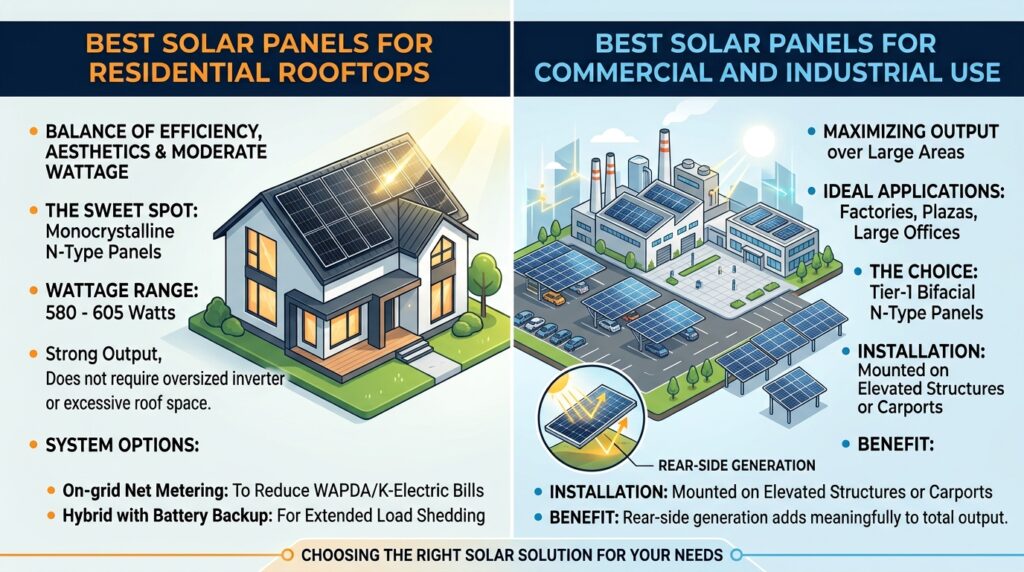
The definition of the “best” solar panel changes depending on where and how it will be used. A panel ideal for a rooftop home system is not necessarily the right choice for a factory or an agricultural tube well.
For homes, a balance of efficiency, aesthetics and moderate wattage works best. Monocrystalline N-Type panels between 580 and 605 watts are the sweet spot for most Pakistani households, offering strong output without requiring an oversized inverter or excessive roof space. These panels pair well with an on-grid net metering system for homeowners who simply want to reduce their WAPDA or K-Electric bill, or with a hybrid system with battery backup for those dealing with extended load shedding.
Factories, plazas and large offices benefit most from bifacial N-Type panels mounted on elevated structures, since the rear-side generation capability adds meaningfully to total output when panels are installed on ground-mount or carport-style structures. Our commercial and industrial solar solutions are built around Tier-1 bifacial panels precisely for this reason.
Farms, tube wells and remote installations without a grid connection need durable, weather-resistant panels that can withstand dust, occasional flooding and minimal maintenance access. Standard Tier-1 monocrystalline panels remain the right choice here, paired with a properly sized battery bank through our off-grid solar systems service.
Pricing is naturally one of the biggest factors buyers weigh when researching the best solar panels in Pakistan. As of 2026, panel prices range between PKR 24 and PKR 55 per watt, depending on brand, wattage and cell technology. Older P-Type and Mono PERC panels sit at the lower end of this range, while premium N-Type bifacial panels from Longi and Jinko command a slight premium due to their higher efficiency and longer real-world lifespan. A complete, professionally installed on-grid system typically costs between PKR 350,000 and PKR 1.7 million depending on system size, and you can find a full breakdown of current market rates on our solar panel price in Pakistan page, updated regularly to reflect USD to PKR exchange movements.
Pricing also varies slightly by city depending on local dealer competition and logistics. If you are based in southern Punjab, our detailed solar panel price in Multan guide breaks down current per-watt rates and complete system costs specific to that region.
It is worth noting that panel prices alone do not tell the whole story. A complete system quote should also include the inverter, mounting structure, cabling, earthing and installation labor, all of which affect the final cost per watt of your finished system.
It is tempting to chase the lowest per-watt price when comparing options, but this is one of the most common and costly mistakes buyers make. Cheaper, uncertified panels often come from Tier-2 or Tier-3 manufacturers whose quality control is inconsistent, meaning individual panels within the same batch can vary significantly in actual output despite carrying identical wattage labels. Over a 25-year investment horizon, a slightly more expensive Tier-1 panel that reliably hits its rated output will almost always outperform a cheaper panel financially, simply because it generates more electricity, degrades more slowly, and is far less likely to fail within its warranty period.
One frequent mistake is buying panels and inverters separately from unrelated vendors without verifying compatibility, which can lead to inefficient energy conversion or even equipment damage. Another is skipping a proper site survey and simply guessing at system size, resulting in either an undersized system that fails to meaningfully reduce electricity bills, or an oversized one that wastes money on unused capacity. Buyers should also be cautious of dealers offering panels significantly below market rate, since this often signals counterfeit or downgraded stock being sold under a genuine brand name.
Pakistan Solar Solutions has been supplying and installing Tier-1 solar systems across Karachi, Sukkur and Rawalpindi since 2017, long before the recent solar boom made this a crowded market. Every panel we install comes from globally certified manufacturers including Longi, Jinko Tiger Neo, JA Solar, Canadian Solar and Trina, backed by genuine manufacturer warranty documentation. Our PEC-certified engineering team conducts a free site survey and energy audit before recommending a system, ensuring you get the right panel technology and system size for your actual consumption pattern rather than a generic, one-size-fits-all package. You can review our complete range of services, from residential rooftops to industrial EPC contracts, or reach out directly through our contact page for a free custom quote.
Longi and Jinko Tiger Neo are widely regarded as the top-performing brands available in Pakistan today, thanks to their N-Type technology, efficiency above 22 percent, and consistent 25-year linear warranties. JA Solar and Trina Vertex N are strong alternatives that offer excellent value for mid-budget projects.
Yes, in most cases. N-Type panels have a lower temperature coefficient, meaning they retain more output during Pakistan’s extreme summer heat compared to older P-Type panels. Over a 25-year system life, this translates into meaningfully higher total electricity generation, which usually justifies the modest price difference.
This depends entirely on your monthly electricity consumption. As a general guide, a 5 kW system using eight to nine panels rated around 600 watts each suits a medium-sized home. Our team offers a free energy audit to calculate the exact number of panels your household needs based on your actual WAPDA or K-Electric bill.
Tier-1 solar panels sold in Pakistan typically carry a 25-year linear performance warranty, guaranteeing at least 80 to 87 percent of original output by year 25. In practice, well-maintained panels from reputable brands often continue producing usable electricity beyond this warranty period.
All solar panels lose some efficiency as temperature rises, but the extent varies by panel technology. Modern N-Type panels are specifically engineered to minimize this loss, making them the preferred choice for installations in high-heat regions like Multan, Karachi and interior Sindh, where summer rooftop temperatures regularly exceed 55 to 60 degrees Celsius.