
Karachi residents are paying some of the highest electricity tariffs in Pakistan’s history. In 2026, K-Electric rates have crossed PKR 60 to 65 per unit, and load shedding continues to drain household and business budgets every single month. The good news is that solar panels price in Karachi has dropped significantly over the last three years, making solar energy the most financially intelligent decision you can make right now. This guide covers everything you need to know about solar panel prices in Karachi in 2026, including system sizes, brands, installation costs, and how to calculate your return on investment before you spend a single rupee.
Over the past decade, the global cost of solar photovoltaic technology has fallen by more than 80 percent. Pakistan benefits directly from this trend because most solar panels are imported from Chinese Tier-1 manufacturers like Longi, Jinko Solar, and JA Solar, all of which have dramatically reduced production costs. In Karachi specifically, a combination of high sunlight hours averaging 5.5 to 6.5 peak sun hours per day and falling equipment prices has made solar power one of the best investments available in the city today. At pakistansolar.solutions, we have been tracking the market since 2017 and can confirm that 2026 represents one of the most competitive pricing environments Pakistani consumers have ever seen for quality solar equipment.
Solar panels price in Karachi varies depending on the system size, panel brand, inverter type, and whether you want battery backup. Below is a transparent overview of current market rates for complete turnkey systems, meaning panels, inverter, mounting structure, cabling, earthing, and installation labor are all included in the quoted price.
A 3kW on-grid solar system is suitable for a small home or apartment consuming between 300 and 400 units per month. In Karachi in 2026, a complete 3kW system costs between PKR 350,000 and PKR 500,000. This system can reduce your monthly K-Electric bill by PKR 6,000 to PKR 10,000 and achieves full payback in approximately 3 to 4 years.
The 5kW system is the most popular choice among Karachi homeowners. It suits medium-sized homes with monthly consumption between 500 and 700 units. A complete 5kW on-grid installation costs PKR 650,000 to PKR 850,000 in 2026. Monthly savings range from PKR 10,000 to PKR 18,000, with payback achieved in 2.5 to 3.5 years. If you want battery backup for load shedding, a 5kW hybrid system costs PKR 850,000 to PKR 1,100,000. You can read more about this size in our detailed guide on 5kW solar system price in Pakistan.
Larger homes, small offices, and shops consuming 800 to 1,200 units monthly benefit most from a 10kW system. In 2026, a 10kW on-grid system in Karachi is priced at PKR 950,000 to PKR 1,200,000. Monthly savings reach PKR 18,000 to PKR 28,000, with full ROI in 2.5 to 3.5 years.
Not all solar panels are equal. At Pakistan Solar Solutions, we install only A-Grade Tier-1 panels from globally certified manufacturers. Longi Hi-Mo X10 panels use N-Type monocrystalline technology delivering over 22 percent efficiency. Jinko Tiger Neo panels feature N-Type bifacial technology at 22.5 percent efficiency. JA Solar N-Type panels reach 21.5 percent efficiency using TopCon technology. Canadian Solar HiKu7 panels offer mono PERC technology at over 21 percent efficiency, and Trina Vertex N panels also deliver over 21 percent efficiency with N-Type cells. All brands carry 25-year linear performance warranties and perform strongly in Pakistan’s extreme heat conditions.
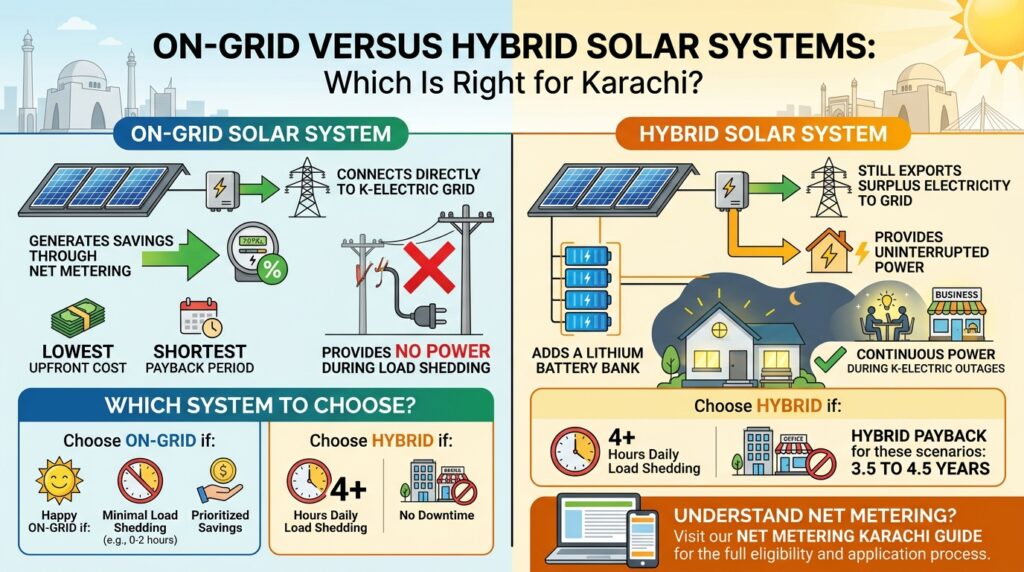
An on-grid solar system connects directly to the K-Electric grid and generates savings through net metering. It has the lowest upfront cost and shortest payback period but provides no power during load shedding. A hybrid solar system adds a lithium battery bank, providing uninterrupted power during K-Electric outages while still exporting surplus electricity to the grid. If your area experiences 4 or more hours of daily load shedding, or if you run a business that cannot afford downtime, the hybrid system pays for its premium cost within 3.5 to 4.5 years. To understand how net metering works with either system type, visit our net metering Karachi guide for the full eligibility and application process.
Net metering is a NEPRA-approved billing mechanism that allows K-Electric customers in Karachi to export surplus solar electricity to the grid and receive credits on their monthly bill. With K-Electric tariffs above PKR 60 per unit and net metering export credits at PKR 19 to 21 per unit, a properly sized system can bring your monthly bill close to zero. To qualify, your property must have a 3-phase connection and your inverter must be on NEPRA’s approved list. Pakistan Solar Solutions handles the entire net metering application process, including K-Electric filing, load-flow diagrams, and green meter coordination, so your application is approved on the first submission without delays.
Solar panels price in Karachi varies based on your actual energy consumption, roof size, shading conditions, and K-Electric connection type. The most reliable way to get an accurate price is through a free on-site energy audit. Pakistan Solar Solutions offers free site surveys across all areas of Karachi. Our engineers visit your property, assess your electrical load, measure your roof dimensions, evaluate shading from surrounding buildings, and prepare a detailed quotation with monthly savings projections and a full ROI timeline. Call 0333-103-1086 or visit pakistansolar.solutions to schedule your free survey today.
Roof type is one of the biggest variables affecting solar installation cost. RCC concrete roofs are the easiest to work with, while metal sheets or unusual structures may require additional mounting hardware. Panel brand selection also plays a significant role, with premium N-Type bifacial panels costing more than standard PERC panels but delivering better long-term performance. Inverter type is another major factor, with hybrid inverters carrying a higher price than basic on-grid models. Battery chemistry matters too, with LiFePO4 lithium batteries offering a 10-year lifespan compared to 3 to 5 years for lead-acid alternatives. Finally, location within Karachi affects labor and logistics costs depending on site accessibility and cable routing requirements.
For a medium-sized home consuming 500 to 700 units per month, the average cost of a complete 5kW on-grid solar installation in Karachi in 2026 is PKR 650,000 to PKR 850,000. This includes Tier-1 panels, inverter, mounting structure, cabling, and installation labor. A hybrid system with battery backup for the same home costs PKR 850,000 to PKR 1,100,000.
A properly sized solar system can reduce your K-Electric bill by 40 to 90 percent depending on consumption and system size. A 5kW system in Karachi typically saves PKR 10,000 to PKR 18,000 per month. Over a 25-year panel lifespan, total savings of PKR 8 to 12 million per 10kW system are achievable at current K-Electric tariff rates.
Solar panel prices have been on a gradual downward trend globally, but currency fluctuations and import duties in Pakistan can cause short-term price movements. Prices in 2026 are currently stable. Waiting for further price drops is generally not financially rational because every month without solar is a month of full K-Electric bills.
Yes, solar panels continue to generate electricity on overcast and cloudy days, just at reduced capacity. During Karachi’s brief monsoon period in July and August, generation drops by 20 to 40 percent on heavy cloud cover days. However, this is more than offset by the very high generation during the long sunny days of March through June and September through November.
All Tier-1 panels carry a 25-year linear power output warranty from the manufacturer, guaranteeing at least 80 to 84 percent of original output at the end of the warranty period. Inverters carry warranties of 5 to 10 years depending on brand. Our installation workmanship warranty covers all electrical and structural work completed by our team.