
If you have been researching solar energy systems in Pakistan, you have almost certainly encountered the question of battery storage. Whether you are dealing with daily load shedding, want to use solar electricity after sunset, or simply want complete energy independence, the battery bank is the component that transforms your solar system from a daytime-only power source into a round-the-clock energy solution. And in 2025, the lithium ion solar battery has emerged as the clear superior choice over older lead-acid and gel battery technologies for virtually all Pakistani solar applications.
The lithium ion solar battery offers longer lifespan, higher usable capacity, faster charging, and better performance in Pakistan’s extreme temperatures compared to every alternative. While the upfront cost of a lithium ion solar battery is higher, the long-term cost per kilowatt-hour of stored electricity is significantly lower, making it the more economical choice over any five to ten year horizon.
At Pakistan Solar Solutions, we have seen lithium ion solar battery installations grow from a small fraction of our business to the dominant battery technology choice among our customers over the last three years. This guide covers everything Pakistani consumers need to know about lithium ion solar batteries: the technology, the chemistry options, pricing, brands, compatibility with popular inverters, and how to choose the right battery for your system.
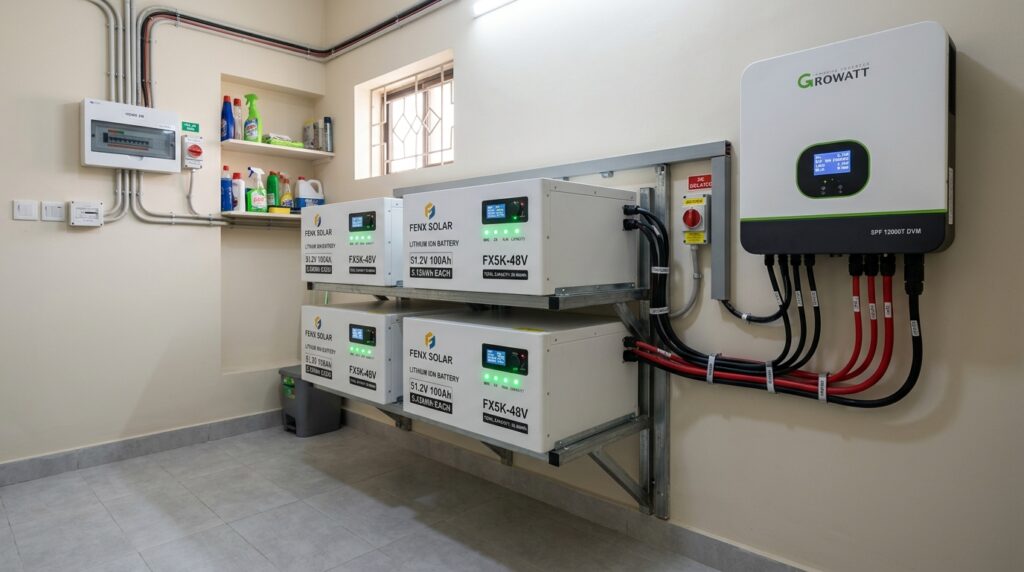
Not all lithium ion solar batteries use the same chemistry, and the chemistry differences directly affect safety, lifespan, performance in high temperatures, and price. Pakistani solar buyers should understand these differences before making a purchase decision.
Lithium iron phosphate, commonly abbreviated as LFP or LiFePO4, is by far the most popular lithium ion solar battery chemistry for residential and commercial solar storage in Pakistan. LFP batteries offer exceptional thermal stability, meaning they do not overheat or catch fire as easily as other lithium chemistries, even in Pakistan’s extreme summer temperatures. They also offer the longest cycle life of any common lithium chemistry, typically rated at three thousand to six thousand charge-discharge cycles. This translates to eight to fifteen years of daily cycling under normal conditions. LFP batteries sacrifice some energy density compared to other lithium chemistries, making them slightly heavier and larger for the same storage capacity, but for stationary solar applications this is not a significant drawback.
Lithium nickel manganese cobalt oxide, or NMC, batteries offer higher energy density than LFP, meaning more storage capacity in a smaller, lighter package. However, NMC cells are more temperature-sensitive and have a higher risk of thermal runaway at elevated temperatures. For Pakistan’s hot climate, NMC batteries require more careful thermal management and are generally not recommended for rooftop or outdoor installations where temperatures can be extreme.
For solar storage in Pakistan, LFP is the recommended chemistry for most applications. When we refer to a lithium ion solar battery in the context of Pakistani solar systems, we are almost always referring to LFP chemistry.
The lithium ion solar battery price in Pakistan depends on capacity, brand, chemistry, and whether the battery includes a built-in battery management system. Understanding price benchmarks helps you evaluate quotes and avoid overpaying.
Small lithium ion solar batteries of one to two kilowatt-hours are priced between forty thousand and eighty thousand rupees in Pakistan. These are suitable for very small solar systems of one to three kilowatts where modest battery backup is needed for a few hours of essential loads like fans and lights during evening load shedding.
Medium lithium ion solar batteries of five kilowatt-hours, the most popular capacity for residential Pakistani solar systems, are priced between one hundred thousand and one hundred and eighty thousand rupees. A five kilowatt-hour LFP battery can power a typical Pakistani household’s essential loads, excluding air conditioning, for four to six hours after sunset.
Large lithium ion solar batteries of ten kilowatt-hours are priced between one hundred and eighty thousand and three hundred and twenty thousand rupees. A ten kilowatt-hour battery provides eight to twelve hours of essential household power or four to six hours of loads including one air conditioner.
Commercial and industrial lithium ion solar battery systems of twenty kilowatt-hours and above are available and priced accordingly, typically from five hundred thousand rupees upward. For large commercial setups, these provide near-complete energy independence when paired with appropriately sized solar panel arrays and hybrid inverters.
One of the most common decisions Pakistani solar buyers face is whether to invest in a lithium ion solar battery or stick with the more familiar and cheaper lead-acid battery. While the lower upfront cost of lead-acid batteries is attractive, the long-term economics and practical performance strongly favour lithium ion in almost every scenario.
The most critical difference is usable capacity. A lead-acid battery should only be discharged to fifty percent of its rated capacity to avoid damaging the cells and shortening their life. A lithium iron phosphate battery can be safely discharged to eighty to ninety percent of its rated capacity. This means a one-hundred-ampere-hour LFP battery delivers eighty to ninety ampere-hours of usable energy, while a one-hundred-ampere-hour lead-acid battery delivers only forty to fifty ampere-hours. To achieve the same usable storage capacity, you need roughly twice as much lead-acid battery capacity as lithium ion battery capacity.
The cycle life difference is equally significant. A quality lead-acid battery lasts three hundred to five hundred cycles when regularly discharged to fifty percent. An LFP lithium ion solar battery lasts three thousand to six thousand cycles at the same depth of discharge. In Pakistan, where daily load shedding means solar batteries are cycled once or twice per day, a lead-acid battery lasts one to two years while an LFP battery lasts eight to fifteen years.
Charging speed is another advantage of the lithium ion solar battery. LFP batteries accept charge at a much higher rate than lead-acid, meaning they can be fully charged by your solar panels in two to three hours compared to six to eight hours for lead-acid. This is particularly valuable in Pakistan during short-sunlight winter days.
Temperature performance matters greatly in Pakistan’s climate. Lead-acid batteries lose significant capacity in high temperatures and can be permanently damaged if charged in very hot conditions. LFP batteries are significantly more tolerant of Pakistan’s summer heat, though they still benefit from installation in a cool, shaded location.
The long-term cost analysis consistently favours the lithium ion solar battery for Pakistani applications. While an LFP battery may cost three to four times more than an equivalent lead-acid battery upfront, its ten to fifteen year lifespan compared to one to two years for lead-acid means the lithium ion battery costs far less per year and per cycle over its operational life.
Selecting the right lithium ion solar battery for your system requires matching the battery’s specifications to your inverter, your daily energy consumption, and your backup duration goals.
The first step is calculating your daily energy consumption from the battery. Identify all the appliances you want to run during load shedding or after sunset, noting their wattage and how many hours you will run each. Sum the total watt-hours required per day. For example, three fans at sixty watts each for eight hours, LED lighting at fifty watts for six hours, a refrigerator at eighty watts for twelve hours, and a television at sixty watts for four hours totals two thousand and seven hundred watt-hours, or two point seven kilowatt-hours. Divide this by the battery’s usable capacity percentage, typically eighty-five percent for LFP, to get the required total battery capacity, which in this example is approximately three point two kilowatt-hours.
The second step is verifying inverter compatibility. Not all hybrid solar inverters support all lithium ion solar battery brands and models. Compatibility depends on the communication protocol used between the battery’s BMS and the inverter. The most common protocol is CAN bus or RS485, and you must ensure your inverter supports the same protocol as your chosen battery. Our hybrid solar inverter guide at Pakistan Solar Solutions covers inverter-battery compatibility in detail, and our team can verify compatibility for your specific inverter model before you purchase a battery.
The third step is evaluating the battery management system. A quality BMS is the brain of the lithium ion solar battery, monitoring individual cell voltages, temperatures, and state of charge to protect the battery from overcharge, over-discharge, short circuits, and thermal issues. Never purchase a lithium ion battery without a certified, well-specified BMS. Poor or absent BMS protection is a major safety risk and a leading cause of lithium battery failures in the Pakistani market.
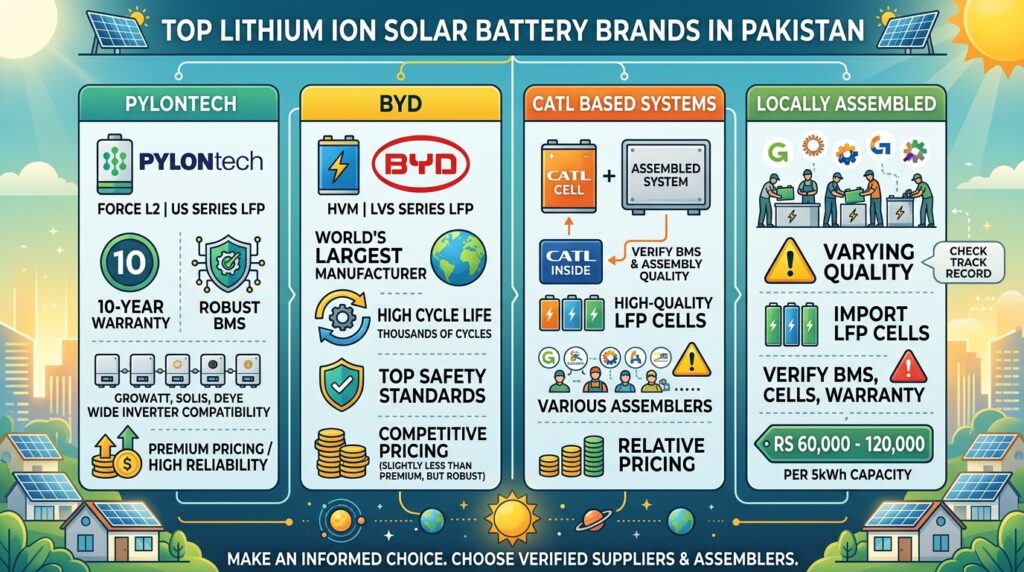
The lithium ion solar battery market in Pakistan includes both internationally established brands and locally assembled options. Knowing which brands offer genuine quality and reliable warranty support is essential.
Pylontech is widely regarded as one of the best lithium ion solar battery brands available in Pakistan. Their Force series and US series LFP batteries offer excellent build quality, a ten-year warranty, robust BMS, and compatibility with most popular hybrid inverters including Growatt, Solis, Deye, and others. Pylontech batteries are priced at a premium but deliver the best reliability and longest warranty support in the Pakistani market.
BYD, the world’s largest lithium battery manufacturer, offers their HVM and LVS series batteries for solar storage. BYD batteries are known for exceptional cycle life and safety standards. They are available in Pakistan through authorised distributors and are priced competitively with Pylontech.
CATL-based battery systems assembled by various brands are increasingly available in Pakistan, offering high-quality LFP cells at relatively competitive prices. As one of the world’s leading battery cell manufacturers, CATL cells in well-assembled battery packs offer excellent performance.
Locally assembled lithium ion solar batteries using imported LFP cells are available at lower prices ranging from sixty thousand to one hundred and twenty thousand rupees for five kilowatt-hour capacity. Quality varies significantly between assemblers, and buyers should verify BMS quality, cell brand, and warranty terms before purchasing. Pakistan Solar Solutions only recommends locally assembled batteries from verified assemblers with a track record of reliable performance.
Proper installation and maintenance of a lithium ion solar battery ensures safety and maximises its operational lifespan in Pakistan’s demanding climate.
The battery should be installed in a cool, dry, well-ventilated indoor location away from direct sunlight. Ideal operating temperature for LFP batteries is between fifteen and thirty-five degrees Celsius. While LFP batteries are more heat-tolerant than other lithium chemistries, extended operation in temperatures above forty-five degrees Celsius accelerates degradation. In Pakistan’s hottest cities, installing the battery in an air-conditioned room or a room with good ventilation is strongly recommended.
The battery should be mounted vertically as specified by the manufacturer, with adequate clearance around it for ventilation. Never stack batteries in configurations not specified by the manufacturer, as this can cause uneven cell heating. Keep the battery away from flammable materials as a general safety precaution, though LFP’s excellent thermal stability makes fire risk very low compared to other lithium chemistries.
Routine maintenance is minimal. Keep the battery terminals clean and check the BMS indicator lights periodically for any warning signals. Firmware updates to the BMS, where available, improve battery management algorithms and should be applied when released by the manufacturer. Ensure your inverter and battery are communicating correctly through their data interface so the inverter can optimally manage charging and discharging based on the battery’s actual state of charge.
For Pakistani solar users participating in net metering, a lithium ion solar battery significantly enhances the financial returns from the solar system. Without battery storage, any solar electricity generated in excess of your real-time consumption is exported to the grid at the net metering tariff, which may be lower than the import tariff. With a lithium ion solar battery, this surplus solar electricity is first stored in the battery and then used during evening hours when import tariffs apply, effectively consuming your own solar electricity at the full avoided import price.
This self-consumption optimisation strategy, enabled by a hybrid solar inverter and lithium battery, ensures you get the maximum financial benefit from every kilowatt-hour your solar panels generate. For a household with a five kilowatt solar system and five kilowatt-hour lithium ion solar battery, self-consumption rates can exceed eighty to ninety percent, dramatically improving the system’s financial performance compared to a no-battery on-grid system. Our 1000w solar panel price guide at Pakistan Solar Solutions and 5kva solar inverter price guide provide additional context on how the full system works together to maximise your savings.
What is the price of a five kilowatt-hour lithium ion solar battery in Pakistan? A quality five kilowatt-hour LFP lithium ion solar battery from a reputable brand like Pylontech or a well-assembled local option costs between one hundred thousand and one hundred and eighty thousand rupees in Pakistan in 2025.
How many years does a lithium ion solar battery last in Pakistan? A quality LFP lithium ion solar battery rated for three thousand cycles, used once daily, lasts approximately eight to ten years in Pakistan. Premium batteries rated for five thousand to six thousand cycles can last fifteen years or more under the same conditions.
Is a lithium ion solar battery safe for home use in Pakistan? Yes, lithium iron phosphate batteries are among the safest battery chemistries available. They are extremely resistant to thermal runaway and fire. With a quality BMS and proper installation in a ventilated space, they are very safe for residential use in Pakistani homes.
Can I add more lithium ion solar batteries to my existing system later? Yes, most LFP lithium ion solar battery systems are designed to be expandable by adding additional battery modules in parallel. Verify expansion compatibility with your specific battery model and inverter before purchase to ensure your system can be scaled up smoothly.
What happens to a lithium ion solar battery during load shedding in Pakistan? During a grid outage or load shedding, the hybrid solar inverter automatically switches to battery power, drawing from the lithium ion solar battery to keep your appliances running without interruption. The transition is seamless and typically occurs within twenty to forty milliseconds, fast enough that sensitive electronics are not affected.