Pakistan’s summers are among the most punishing in the world. In cities like Multan, Sukkur, Jacobabad, and Hyderabad, temperatures regularly climb above forty-five degrees Celsius, while even in traditionally milder cities like Lahore and Karachi, recent summers have broken historical heat records. For the millions of Pakistani households who cannot afford the electricity bills of a conventional air conditioner, or who face extended load shedding precisely when they need cooling the most, the solar cooler has emerged as a life-changing solution.
The solar cooler is a specially designed evaporative or air cooler that runs directly on DC power from solar panels without requiring a conventional AC inverter, making it extremely energy-efficient and perfectly suited to Pakistan’s sunny summers. Interest in the solar cooler price in Pakistan has surged as awareness of this technology has grown. At Pakistan Solar Solutions, we have seen solar coolers become one of our most sought-after product categories, and this comprehensive guide addresses every question Pakistani buyers have about solar coolers, from how they work to which models offer the best value.
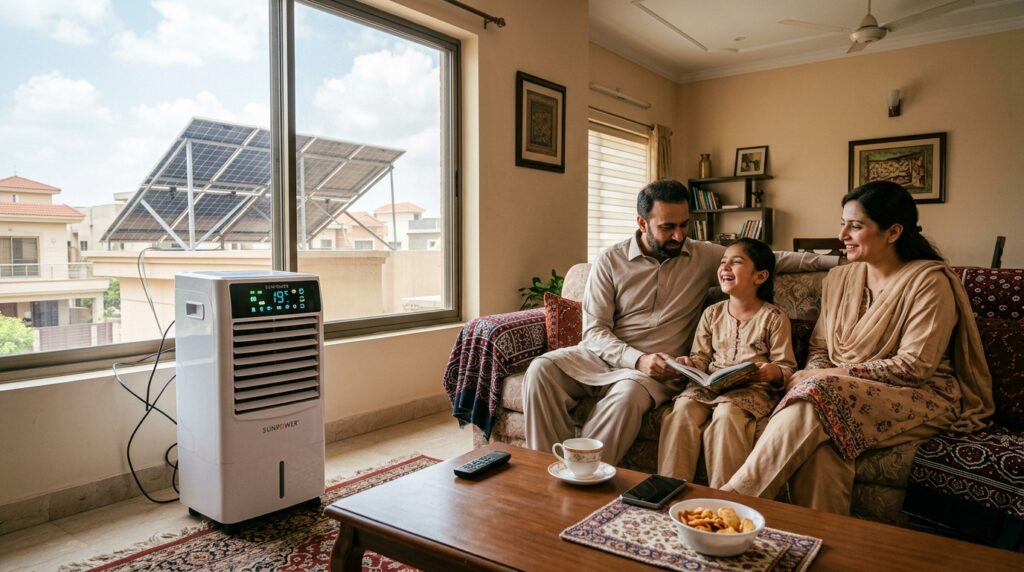
A solar cooler is an evaporative air cooler specifically engineered to run on low-voltage DC power, typically twelve or twenty-four volts, which can be supplied directly from solar panels without going through an inverter. Conventional air coolers run on two hundred and twenty volt AC power, which means they require either the grid or a solar inverter to operate. A DC solar cooler bypasses this requirement entirely, drawing power straight from the solar panel output or from a twelve or twenty-four volt battery bank.
The cooling mechanism itself is identical to a conventional evaporative cooler. A water pump circulates water onto cooling pads, and a fan draws hot outdoor air through these moist pads. As water evaporates, it absorbs heat from the air, reducing the air temperature by eight to fifteen degrees Celsius before it enters the room. In Pakistan’s hot but relatively dry inland climate, evaporative coolers can deliver very effective cooling, particularly in cities like Lahore, Multan, Faisalabad, and the interior of Sindh where humidity is lower than in coastal cities like Karachi.
Because a DC solar cooler operates directly on twelve or twenty-four volt solar power, it avoids the conversion losses associated with running AC appliances through an inverter. A typical DC solar cooler consumes between thirty and one hundred and fifty watts depending on its capacity and fan speed, compared to one hundred and fifty to three hundred watts for a comparable conventional AC cooler. This dramatic power difference is what makes the solar cooler price in Pakistan so attractive from a long-term operational cost perspective.
The solar cooler price in Pakistan in 2025 varies based on cooling capacity, features, and brand. The market ranges from entry-level twelve-volt DC coolers starting at twelve thousand rupees to large capacity hybrid solar coolers priced above sixty thousand rupees.
Small DC solar coolers with a cooling capacity suitable for a single room of up to two hundred square feet and power consumption of thirty to fifty watts are the most affordable segment. These are priced between twelve thousand and twenty-five thousand rupees and are popular for bedrooms, small offices, and shops. They run directly from a single one-hundred-watt solar panel, making the complete solar cooler and panel setup very affordable.
Medium-capacity DC solar coolers suitable for larger rooms or open spaces consume between fifty and one hundred watts and are priced between twenty-five thousand and forty-five thousand rupees. These offer higher airflow, larger water tanks, and additional features like remote control and multiple speed settings.
Large DC solar coolers and hybrid models that can run on both DC solar power and conventional AC grid power are the most versatile and are priced between forty thousand and seventy thousand rupees. These are suitable for large living rooms, commercial spaces, small workshops, and outdoor covered areas.
For the most current and verified solar cooler prices in Pakistan, visit Pakistan Solar Solutions where we maintain updated listings of available models.
Understanding the different types of solar coolers helps you match the right product to your needs and budget before focusing on the solar cooler price in Pakistan.
Pure DC solar coolers are the most energy-efficient type, running exclusively on twelve or twenty-four volt DC power from solar panels or batteries. They are ideal for off-grid locations, areas with severe load shedding, or buyers who want maximum independence from the grid. They require no inverter and can even run directly from a single solar panel during the day without any battery storage.
Dual-power or hybrid solar coolers can run on both DC solar power and conventional AC grid electricity. When solar power is available, they draw from the panels. When the sun goes down or on cloudy days, they switch to grid power. This flexibility makes them suitable for both day and night cooling, though they do require an inverter or battery for nighttime DC operation.
Inverter-based solar coolers are conventional high-efficiency coolers with variable-speed motors and inverter technology that dramatically reduces electricity consumption. While they do not run on DC solar power directly, their low AC power consumption makes them very well-suited to operation from a solar system’s inverter output. These are typically priced higher and are popular among Pakistani buyers who already have a hybrid solar inverter system installed.
Pakistan’s diverse geography means that cooling needs and the most appropriate solar cooler type differ significantly from region to region.
In the hot, dry interior plains of Punjab and Sindh, evaporative cooling is extremely effective. Cities like Multan, Faisalabad, Rahim Yar Khan, and Hyderabad are ideal environments for solar coolers because the dry air allows maximum evaporative cooling efficiency. A medium to large DC solar cooler in these regions can reduce room temperature by ten to fifteen degrees Celsius, providing very effective relief during the hottest months.
In Karachi and the coastal areas, humidity is significantly higher, which reduces the effectiveness of evaporative cooling. Coastal residents may find that a solar cooler provides less relief than inland users. In this context, an inverter air conditioner powered by a hybrid solar system, as detailed in our solar panels for AC units guide at Pakistan Solar Solutions, may offer better cooling comfort despite the higher initial cost.
In the cooler northern regions including Islamabad, Abbottabad, and Gilgit-Baltistan, cooling needs are moderate and a small to medium DC solar cooler is more than adequate for most summer days.
The number of solar panels required to run a solar cooler depends on the cooler’s power consumption and how many hours you want to run it. For a fifty-watt DC solar cooler, a single one-hundred-watt to one-hundred-and-fifty-watt solar panel is sufficient to run it continuously during daylight hours. For a one-hundred-watt cooler, two one-hundred-watt panels or one two-hundred-watt panel provides comfortable capacity with some surplus for battery charging.
If you want to run the cooler after sunset using battery power, you need to calculate the nighttime energy requirement and ensure your battery bank can supply it. Running a one-hundred-watt solar cooler for eight hours at night requires eight hundred watt-hours of battery capacity. A one-hundred-ampere-hour twelve-volt battery stores one thousand and two hundred watt-hours, of which approximately sixty percent is usable in a lead-acid battery, giving you seven hundred and twenty watt-hours or about seven hours of cooler runtime per night.
For extended nighttime cooling, using a lithium iron phosphate battery, which we cover in depth in our lithium ion solar battery guide at Pakistan Solar Solutions, is strongly recommended as these batteries offer eighty to ninety percent usable capacity and far greater cycle life than lead-acid alternatives.
One of the most common dilemmas for Pakistani buyers is whether to invest in a solar cooler or a solar-powered air conditioner. Both have merit, and the right choice depends on your cooling requirements, budget, and existing solar infrastructure.
A DC solar cooler setup, including the cooler itself and the solar panels to run it, can be assembled for twenty-five thousand to seventy thousand rupees, making it one of the most affordable cooling solutions in Pakistan. It works effectively in dry inland climates and provides immediate relief from heat without the large upfront investment of a full solar system. Running costs are essentially zero during daylight hours.
A one-ton DC inverter air conditioner running on a solar system provides significantly better cooling, especially in humid environments or for people with health conditions requiring precise temperature control. However, the complete solar system including panels, hybrid inverter, and batteries needed to run an AC unit costs three hundred thousand to six hundred thousand rupees. While the long-term savings are substantial, as detailed in our solar panels for AC units article at Pakistan Solar Solutions, the upfront investment is far greater than a solar cooler setup.
For budget-conscious buyers prioritising immediate relief from heat and load shedding at minimal cost, the solar cooler offers outstanding value. For buyers who can invest in a complete solar system and want air conditioning quality cooling, the solar-powered AC system delivers superior comfort.
The solar cooler market in Pakistan includes both international brands and locally assembled products. Knowing which brands have a track record of performance and availability of after-sales service is important.
Kenwood, Super Asia, and Pak Fan are well-known Pakistani brands that now offer solar-compatible and DC cooler models. Their products are widely available, affordable, and backed by local service networks. Orient and Dawlance have also entered the solar cooler market with energy-efficient models compatible with solar systems.
For pure DC solar coolers from Chinese manufacturers, brands like Portable Air and several unbranded products are available through solar equipment suppliers at competitive prices. While these may offer the lowest solar cooler prices in Pakistan, warranty support can be inconsistent and buyers should verify return and service policies before purchasing.
Pakistan Solar Solutions evaluates and recommends solar cooler brands based on actual performance in Pakistani conditions. Visit Pakistan Solar Solutions for our current recommended models and pricing.
Solar coolers require simple but regular maintenance to perform efficiently and last their full expected lifespan of five to eight years. The cooling pads should be cleaned every two weeks during the cooling season to prevent algae and bacterial growth. The water tank should be drained and cleaned monthly to prevent limescale buildup, which is common with Pakistan’s hard water. The fan blades should be wiped down periodically, and the water pump should be checked for blockages.
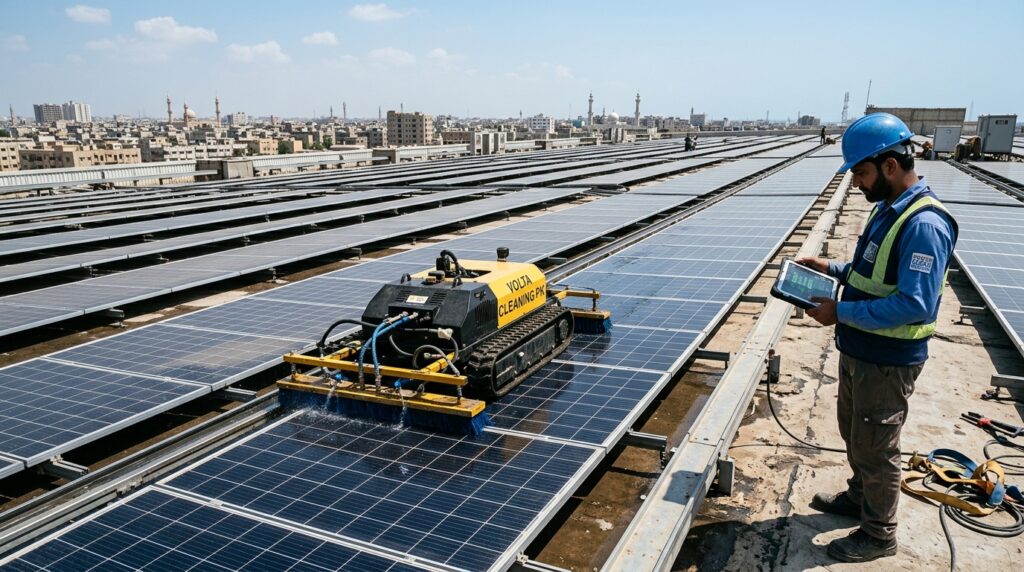
Clean solar panels powering your cooler, which ties back to the importance of regular maintenance covered in our solar plate cleaning guide at Pakistan Solar Solutions, ensure the cooler receives consistent DC power and runs at its rated capacity throughout the day.
What is the minimum budget for a complete solar cooler setup in Pakistan? The most affordable complete setup, including a small DC solar cooler and a single solar panel to run it, can be assembled for approximately twenty-two thousand to thirty-five thousand rupees in Pakistan.
Can a solar cooler run at night in Pakistan? Yes, with a battery bank. A twelve volt battery of sufficient capacity stores the daytime solar energy and powers the cooler after sunset. For extended nighttime operation, a lithium battery is recommended for better efficiency and longer cycle life.
Is a solar cooler as effective as an air conditioner? A solar cooler is effective in dry climates and can reduce room temperature by eight to fifteen degrees Celsius. An air conditioner cools to a precise set temperature regardless of humidity. In Pakistan’s dry inland cities, many people find a solar cooler sufficiently comfortable, but in high-humidity coastal areas, an AC provides superior comfort.
How long does a DC solar cooler motor last? DC motors in quality solar coolers are designed for long service life and typically last five to eight years with proper maintenance. Brushless DC motors, used in premium models, last even longer.
Does the solar cooler price in Pakistan include the solar panel? Most retailers quote solar cooler prices without the panel. The panel must be purchased separately. Confirm what is included before purchasing and visit Pakistan Solar Solutions for bundled cooler-and-panel packages.