

Pakistan’s agricultural economy is the backbone of the national GDP, and irrigation is the backbone of Pakistani agriculture. Yet millions of farmers across Sindh, Punjab, Balochistan, and Khyber Pakhtunkhwa continue to power their irrigation pumps with expensive diesel generators or unreliable WAPDA connections that fail precisely when water demand is highest during the summer growing season. The solar water pump has emerged as the most transformative technology for Pakistani agriculture in the last decade, eliminating diesel costs, providing reliable daytime irrigation, and delivering full capital recovery within 2 to 3 years in most agricultural applications.
This guide covers everything Pakistani farmers, rural property owners, and commercial water users need to know about solar water pumps in Pakistan in 2026, from system types and pricing to installation requirements, agricultural savings calculations, and how Pakistan Solar Solutions designs pumping systems specifically for Pakistani land and climate conditions.
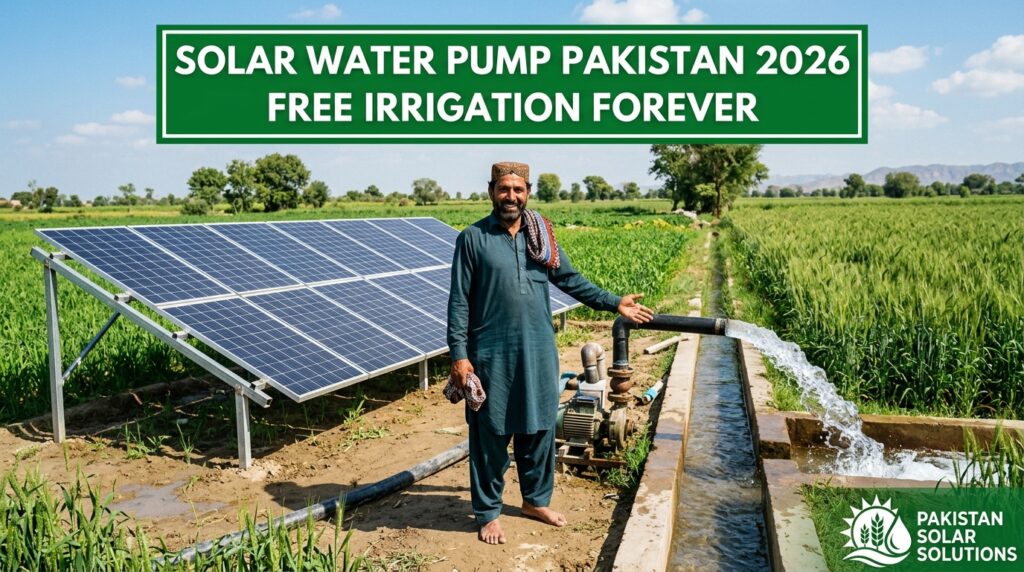
A solar water pump system replaces the diesel engine or WAPDA electric motor that drives your pump with a solar-powered drive system that generates and delivers electricity directly to the pump motor during daylight hours. The solar panels generate DC electricity from sunlight, which is either used directly by a DC pump motor or converted to AC by a solar pump inverter to drive a standard AC motor. The pump then draws groundwater from a tube-well or surface water from a canal, pond, or reservoir and delivers it to the field, drip irrigation lines, livestock troughs, or storage tanks as required.
The fundamental advantage of a solar water pump in Pakistan is the alignment between peak solar generation hours, which run from approximately 8 AM to 5 PM, and the period when irrigation is most productive in Pakistan’s climate. Farmers in Sindh and Punjab can pump water for 6 to 9 hours daily from a properly sized solar pumping system without any fuel cost, without load shedding interruptions, and without the maintenance demands of diesel engines.
Understanding the different types of solar water pump systems available in Pakistan helps you choose the right configuration for your specific application and budget.
DC solar water pumps connect directly to solar panels without an inverter, using the DC electricity generated by the panels to drive a brushless DC pump motor. These systems are the simplest and most cost-effective option for small water volumes, low static heads, and applications where pumping only needs to occur during sunlight hours. DC pumps are popular for livestock watering systems, small garden irrigation, and drinking water supply in rural homes. They require no inverter, no battery for daytime operation, and very little maintenance due to the brushless motor design.
AC solar water pump systems use a solar pump inverter, also known as a Variable Frequency Drive or VFD, to convert DC electricity from the solar panels into AC power for a standard three-phase AC submersible or surface pump motor. This configuration supports much higher power levels and deeper tube-wells than DC pump systems, making it the standard choice for Pakistani agricultural tube-wells with depths of 50 to 300 metres and flow requirements of 5,000 to 100,000 litres per hour.
AC solar pump inverters automatically adjust pump speed based on available solar irradiance, running the pump at full speed during peak midday sun and slowing it proportionally as the sun rises and sets. This maximum power point tracking ensures your panels are always operating at their peak efficiency point and maximizes daily water volume even during partially cloudy conditions.
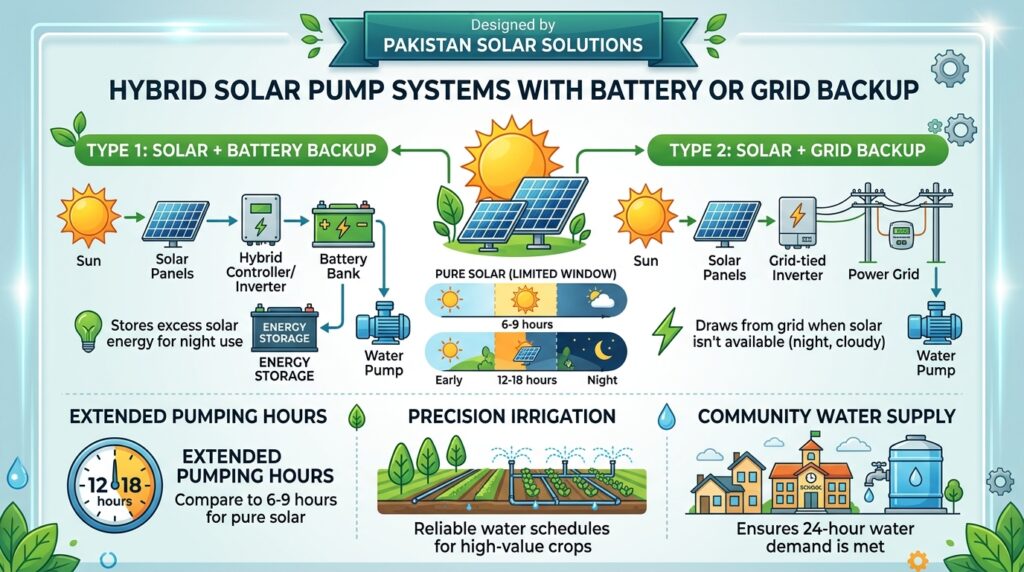
For applications where pumping is required during early morning, evening, or night hours beyond the solar generation window, Pakistan Solar Solutions designs hybrid solar pump systems that combine solar generation with either battery storage or grid backup. These systems allow farmers to pump water for 12 to 18 hours daily rather than the 6 to 9 hours available from pure solar. The hybrid configuration is particularly valuable for high-value crops requiring precise irrigation schedules or for water supply systems serving communities with 24-hour demand.
Solar water pump prices in Pakistan in 2026 depend on pump motor horsepower, well depth, required flow rate, panel capacity, and whether battery storage or grid backup is included. The following price ranges represent complete systems including panels, solar pump inverter or controller, cabling, panel mounting structure, and installation.
A small DC solar pump system of 0.5 horsepower to 1 horsepower suitable for livestock watering, small garden irrigation, or domestic rural water supply costs PKR 80,000 to PKR 180,000. A medium AC solar pump system of 3 horsepower to 5 horsepower suitable for small tube-wells and market garden irrigation costs PKR 280,000 to PKR 550,000. A standard agricultural AC solar pump system of 7.5 horsepower to 10 horsepower suitable for medium-scale tube-wells in Sindh and Punjab costs PKR 550,000 to PKR 950,000. A large agricultural AC solar pump system of 15 horsepower to 25 horsepower suitable for large tube-wells, canal pumping stations, and commercial water supply costs PKR 1,200,000 to PKR 2,200,000. Systems above 25 horsepower are priced on a project-specific basis following site feasibility assessment.
The economic case for solar water pumps in Pakistan is among the strongest of any solar technology application because it directly replaces diesel fuel, which is both expensive and subject to significant price volatility. Understanding the actual savings requires calculating your current diesel expenditure and comparing it to the capital cost and maintenance of a solar pumping system.
A typical 7.5 horsepower diesel pump running 8 hours daily in Sindh consumes approximately 6 to 8 litres of diesel per hour, totaling 48 to 64 litres per day. At 2026 diesel prices of PKR 300 to PKR 330 per litre, this represents PKR 14,400 to PKR 21,120 in daily fuel costs, or PKR 432,000 to PKR 633,600 per month during the peak irrigation season. Over a 6-month peak irrigation season, total diesel expenditure reaches PKR 2,592,000 to PKR 3,801,600 for a single 7.5 horsepower pump.
A solar pumping system of equivalent capacity costs PKR 550,000 to PKR 950,000 as a complete installation. At this cost versus the diesel savings of PKR 2,592,000 or more per agricultural year, the payback period is less than 6 months in many cases. Even accounting for reduced pumping in the non-peak season and the full year’s capital cost, solar pump payback in Pakistani agricultural applications is consistently achieved within 1 to 2 years, after which the farmer enjoys free irrigation water for the remaining 23-plus years of the panel’s life.
For farms that currently pump using WAPDA-connected electric motors, the savings calculation is different but equally compelling. Agricultural electricity tariffs in Pakistan have increased dramatically in 2024 and 2025, and many farmers in Punjab and Sindh now pay PKR 30 to PKR 50 per unit for agricultural power under peak demand conditions. A solar pumping system eliminates this tariff exposure and provides immunity from future tariff increases, which have historically been steep and unpredictable in Pakistan.
Correct pump sizing is the most technically important decision in a solar water pump installation. An undersized system fails to deliver adequate water volume during critical irrigation periods, while an oversized system wastes capital investment. Pakistan Solar Solutions conducts a detailed pumping requirement analysis before recommending any system, covering the following key parameters.
Static water level is the distance from ground level to the water surface in your well or source under non-pumping conditions. Dynamic water level is the depth to which the water surface drops during active pumping, which can be significantly deeper than static level in sandy aquifers during extended pumping. Total head is the sum of dynamic water level and the vertical height from the wellhead to your delivery point, plus friction losses in the pipes. Required flow rate is the volume of water your irrigation system needs per hour to cover your land area adequately based on your crop type and irrigation method. All of these parameters must be known accurately to select the right pump motor, panel capacity, and inverter rating.
Pakistan Solar Solutions installs solar water pump systems across Pakistan with particular expertise in the agricultural regions of Sindh and Punjab. Our installation teams handle the complete process from site assessment through final commissioning.
The process begins with a free site visit during which our engineer measures static water level, tests well yield, assesses pipe infrastructure, and calculates total head and flow requirements. Based on this assessment, we prepare a detailed proposal specifying panel capacity, inverter model, pump motor rating, pipe diameter, and mounting structure design. After approval, our team procures all components and completes installation within 2 to 5 days depending on well depth and site conditions. We commission the system with full flow testing and deliver a complete operating manual to the farmer or property owner. For farms also interested in household solar solutions, Pakistan Solar Solutions can combine a solar pumping installation with a residential off-grid or hybrid system in a single visit and proposal. For complete off-grid energy independence, visit our off-grid solar system Pakistan guide.
A complete 7.5 horsepower AC solar water pump system suitable for medium agricultural tube-wells in Pakistan costs PKR 550,000 to PKR 950,000 in 2026. This includes a solar panel array of approximately 7.5kW to 10kW, a solar pump inverter, all cabling, panel mounting structure, and professional installation. Final pricing depends on well depth, required flow rate, and site conditions.
Yes. Solar water pumps continue operating on overcast and partly cloudy days at reduced speed. Modern solar pump inverters automatically adjust pump speed based on available solar power, extracting maximum water volume even under reduced irradiance. On heavily overcast days, pumping capacity may drop by 30 to 60 percent, but irrigation can continue throughout the day as clouds are rarely uniform in Pakistani weather conditions.
Modern AC solar submersible pump systems can operate at depths of up to 300 metres or more depending on pump motor size and power capacity. Most Pakistani agricultural tube-wells sit between 50 and 200 metres depth, well within the operational range of solar pumping systems from 3 horsepower to 25 horsepower. Pakistan Solar Solutions can design solar pump systems for any well depth after measuring static and dynamic water levels on site.
A basic solar water pump system does not require batteries and pumps only during daylight hours, which is sufficient for most agricultural applications. If pumping is required at night or early morning, battery storage can be added to extend operation. Alternatively, Pakistan Solar Solutions can design a solar pump system with grid backup for properties with WAPDA connections that need to pump beyond daylight hours.
Solar panels in a pumping system carry the same 25-year linear performance warranty as residential and commercial panels. Solar pump inverters carry warranties of 3 to 5 years from the manufacturer. Submersible pump motors typically last 7 to 15 years depending on water quality and operational hours. LiFePO4 batteries, if included, carry 10-year warranties. Overall system lifespan from a quality installation is 20 to 25 years with normal maintenance.