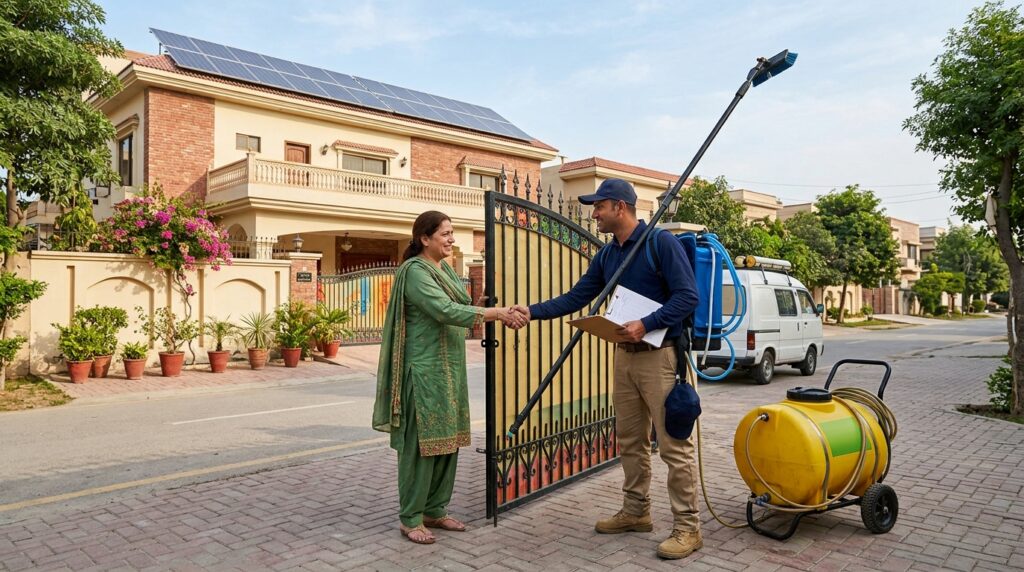


If you already own a solar system and have started searching for solar panel cleaning near me, you are likely one of two types of buyers: someone who wants the convenience of a professional handling this task rather than doing it themselves, or someone whose rooftop access, height, or personal circumstances make DIY cleaning genuinely impractical or unsafe. Either way, finding a reliable local cleaning service in Pakistan requires knowing what to actually look for, what a fair price looks like, and what a proper service visit should include. This guide walks through exactly that, so you can book a cleaning service with confidence rather than guesswork.
For the technical background on why cleaning matters so much in Pakistan’s climate and how the process actually works, our companion guide to the solar panel cleaning brush covers the underlying method in detail. This guide focuses specifically on finding and evaluating a local professional service rather than doing the job yourself.
While a basic DIY cleaning approach works perfectly well for many households, an increasing number of Pakistani solar owners are choosing professional cleaning services for a combination of practical reasons. Rooftop access can be genuinely difficult or risky for some homeowners, particularly on taller buildings or properties with steep or complicated roof access. Busy households often simply prefer not to add another regular maintenance task to their schedule, especially given that proper cleaning during Pakistan’s dry season should happen every two to three weeks for best results. Commercial property owners and larger residential installations frequently find that the labor time required for thorough manual cleaning makes a professional service more time-efficient than handling it internally, even when the underlying technique remains fundamentally similar to what a homeowner could do themselves.
Before booking any local cleaning service, understanding what a genuinely thorough, professional visit should actually cover helps you evaluate whether a specific provider is offering real value or simply a quick, superficial wipe-down.
A professional service should use soft-bristle brushes or microfiber materials specifically suited to solar panel glass, never hard bristles or abrasive materials that risk scratching the panel surface and permanently reducing its light transmission. The technician should avoid cleaning during peak midday heat, since spraying cool water onto sun-heated glass can create thermal stress, and should instead schedule visits for early morning or evening hours when panels are cooler.
For any service involving physical rooftop access rather than ground-level telescopic pole cleaning, proper safety practices matter significantly, both for the technician’s wellbeing and to avoid any accidental damage to your roof or panels during the cleaning process. A reputable service should arrive with appropriate safety equipment and demonstrate clear awareness of safe movement across a rooftop covered in panels, since walking directly on panels can cause internal micro-fractures that are invisible but permanently reduce output.
Ask whether the service uses treated or filtered water rather than standard tap water for the final rinse, since repeated cleaning with high-mineral-content tap water can gradually leave behind mineral spotting that reduces light transmission over time, a detail covered further in our cleaning brush guide. A service using proper water treatment demonstrates a more thorough, long-term-minded approach to panel care rather than simply prioritizing speed.
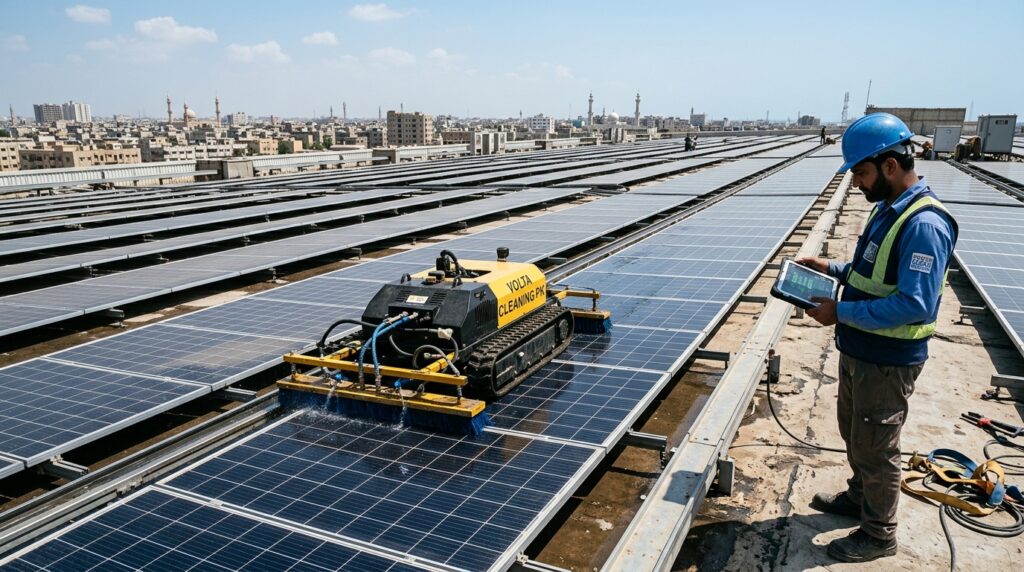
As of 2026, professional solar panel cleaning services in Pakistan typically charge based on system size and cleaning frequency arrangement. A single cleaning visit for a standard residential 5 kW system generally costs between PKR 1,500 and PKR 4,000, depending on the specific service provider, your city, and whether the visit includes both front-side cleaning and a general system inspection. Many providers offer discounted rates for recurring service contracts, such as monthly or bi-weekly cleaning during peak dust season, compared to one-off individual visits, since a standing arrangement reduces the scheduling overhead for both the customer and the service provider. For larger commercial and industrial installations, pricing is generally quoted based on total system size and cleaning frequency, following the same scale-based logic covered in our guide to solar panel cleaning machine options for larger arrays.
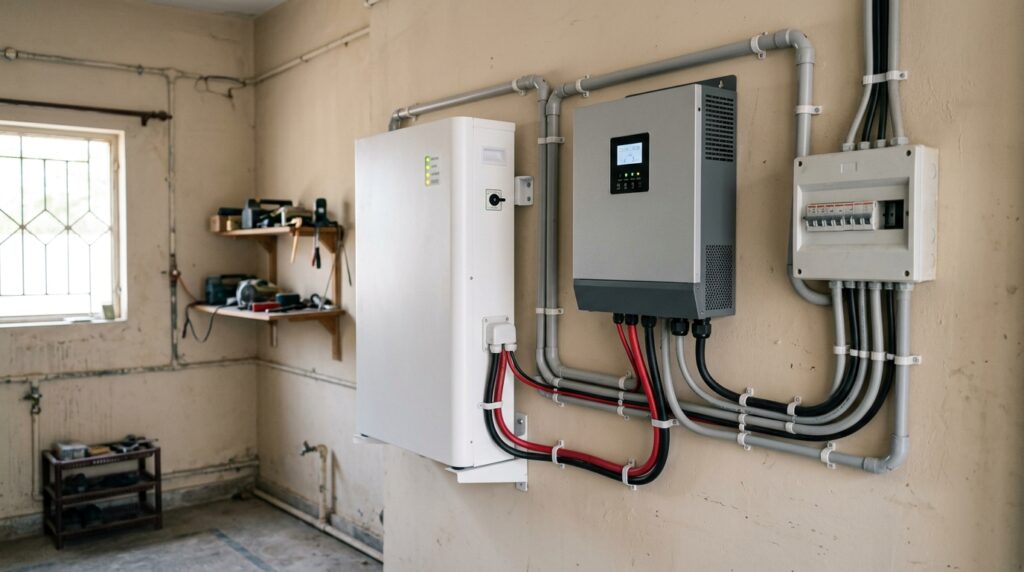
A few practical questions help you evaluate whether a specific local provider is genuinely reliable before committing to a booking. Ask what equipment and technique they use, specifically confirming soft-bristle or microfiber materials rather than anything abrasive. Ask whether they carry any liability coverage or guarantee against accidental damage during the cleaning process, since rooftop work always carries some inherent risk that a responsible provider should be prepared to address. Ask whether the service includes a basic visual inspection of your system’s general condition, since an experienced technician working across your panels regularly is well positioned to notice early signs of physical damage, loose mounting hardware, or other issues worth flagging to you before they become more significant problems.
Beyond the specific questions above, a few broader signals help distinguish a genuinely reliable local cleaning provider from a less accountable option. A provider willing to explain their process clearly and answer your questions in detail, rather than giving vague or dismissive responses, generally reflects genuine expertise and confidence in their approach. Established providers with a track record of serving your specific area, ideally with references or reviews you can verify, offer more accountability than a completely unknown or newly formed operation. Providers who are part of a broader, established solar company, rather than an entirely independent cleaning-only operation with no connection to actual solar installation expertise, often bring a more technically informed understanding of panel care, since their broader business depends on customer systems continuing to perform well over the long term rather than cleaning being a standalone, disconnected transaction.
If you have straightforward, safe rooftop access and do not mind the modest recurring time investment, DIY cleaning using a proper soft-bristle telescopic brush, covered in detail in our dedicated guide, remains a perfectly reasonable and cost-effective approach for most standard residential systems. Professional cleaning becomes the more sensible choice specifically when rooftop access is genuinely difficult or risky, when your schedule makes consistent DIY maintenance impractical, or when you are managing a larger commercial installation where the labor time required makes professional service more efficient than internal management. Neither choice is inherently right or wrong, and the decision should reflect your specific circumstances rather than any universal recommendation.
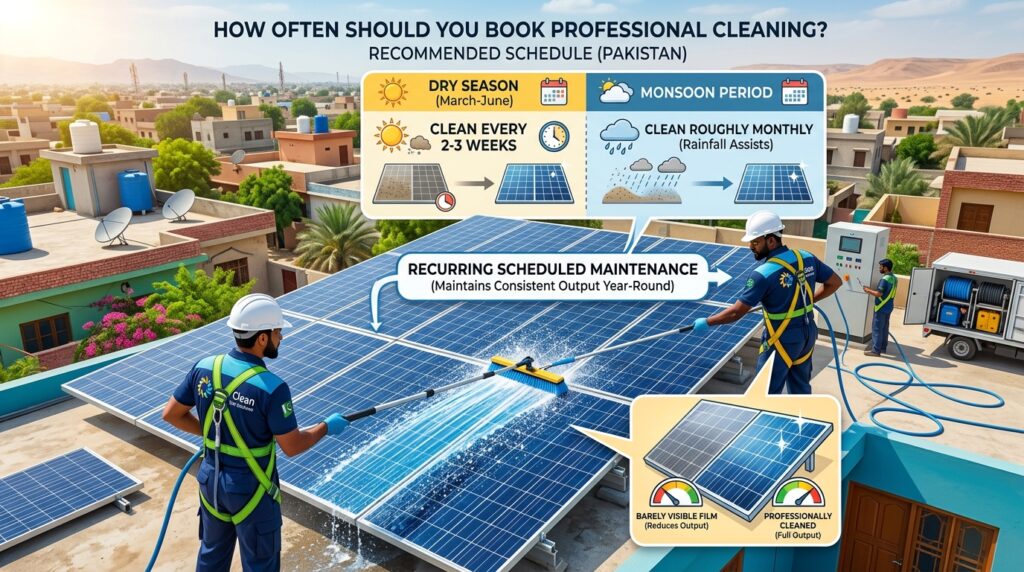
Following the same general guidance covered in our technical cleaning guide, most Pakistani solar systems benefit from cleaning every two to three weeks during the dry season between March and June, and roughly monthly during the monsoon period when natural rainfall assists with dust removal. When arranging a professional service, discussing a recurring schedule aligned with this pattern, rather than booking cleaning only when panels visibly appear dusty, generally maintains more consistent system output throughout the year, since a thin, barely visible film of dust can meaningfully reduce output even before it becomes obviously noticeable to the eye.
Pakistan Solar Solutions offers panel cleaning and maintenance support as part of our after-sales services for systems we install, and we are also happy to assist customers whose systems were installed by another provider, ensuring your investment continues performing at its rated output regardless of who originally handled the installation. Our team follows the proper technique and equipment standards covered throughout this guide, including appropriate water treatment and safety practices for rooftop access. You can arrange a cleaning service or a broader system inspection through our contact page, and our team can also advise on whether your specific system might benefit from the automated cleaning solutions covered in our solar panel cleaning machine guide if you are managing a larger commercial installation.
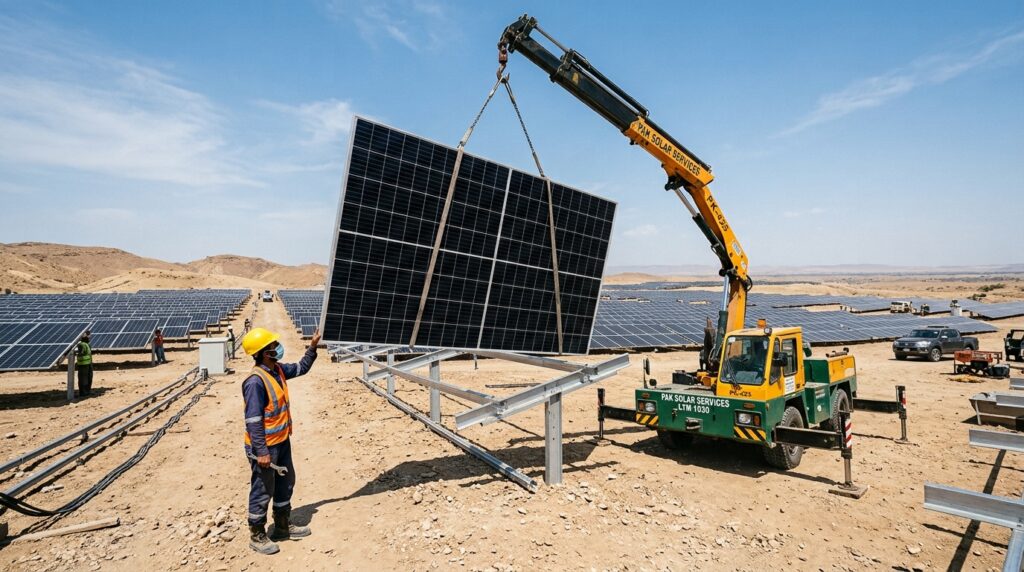
As solar adoption has grown across Pakistan, professional cleaning services have become increasingly available across all the major cities where residential and commercial solar installations are concentrated, including Karachi, Lahore, Faisalabad, Multan, Gujranwala, and other urban centers covered throughout our city-specific pricing guides. In larger cities with a longer-established solar market, such as Karachi and Lahore, buyers generally have a wider selection of dedicated cleaning providers, including some operating purely as cleaning specialists alongside broader solar installation companies offering cleaning as an add-on service. In smaller cities and towns with a more recently developing solar market, dedicated cleaning-only providers may be less common, making it more likely that your best option is a broader solar company, similar to Pakistan Solar Solutions, that offers cleaning as part of its after-sales support alongside installation and maintenance services.
Given how much cleaning demand concentrates during Pakistan’s dry season between March and June, when dust accumulation is at its most severe, booking a service provider in advance of this period, rather than waiting until panels are visibly dust-covered, often results in more convenient scheduling and potentially better availability than trying to book during the peak demand period when providers may be juggling a larger volume of customer requests. Setting up a recurring service arrangement ahead of the dry season, discussed earlier in this guide, is one practical way to avoid this seasonal scheduling crunch while also ensuring your system receives the more frequent cleaning it genuinely benefits from during these months.
Understanding the typical flow of a professional cleaning visit helps set accurate expectations when booking. A technician will generally arrive with a telescopic brush or water-fed pole system, along with a water source or portable water container if your property does not have convenient rooftop water access. The actual cleaning process for a standard residential system typically takes between thirty minutes and an hour, depending on system size and roof accessibility, followed by a brief visual inspection of the panels and general mounting structure condition. A thorough provider will also check for any obvious wiring or connection issues visible during their time on the roof, flagging anything unusual to you even though a full electrical inspection would require separate specialized service. Payment terms vary by provider, with some requiring payment per visit and others offering monthly or seasonal package pricing for recurring arrangements.
A single cleaning visit for a standard residential 5 kW system typically costs between PKR 1,500 and PKR 4,000, with many providers offering discounted rates for recurring service contracts compared to one-off visits.
Ask specifically what equipment they use, confirming soft-bristle or microfiber materials rather than anything abrasive, and ask about their approach to timing, since cleaning should happen during cooler morning or evening hours rather than peak midday heat.
Neither is inherently better. DIY cleaning works well for households with safe, accessible rooftops and the time for regular maintenance. Professional cleaning makes more sense when rooftop access is difficult, your schedule is busy, or you are managing a larger commercial system.
Most Pakistani systems benefit from cleaning every two to three weeks during the dry season between March and June, and roughly monthly during the monsoon period, when natural rainfall assists with dust removal.
Yes, improper technique, including hard bristles, abrasive materials, or walking directly on panels, can cause scratching or internal micro-fractures that permanently reduce output. This is why verifying a provider’s equipment and technique before booking matters significantly.
Availability is generally strongest in established solar markets like Karachi and Lahore, though broader solar companies offering cleaning as part of their after-sales support, rather than cleaning-only specialists, are often available even in smaller cities and towns with a growing solar market.
Booking ahead of the dry season, roughly before March, often results in more convenient scheduling than waiting until peak demand during the driest months, and setting up a recurring arrangement helps ensure your system gets cleaned frequently enough throughout this critical period.