

Battery storage has quietly become the single biggest cost and value driver in Pakistan’s growing hybrid solar market, and lithium technology, specifically lithium iron phosphate batteries, has emerged as the clear standard recommendation for new installations, replacing the lead-acid batteries that dominated the market for decades. Understanding what makes lithium batteries different, what they actually cost, and how to size a battery bank correctly for your specific needs is essential before committing to a hybrid solar investment. This guide covers the technology, pricing, and practical sizing considerations Pakistani buyers need to know in 2026.
For most of the history of battery-backed solar systems in Pakistan, lead-acid batteries, including flooded and sealed variants, represented the default and often only realistic choice, given their lower upfront cost and widespread local availability. Lithium iron phosphate technology, commonly abbreviated as LiFePO4, has steadily displaced lead-acid as the recommended standard for new hybrid installations, driven primarily by a combination of dramatically longer cycle life, better usable capacity relative to physical size and weight, and improved safety characteristics compared to older chemistries. While lithium batteries still carry a meaningfully higher upfront cost per kilowatt-hour of capacity than lead-acid, the total cost of ownership calculation, accounting for how many times each battery type must be replaced over a system’s 25-year operational life, increasingly favors lithium for buyers planning a serious, long-term hybrid solar investment.
Understanding the practical differences between these two battery chemistries clarifies why the market has shifted so decisively toward lithium technology in recent years.
A quality lithium LiFePO4 battery typically delivers between 3,500 and 6,000 full charge and discharge cycles before capacity degrades to around eighty percent of its original rating, translating into a realistic operational lifespan of eight to fifteen years under typical daily cycling patterns common in Pakistani hybrid solar systems. Standard lead-acid batteries, by comparison, typically deliver only 300 to 500 full cycles before similar degradation, meaning a lead-acid battery bank in a system cycling daily might need replacement every one to two years, compared to the near-decade-long lifespan a comparable lithium bank can deliver.
Lead-acid batteries generally should not be discharged below fifty percent of their rated capacity without meaningfully shortening their already limited lifespan, meaning a 10 kilowatt-hour lead-acid battery effectively provides only around 5 kilowatt-hours of genuinely usable, sustainable capacity. Lithium LiFePO4 batteries, by contrast, can typically be safely discharged to eighty or even ninety percent of their rated capacity without significant lifespan impact, meaning a 10 kilowatt-hour lithium battery delivers closer to 8 to 9 kilowatt-hours of genuinely usable capacity, a substantial practical advantage when sizing a battery bank for real household needs.
Lithium batteries are considerably lighter and more compact than lead-acid batteries of equivalent capacity, generally simplifying installation and reducing the structural and space considerations involved, particularly relevant for households with limited utility room or wall-mounting space available for battery equipment.
LiFePO4 chemistry specifically, as distinct from other lithium battery chemistries used in some consumer electronics, is widely regarded as one of the safest lithium battery types available, with a significantly lower risk of thermal runaway compared to other lithium chemistries, making it well suited to the sustained, heavy-cycling demands of a residential or commercial hybrid solar system operating in Pakistan’s hot climate.
As of 2026, lithium LiFePO4 battery pricing in Pakistan generally ranges from PKR 45,000 to PKR 70,000 per kilowatt-hour of rated capacity, depending on brand, battery management system quality, and whether the unit is a standalone battery module or part of an integrated all-in-one system combining the battery and inverter in a single unit. A moderate 5 kilowatt-hour lithium battery bank, suitable for covering basic evening lighting, fan, and essential appliance needs, typically costs between PKR 225,000 and PKR 350,000. A larger 10 kilowatt-hour system, sized for more substantial overnight coverage including possibly running an air conditioner for part of the night, discussed in our best solar system for AC in Pakistan guide, typically costs between PKR 450,000 and PKR 700,000.
Proper battery sizing depends entirely on your specific nighttime or backup power requirements rather than any generic standard recommendation.
For households wanting to cover only essential lighting, a few fans, and basic device charging through the evening and into the night, a battery bank in the 3 to 5 kilowatt-hour range generally provides adequate coverage, discussed further in our overview of night solar panels and how battery storage delivers practical nighttime power.
For households wanting to cover a broader range of evening and nighttime consumption, including refrigeration, television, and general household electronics alongside basic lighting and fans, a battery bank in the 7 to 10 kilowatt-hour range typically provides more comfortable coverage across a full night without needing to fall back to grid power for these everyday loads.
For households specifically wanting to run air conditioning through the night, battery requirements increase substantially given how much power cooling equipment consumes. A 1.5 ton AC running six to eight hours overnight typically requires 10 to 15 kilowatt-hours of usable battery capacity on its own, before accounting for any other household consumption running simultaneously, a calculation covered in detail in our dedicated guide to how many solar panels are required for a 1.5 ton AC.
Every quality lithium battery bank relies on an integrated battery management system, a specialized electronic circuit that monitors individual cell voltages, manages charging and discharging rates, and protects the battery from conditions that could otherwise shorten its lifespan or create safety risks, including overcharging, deep over-discharge, and excessive temperature exposure. When comparing lithium battery options in Pakistan, the quality and sophistication of this management system deserves as much attention as the raw capacity rating, since a battery with a well-engineered management system generally delivers more consistent performance and a longer realistic lifespan than a similarly rated battery with a more basic protection circuit, even if the raw cell chemistry is broadly comparable between the two options.
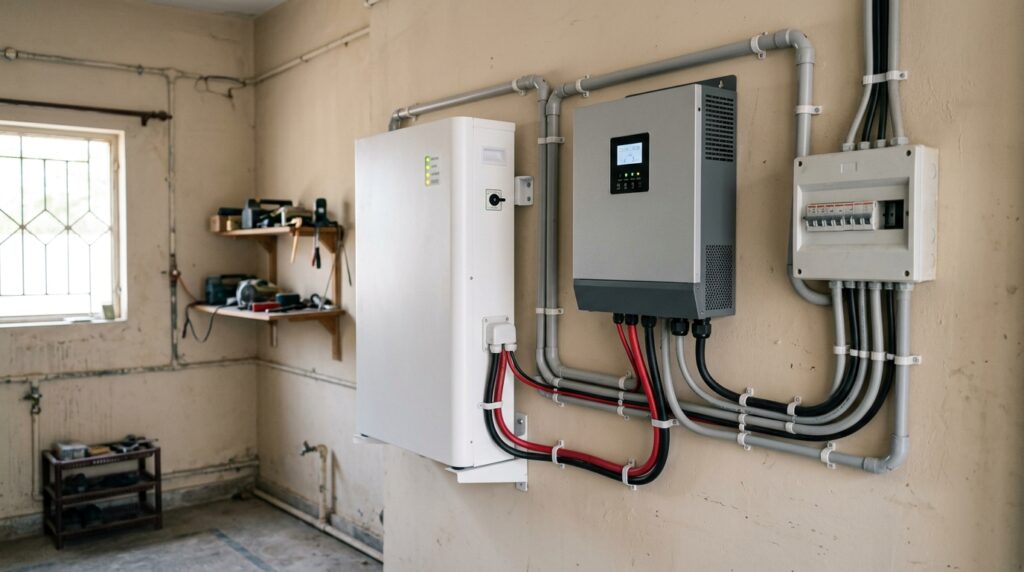
A lithium battery bank does not operate in isolation, but works as part of a complete hybrid system alongside your solar panels and a compatible hybrid inverter, covered in detail in our hybrid solar systems guide. Proper integration requires ensuring the battery’s voltage and communication protocol are compatible with your specific inverter, a technical matching process our engineering team handles as a standard part of every hybrid system design, since mismatched components can lead to reduced charging efficiency or, in some cases, the battery and inverter failing to communicate correctly at all.
Quality lithium LiFePO4 batteries sold in Pakistan typically carry manufacturer warranties in the range of five to ten years, though the realistic operational lifespan, based on the cycle life figures discussed earlier, often extends well beyond the formal warranty period under typical Pakistani household usage patterns. Buyers should confirm the specific warranty terms and any capacity retention guarantees, similar in concept to the linear performance warranty offered on solar panels themselves, before finalizing a battery purchase, since warranty quality and terms vary meaningfully between different manufacturers and sellers in this rapidly growing segment of the Pakistani market.
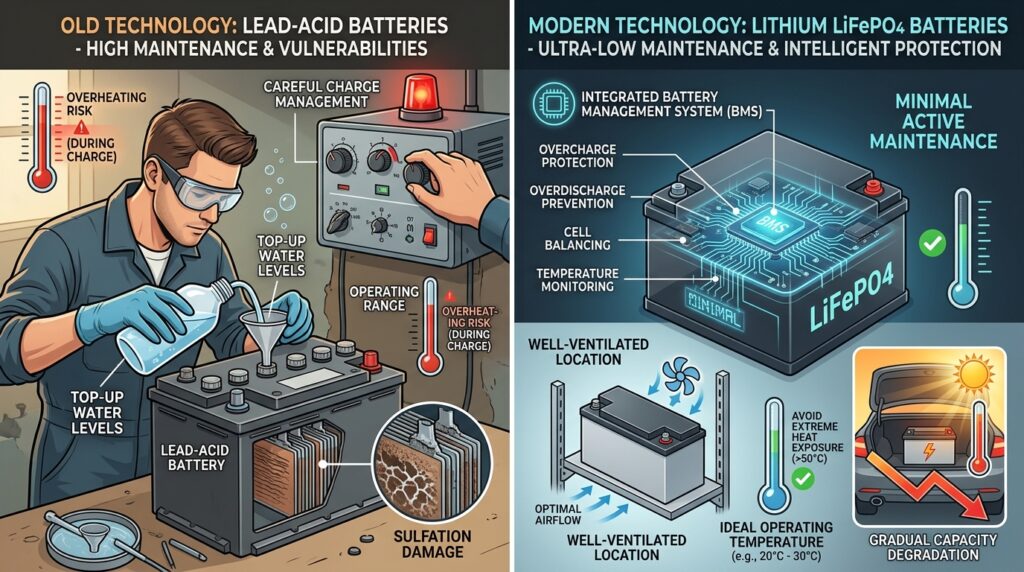
Unlike lead-acid batteries, which often require periodic water top-ups and careful charge management to avoid sulfation damage, lithium LiFePO4 batteries require minimal active maintenance under normal operating conditions, with the integrated battery management system handling most of the protective functions automatically. Avoiding extreme temperature exposure where possible, since very high heat can gradually accelerate capacity degradation even in temperature-tolerant LiFePO4 chemistry, and ensuring the battery is installed in a reasonably ventilated location rather than a fully enclosed, poorly ventilated space, helps preserve long-term performance and maximize the realistic operational lifespan of your investment.
Given how significantly battery choice and sizing affects both total system cost and the practical nighttime independence your hybrid system actually delivers, working through this decision with a proper site survey rather than a generic recommendation matters considerably. Pakistan Solar Solutions calculates the appropriate lithium battery configuration specific to your household’s actual consumption pattern and backup power goals as part of our standard hybrid system design process, ensuring you invest in the capacity you genuinely need rather than overpaying for unnecessary capacity or underinvesting in a bank too small to reliably meet your expectations. You can review our complete solar panel price in Pakistan overview or reach out through our contact page to begin this conversation.
The Pakistani market now offers lithium LiFePO4 batteries from a range of manufacturers, spanning established international brands with long track records in battery manufacturing alongside newer entrants specifically focused on the growing residential solar storage segment. When comparing options, buyers should look beyond the headline capacity and price figures to examine the specific cycle life rating, warranty terms, and whether the manufacturer publishes independently verified test data supporting their performance claims, similar to the datasheet verification process recommended for solar panels themselves in our guide to the best solar panels in Pakistan. Established brands with a demonstrated track record in the Pakistani market generally offer more reliable after-sales support and warranty honoring compared to newer, less proven entrants, an important consideration given how central the battery is to a hybrid system’s overall reliability and how costly premature battery failure or degradation would be to remedy outside of warranty coverage.
An increasingly popular configuration in Pakistan’s hybrid solar market involves all-in-one units that combine the lithium battery, hybrid inverter, and battery management system into a single integrated enclosure, rather than sourcing these as separate components from potentially different manufacturers. These all-in-one units generally simplify installation and ensure guaranteed compatibility between the battery and inverter, since both are designed and tested together by the same manufacturer, removing the compatibility matching considerations that separate component systems require. The trade-off typically involves somewhat less flexibility to independently upgrade or replace just the battery or just the inverter in the future, since the integrated design generally requires replacing the entire unit if either component eventually needs servicing or upgrading, a consideration worth discussing with your installer when weighing this configuration against a traditional separate-component hybrid system.
Given how significantly battery storage adds to total hybrid system cost, financing considerations, covered in more detail in our guide to solar panel schemes, deserve particular attention for buyers specifically planning a battery-inclusive system. Since battery capacity represents a substantial and sometimes the single largest cost component of a hybrid system, buyers working with a fixed budget sometimes choose to install solar panels and an on-grid or hybrid-ready inverter initially, while deferring the full battery bank purchase to a later phase once additional budget becomes available, an approach our team can help plan for during the initial system design to ensure the inverter and wiring infrastructure properly accommodate a future battery addition without requiring significant rework at that later stage.
As of 2026, lithium LiFePO4 batteries in Pakistan typically cost PKR 45,000 to PKR 70,000 per kilowatt-hour of rated capacity, meaning a moderate 5 kilowatt-hour battery bank generally costs between PKR 225,000 and PKR 350,000.
Quality LiFePO4 batteries typically deliver 3,500 to 6,000 full charge cycles, translating into a realistic operational lifespan of eight to fifteen years under typical daily cycling patterns, considerably longer than the one to two year practical lifespan of lead-acid batteries under similar use.
For most buyers planning a long-term hybrid solar investment, yes. While lithium costs more upfront per kilowatt-hour, its significantly longer lifespan and greater usable capacity generally result in a lower total cost of ownership over a system’s operational life compared to repeatedly replacing lead-acid batteries every one to two years.
This depends on your specific consumption. Basic lighting and fan coverage typically needs 3 to 5 kilowatt-hours, broader household coverage including refrigeration and electronics needs 7 to 10 kilowatt-hours, and running air conditioning overnight typically requires 10 to 15 kilowatt-hours or more on its own.
Lithium LiFePO4 batteries require minimal active maintenance compared to lead-acid batteries, though avoiding extreme temperature exposure and ensuring reasonable ventilation around the installed battery helps preserve long-term performance and lifespan.
In many cases yes, provided your existing inverter is hybrid-capable or can be upgraded to one. Our team can assess your current setup and advise on the best path to add lithium battery storage without needing to replace your entire existing system.
Quality LiFePO4 batteries typically carry manufacturer warranties of five to ten years, often with capacity retention guarantees similar in concept to a solar panel’s linear performance warranty. Always confirm specific warranty terms in writing before purchasing, since coverage varies meaningfully between brands.