

Two households can install the exact same solar panels, from the exact same brand, at the exact same wattage, and end up with meaningfully different electricity bills purely because of one overlooked variable: the angle at which the panels are mounted. Solar panel angle is one of the most underappreciated factors in system performance, quietly determining how much of Pakistan’s abundant sunlight actually gets captured throughout the year. Get it right, and your system performs close to its rated potential. Get it wrong, and you could be leaving ten to twenty percent of your system’s generation capacity on the table without ever realizing why your bills are not dropping as much as expected.
This guide explains exactly how solar panel angle works, the ideal tilt for major Pakistani cities, and the practical mounting considerations that determine what angle is actually achievable on your specific roof.
Solar panels generate the most electricity when sunlight strikes their surface as close to perpendicular as possible, meaning directly head-on rather than at a shallow, glancing angle. Since the sun’s position in the sky changes both throughout the day and across the seasons, no single fixed angle can achieve perfectly perpendicular sunlight at every moment of every day, but a properly calculated angle optimizes the panel’s exposure across the full year, maximizing total annual electricity generation even though it will not be perfectly optimal on any single given day. For a typical residential system, the difference between a well-calculated angle and a poorly chosen one, such as panels installed completely flat or at a random angle chosen without any calculation, can represent a meaningful percentage of total annual output, directly translating into slower payback on your solar investment and smaller monthly bill reductions than the system is actually capable of delivering.
Two separate measurements determine a solar panel’s orientation, and both need to be considered together for optimal performance.
Tilt angle refers to how steeply the panel is angled relative to a perfectly flat, horizontal surface, measured in degrees. A panel lying completely flat has a tilt angle of zero degrees, while a panel standing perfectly vertical, like a wall, has a tilt angle of ninety degrees. Most rooftop solar installations in Pakistan use a tilt angle somewhere between ten and thirty five degrees, depending on the specific city’s latitude and the installer’s approach to balancing summer versus winter performance.
Azimuth refers to the horizontal compass direction the panel is facing, measured in degrees from true north. Since Pakistan sits in the northern hemisphere, panels facing south generally receive the most consistent sunlight exposure throughout the day, since the sun’s path arcs across the southern sky for the vast majority of the year across all Pakistani latitudes. Panels facing directly south, corresponding to an azimuth of 180 degrees, are generally recommended as the default orientation for most installations across the country, with east or west-facing alternatives generally producing somewhat lower total annual output, though they may be worth considering in specific cases where morning or evening electricity usage patterns make earlier or later peak generation more valuable than maximizing total annual output alone.
The ideal tilt angle varies by latitude, since cities further from the equator require a steeper angle to optimally capture the sun’s lower average position in the sky throughout the year.
Karachi sits at a relatively low latitude of approximately 24.8 degrees north, meaning a tilt angle in the range of 20 to 25 degrees generally provides strong year-round performance for most residential and commercial installations in the city and surrounding coastal Sindh region. Given Karachi’s relatively consistent sun exposure across seasons compared to more northern cities, installers in the region often lean toward the lower end of this range to slightly favor summer performance, when electricity demand and grid tariffs are typically at their highest.
Lahore, at approximately 31.5 degrees north latitude, generally performs best with panels tilted between 28 and 33 degrees, reflecting the city’s higher latitude compared to Karachi. This steeper angle helps compensate for the lower average sun position experienced in central Punjab, particularly during the winter months when the sun sits noticeably lower in the sky than during peak summer.
Islamabad and the broader northern regions of Pakistan sit at approximately 33.7 degrees north latitude, generally benefiting from a tilt angle in the range of 30 to 35 degrees. Areas further north into Khyber Pakhtunkhwa and Gilgit-Baltistan may benefit from angles toward the upper end of this range or slightly beyond, given their even higher latitude and correspondingly lower average winter sun angle.
Multan and Faisalabad, sitting at intermediate latitudes between Karachi and Lahore, generally perform well with a tilt angle in the range of 25 to 30 degrees. Interior Sindh, including cities further south than Multan but generally further inland than Karachi, typically falls within a similar range, with the exact optimal angle depending on the specific city’s precise latitude.
Most residential and commercial solar installations in Pakistan use a single, fixed mounting angle calculated to optimize total annual generation, since this approach avoids the added cost, complexity, and maintenance requirements of a seasonally adjustable mounting system. A fixed angle set close to the installation location’s latitude generally captures somewhere around ninety five to ninety eight percent of the theoretical maximum annual generation achievable with perfect seasonal tracking, meaning the additional complexity of a seasonally adjustable structure rarely justifies its cost for typical residential and commercial applications. Some installers do offer a compromise approach, setting the panels at a slightly shallower angle than the pure latitude-based calculation to favor summer generation specifically, since Pakistan’s peak electricity demand and highest grid tariffs both occur during the intense summer months, making summer-weighted optimization a genuinely reasonable strategy for many households and businesses even though it sacrifices a small amount of winter performance in the trade-off.
The physical characteristics of your specific roof significantly influence what angle is actually practical to achieve during installation, regardless of what the theoretical optimal calculation suggests.
Flat concrete rooftops, extremely common across Pakistani residential and commercial construction, offer the most flexibility for achieving the theoretically optimal tilt angle, since a mounting structure can be built to any desired angle without needing to work around an existing roof pitch. This is one of the reasons flat concrete roofs are generally considered the easiest and most cost-effective roof type for solar installation in Pakistan, allowing installers to freely calculate and construct the ideal angle for the specific location without any structural compromise.
Sloped and tin roofs, more common in certain rural areas, older housing stock, and some commercial or industrial buildings, present a different challenge, since the existing roof pitch may not match the theoretically ideal solar angle for the location. In these cases, installers generally have two options: mounting panels flush with the existing roof pitch, which is simpler and less expensive but may result in a suboptimal angle, or building a raised mounting structure that achieves the ideal angle independent of the underlying roof pitch, which adds cost and structural complexity but captures closer to the maximum achievable generation. The right choice between these approaches typically depends on how far the existing roof pitch deviates from the ideal calculated angle, with a wider deviation generally justifying the additional cost of a raised structure.
Several avoidable mistakes related to panel angle continue to show up across poorly planned solar installations in Pakistan, often significantly reducing system performance without the homeowner realizing the underlying cause. Installing panels completely flat, sometimes done to simplify mounting or reduce visual prominence on a rooftop, meaningfully reduces annual generation compared to a properly calculated tilt angle, since flat panels lose significant performance during morning and evening hours when the sun sits at a lower angle in the sky. Choosing an angle based purely on what looks structurally convenient rather than calculating the location’s specific latitude is another common shortcut that leaves measurable performance on the table, particularly for cities toward the higher latitude end of Pakistan’s range, such as Islamabad and points further north, where the gap between a casually chosen angle and the properly calculated optimal angle tends to be larger. Failing to account for nearby shading sources, such as a neighboring building, water tank, or parapet wall, when finalizing panel angle and placement is another frequent oversight, since even a well-calculated tilt angle cannot compensate for direct shading falling across part of the array during key sunlight hours.
Seasonally adjustable mounting structures, which allow the panel angle to be manually changed a few times per year to better track the sun’s seasonal position, are technically available but rarely used in residential and small commercial installations across Pakistan, primarily because the performance gain over a well-calculated fixed angle is relatively modest, typically in the range of two to five percent additional annual generation, while the added structural cost and ongoing maintenance requirement rarely justify this modest improvement for most buyers. Adjustable structures see more justified use in larger utility-scale or research-oriented installations where even small percentage gains translate into meaningful absolute electricity generation given the scale involved, but for the vast majority of homes and businesses considering solar in Pakistan, a properly calculated fixed angle remains the more practical and cost-effective choice.
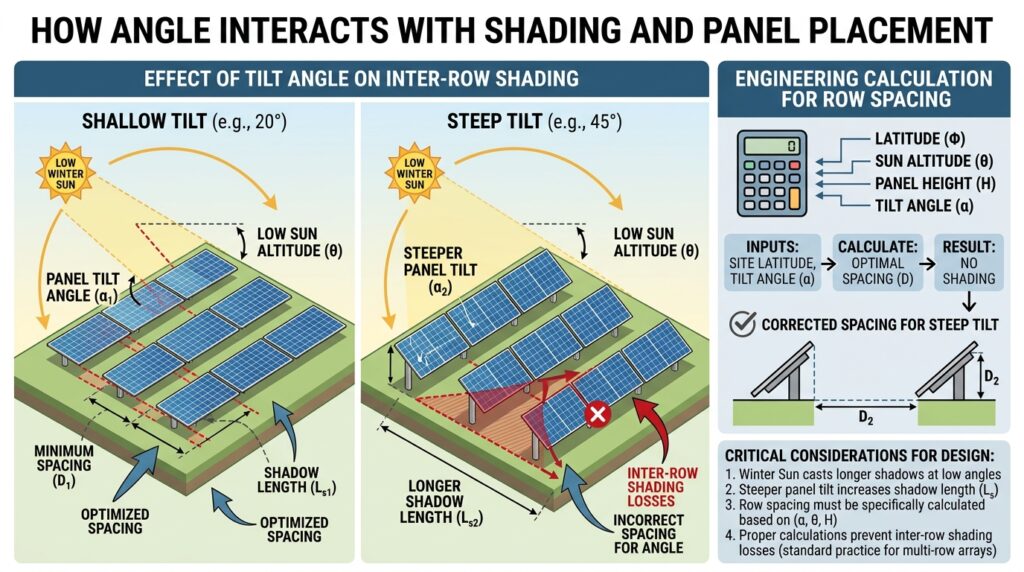
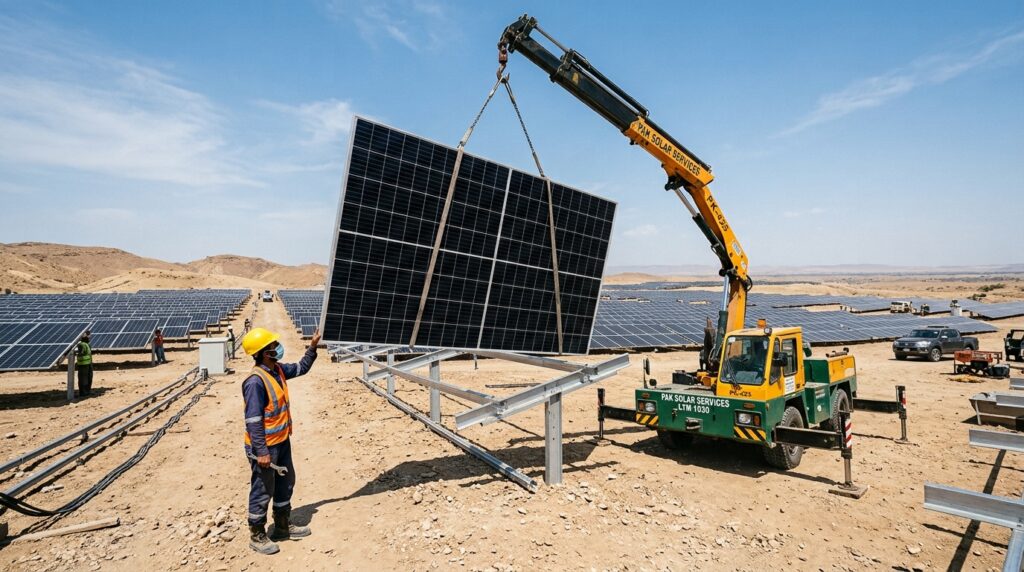
Panel angle does not exist in isolation from the broader installation layout, and how it interacts with shading patterns across the day deserves careful consideration during system design. A panel mounted at a steeper angle can sometimes cast a longer shadow onto panels mounted behind it in a multi-row array, particularly during winter months when the sun sits lower in the sky, meaning row spacing calculations need to account for the chosen tilt angle to avoid inter-row shading losses. This consideration becomes particularly important for larger commercial and industrial installations using multiple rows of ground-mounted or elevated panels, where proper spacing calculated specifically for the chosen angle and the site’s latitude prevents one row from shading another during critical sunlight hours, a design detail our engineering team calculates as standard practice for every multi-row installation regardless of project size.
Bifacial panels, which generate additional electricity from their rear surface by capturing reflected light, introduce an additional angle-related consideration beyond standard front-facing optimization. The mounting angle and height above the roof or ground surface both influence how much reflected light reaches the panel’s rear surface, meaning bifacial installations sometimes benefit from a slightly different angle calculation than standard monofacial panels, particularly when combined with a reflective or light-colored roofing surface that enhances the rear-side light capture. For commercial and industrial projects specifically using bifacial technology, covered in more detail in our guide to high efficiency solar panels, our engineering team factors this additional consideration into the mounting angle and height calculation to maximize the bifacial performance advantage rather than simply applying a standard monofacial angle calculation.
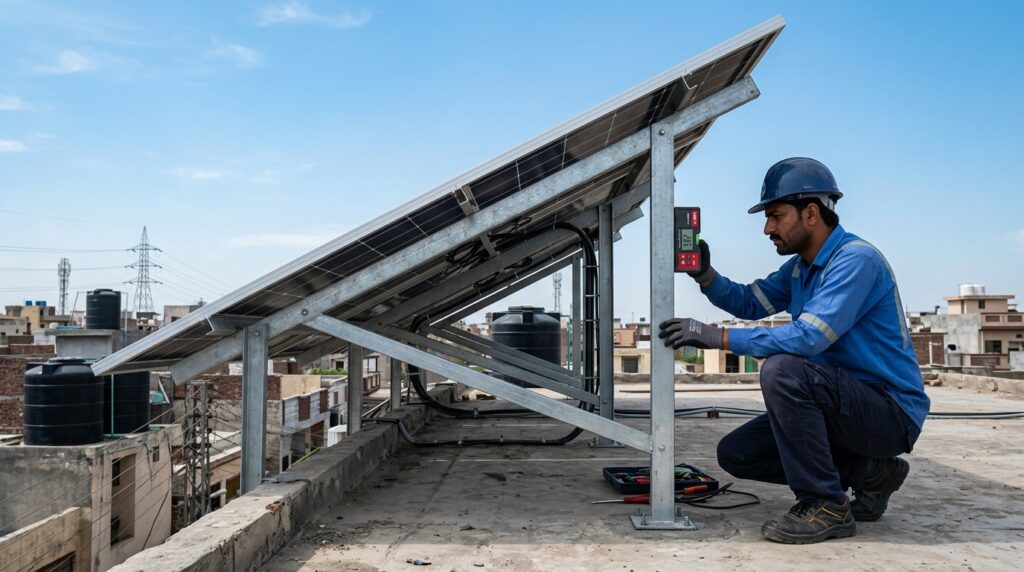
For homeowners and business owners overseeing their own solar installation, a few simple checks help verify that the mounting angle actually matches what was specified in the system design before installation is finalized. A basic digital angle finder or smartphone app with an inclinometer function can quickly confirm the actual mounted angle of the panels, allowing any discrepancy from the intended design angle to be caught and corrected before the installation is fully completed and difficult to adjust. Comparing this measured angle against the recommended range for your specific city, covered earlier in this guide, provides a quick sanity check that the installer has calculated and executed the mounting angle correctly rather than defaulting to a generic or convenient angle without proper site-specific calculation.
For buyers who want a quick way to estimate their own ideal tilt angle without waiting for a professional site survey, a widely used rule of thumb in the solar industry is to set the panel tilt angle roughly equal to the location’s latitude for balanced year-round performance. Since Pakistan spans latitudes roughly between 24 and 37 degrees north from the southern coast to the northern mountains, this rule of thumb produces the ranges discussed earlier for each major city. For installations specifically prioritized toward maximizing summer generation, since Pakistan’s electricity demand and tariffs peak during the hottest months, a common adjustment is to subtract roughly ten to fifteen degrees from the latitude-based figure, which shifts the panel toward a shallower angle that performs better when the sun sits higher in the summer sky, at some modest cost to winter performance. Conversely, for installations prioritizing winter generation, adding roughly ten to fifteen degrees to the latitude-based figure shifts the panel toward a steeper angle better suited to capturing the lower winter sun position. Most residential systems in Pakistan use the balanced, latitude-matched approach as a sensible default, since it avoids over-optimizing for one season at the expense of the other.
To fully appreciate why angle calculations matter, it helps to understand how dramatically the sun’s position actually shifts across the year at any given Pakistani location. During the summer solstice in June, the sun reaches its highest point in the sky for the year across the entire country, meaning panels can perform reasonably well even at a fairly shallow angle during this period, since sunlight strikes closer to perpendicular even without a steep tilt. During the winter solstice in December, the sun sits dramatically lower in the sky, particularly in northern cities like Islamabad, meaning a shallow-angled panel captures noticeably less usable sunlight during these winter months compared to a properly angled one. This seasonal swing is more pronounced at higher latitudes, which is precisely why northern Pakistani cities require a comparatively steeper angle than southern coastal cities like Karachi to maintain strong performance across the full year rather than only during summer months when the sun’s high position is more forgiving of angle miscalculations.
To make the financial impact of angle concrete, consider a household in Lahore installing a 5 kW system. If the panels are mounted at a poorly chosen angle of, for example, 10 degrees rather than the recommended 28 to 33 degree range for the city’s latitude, the system might realistically generate somewhere between ten and eighteen percent less electricity annually than an identically sized system mounted at the correct angle. For a household expecting monthly savings of PKR 10,000 to 18,000 from a properly angled 5 kW system, a fifteen percent shortfall due to poor angle calculation could mean losing roughly PKR 1,500 to PKR 2,700 in potential monthly savings, adding up to significant lost value over the system’s 25-year operational life. This example illustrates why angle calculation deserves the same careful attention as panel brand selection or inverter sizing during system design, rather than being treated as a minor installation detail left to whatever happens to be structurally convenient at the time.
For homeowners specifically focused on maximizing net metering benefits, panel angle plays a particularly important role, since net metering credits are earned based on surplus electricity exported to the grid during periods when generation exceeds household consumption, typically concentrated around midday. A properly angled system captures more total electricity across these peak generation hours, directly increasing the surplus available for export and the resulting net metering credits earned each billing cycle. Since net metering export credits, discussed in more detail through our net metering services page, currently sit around PKR 19 to 21 per unit in Pakistan, even a modest angle-related improvement in peak generation capacity can meaningfully increase the monthly credit value earned by a well-designed system compared to a poorly angled equivalent.
While most of this guide focuses on rooftop installations, angle calculations apply equally, and in some ways more flexibly, to ground-mounted systems commonly used for agricultural tube wells and off-grid rural applications across Pakistan. Ground-mounted systems offer complete freedom to select any desired tilt angle without any roof pitch constraint, making it easier to achieve the theoretically ideal latitude-based angle for the specific installation site. This flexibility is particularly valuable for larger agricultural installations, discussed further in our off-grid solar systems guide, where even a small percentage improvement in generation efficiency can meaningfully affect how much water a solar-powered tube well pump can move across a full irrigation season, directly impacting agricultural productivity for the farm relying on the system.
While the rule-of-thumb approach outlined earlier provides a reasonable starting estimate, a proper professional site survey accounts for additional site-specific factors that a simple latitude-based calculation cannot capture on its own, including precise roof orientation relative to true south, any physical obstructions or shading sources unique to the property, and the specific trade-offs between summer and winter performance that best match the household’s actual consumption pattern throughout the year. Pakistan Solar Solutions conducts a full site survey and energy audit for every project, calculating the optimal tilt angle specifically for your roof’s exact orientation, your city’s precise latitude, and your household’s consumption pattern, rather than applying a generic estimate that might leave meaningful performance on the table. You can review our complete solar panel price in Pakistan overview or reach out through our contact page to arrange a free site survey that includes proper angle calculation as a standard part of the system design process.
Not every Pakistani home has a roof conveniently oriented to face directly south, and this is one of the most common real-world constraints installers encounter during system design. When a roof faces southeast, southwest, or even east or west due to the property’s specific orientation relative to the street and surrounding plots, the system will generally still function well, though with a modest reduction in total annual generation compared to a true south-facing equivalent. A roof oriented up to around 30 degrees away from true south in either direction typically experiences only a small generation penalty, often in the range of two to five percent, meaning most moderately off-axis roofs remain perfectly viable for solar installation without requiring unusual mounting solutions. For roofs oriented more significantly away from true south, installers sometimes use angled mounting brackets to correct the panel’s effective azimuth independent of the roof’s actual orientation, essentially building a frame that points the panels toward true south even though the underlying roof surface faces a different direction. This correction adds some mounting complexity and cost but can meaningfully improve generation for a poorly oriented roof, and our team evaluates whether this correction is worthwhile on a case-by-case basis depending on how far off-axis the specific roof happens to be and how much additional generation the correction would realistically capture.
While maximizing electricity generation is usually the primary goal, some homeowners in Pakistan also weigh aesthetic considerations when finalizing panel angle, particularly for properties where the rooftop installation is visible from the street or neighboring buildings and the homeowner has preferences about how prominent or low-profile the mounting structure appears. A lower, more flush-mounted angle tends to be less visually prominent but sacrifices some generation compared to the theoretically optimal steeper angle, while a more pronounced, professionally calculated tilt captures more electricity but creates a more visible structure on the roofline. Most homeowners ultimately prioritize generation performance once they understand the financial trade-off involved, but for properties with specific architectural or homeowner association considerations, a knowledgeable installer can usually find a reasonable middle ground that balances both concerns without sacrificing an excessive amount of system performance for purely cosmetic reasons.
Homeowners curious about their roof’s current orientation and any existing structures’ angle before contacting an installer can use a few simple, freely available tools to get a rough initial sense of their situation. Most modern smartphones include a built-in compass application that can indicate roughly which direction a roof or wall faces relative to true north, providing a quick starting point for understanding whether a roof leans toward true south or veers noticeably east or west. Free satellite mapping tools available online also allow homeowners to view their property from above, helping visually confirm roof orientation and identify potential shading sources such as neighboring buildings, trees, or water tanks that might affect panel placement regardless of the chosen tilt angle. While these tools provide a useful preliminary understanding, they are not a substitute for a proper professional site survey, which uses specialized equipment and shading analysis software to calculate precise, site-specific angle recommendations that account for factors a smartphone compass or satellite image alone cannot fully capture, such as exact seasonal shading patterns throughout the year or fine-grained roof pitch measurements.
To illustrate how meaningfully angle recommendations vary across the country, consider the practical difference between a Karachi installation and an Islamabad installation using the same panel technology and system size. In Karachi, given the city’s relatively low latitude and correspondingly modest recommended tilt angle of 20 to 25 degrees, even a somewhat casually mounted system closer to 15 degrees might only sacrifice a modest percentage of potential annual generation, since the sun’s higher average position throughout the year in this coastal region is more forgiving of angle imprecision. In Islamabad, however, given the city’s higher latitude and steeper recommended angle of 30 to 35 degrees, an identically casual mounting choice at 15 degrees would sacrifice a considerably larger percentage of potential generation, since the lower average winter sun position in this northern city punishes an insufficiently steep angle far more severely than the same error would in Karachi. This comparison highlights why buyers and installers in Pakistan’s northern cities should pay particularly close attention to proper angle calculation, since the financial cost of getting it wrong is meaningfully higher there than it would be for an equivalent installation closer to the coast.
For Lahore, at approximately 31.5 degrees north latitude, a tilt angle between 28 and 33 degrees generally provides the best year-round performance for most residential and commercial installations.
Yes. A properly calculated angle compared to a poorly chosen or flat installation can represent a difference of ten to twenty percent in total annual electricity generation, directly affecting how quickly your system pays back its cost and how much your monthly bill actually drops.
Generally yes. Since Pakistan sits in the northern hemisphere, south-facing panels typically capture the most consistent sunlight throughout the day and across the year, making south the recommended default orientation for most installations unless specific site constraints require an alternative direction.
For most residential and small commercial installations, no. A well-calculated fixed angle captures the vast majority of the theoretical maximum generation achievable with seasonal adjustment, typically within two to five percent, meaning the added cost and maintenance of an adjustable structure rarely provides proportional value for typical buyers.
While technically possible, installing panels completely flat generally reduces annual generation compared to a properly calculated tilt angle, since flat panels perform worse during the morning and evening hours when the sun sits at a lower position in the sky. A calculated tilt angle based on your city’s latitude is recommended for optimal performance.