

Air conditioning is, without question, the single biggest electricity consumer in most Pakistani households during the summer months, and it is also the single biggest reason people research solar in the first place. Running an AC on WAPDA or K-Electric power through a brutal June and July can push a household’s monthly bill into tens of thousands of rupees, which is exactly why so many homeowners specifically search for the best solar system for AC in Pakistan rather than a generic residential solar package. The challenge is that air conditioners have a very different load profile compared to lighting, fans or refrigeration, and sizing a system incorrectly for AC use is one of the most common and costly mistakes buyers make.
This guide walks through exactly how much solar capacity different AC sizes require, how battery backup factors into running an AC at night, and what a properly sized solar-for-AC system actually costs in Pakistan today.
Unlike a fan or a few LED bulbs, an air conditioner draws a large, concentrated electrical load the moment it starts, followed by continuous consumption for as long as it runs. A standard 1.5 ton split AC unit typically draws between 1,500 and 2,000 watts during steady operation, with a noticeably higher surge load during the compressor’s initial startup. This means a solar system built around AC use needs to account not just for total daily energy consumption, but also for the instantaneous power the inverter must be able to deliver at the moment the compressor kicks in, which is a very different design consideration than sizing a system purely for lighting and small appliances.
Panel requirements scale directly with AC tonnage, and getting this calculation right from the start avoids the common problem of an undersized system that cannot actually run the AC reliably, particularly during peak afternoon heat when cooling demand is highest.
A 1 ton inverter AC typically consumes around 900 to 1,200 watts during steady-state operation. To reliably power this load alongside basic household consumption, a minimum 3 kW solar system, using five to six panels rated around 550 to 600 watts, is generally recommended, giving enough headroom for both the AC and everyday household loads running simultaneously.
A 1.5 ton inverter AC, the most common size installed in Pakistani homes, draws approximately 1,500 to 1,800 watts under normal operation. Running this comfortably alongside general household consumption typically requires at minimum a 5 kW system, using eight to nine panels rated around 580 to 615 watts, which is why the standard 5 kW package remains the most frequently installed residential configuration across Pakistan.
A 2 ton AC draws meaningfully more power, generally between 2,000 and 2,500 watts, and running even a single 2 ton unit alongside typical household loads usually pushes the recommended system size to 7 kW or higher. Homes running multiple AC units, a common scenario in larger houses across Lahore, Karachi and Islamabad during peak summer, often require a 10 kW system or larger to comfortably cover simultaneous AC operation across multiple rooms without straining the inverter.
The type of air conditioner installed makes a significant difference to solar system sizing. Inverter-type ACs, now standard in most new installations across Pakistan, modulate their compressor speed based on cooling demand rather than switching fully on and off, which results in a smoother, more predictable power draw that is considerably easier for a solar system and inverter to handle efficiently. Older non-inverter ACs cycle the compressor fully on and off, creating sharp power spikes each time the compressor restarts, which places a heavier instantaneous demand on the solar inverter and generally requires a system sized with more headroom to handle these surges reliably without tripping or underperforming.
For AC-focused solar planning, the choice between an on-grid solar system and a hybrid solar system carries particular weight, since AC usage patterns often extend into the evening and night, well beyond when solar panels are actively generating electricity. An on-grid system works well for households that primarily run their AC during daylight hours and are comfortable falling back to grid electricity in the evening, since net metering credits earned during peak daytime generation help offset the cost of nighttime grid consumption. For households that run AC heavily through the night, particularly common during Pakistan’s hottest months when nighttime temperatures remain uncomfortably high, a hybrid system with a properly sized lithium battery bank is generally the better choice, since it allows the AC to run on stored solar energy after sunset rather than drawing directly and continuously from the grid.
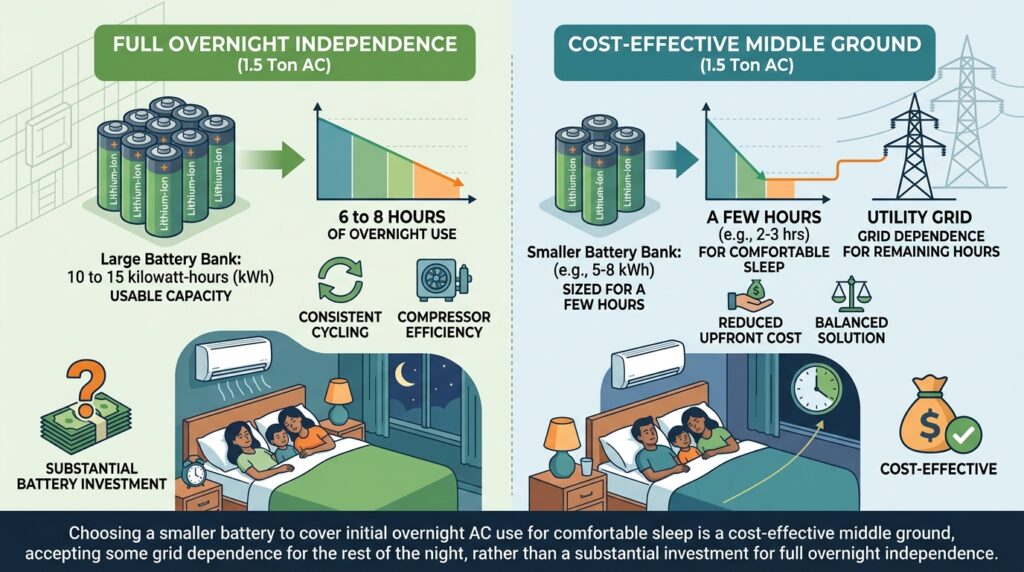
Running an AC through the night on battery power requires meaningfully more storage capacity than a standard hybrid system designed for basic lighting and fan backup. A 1.5 ton AC running for six to eight hours overnight typically requires a battery bank in the range of 10 to 15 kilowatt-hours of usable capacity, depending on the specific compressor efficiency and how consistently the unit cycles through the night. This is a substantial battery investment, and for many households, a more cost-effective middle ground is sizing the battery bank to cover a few hours of overnight AC use for comfortable sleep, while accepting some grid dependence for the remaining hours, rather than attempting to achieve full overnight independence purely through battery storage.
For a smaller home running a single 1 to 1.5 ton AC unit primarily during the day, a 5 kW on-grid system offers the best balance of cost and effectiveness, comfortably covering the AC alongside standard household loads while keeping upfront investment reasonable. For a medium-sized home running one AC unit through both day and evening hours, a 5 kW to 7 kW hybrid system with a moderate battery bank provides a practical middle ground, extending AC comfort into the evening without the cost of full overnight battery coverage. For larger homes running multiple AC units across several rooms, a 10 kW or larger hybrid system, sized through a proper energy audit rather than a generic estimate, is generally necessary to comfortably handle simultaneous AC operation without straining the inverter or battery bank.
A 5 kW on-grid system suitable for a single 1.5 ton AC alongside standard household loads typically costs between PKR 650,000 and PKR 850,000 fully installed. Adding hybrid capability with a moderate lithium battery bank for extended evening AC use raises this to roughly PKR 850,000 to PKR 1,100,000. For larger homes requiring a 10 kW hybrid system with substantial battery capacity to support multiple AC units well into the night, total installed cost typically ranges from PKR 1,400,000 to PKR 1,700,000 or higher depending on the exact battery specification. A complete breakdown of system pricing across all configurations is available on our solar panel price in Pakistan page.
The most frequent mistake homeowners make is sizing a solar system based only on general household consumption without properly accounting for AC as a distinct, heavy load, resulting in a system that technically works but leaves the AC struggling or forces frequent grid fallback during peak summer heat, exactly when solar independence matters most. Another common error is underestimating battery requirements for households that genuinely want overnight AC coverage, leading to disappointment when a modestly sized battery bank depletes within a couple of hours rather than lasting through the night. Choosing an inverter or charge controller that is undersized relative to the AC’s startup surge is another frequent issue, which is why working with a PEC-certified engineering team that properly calculates surge loads, rather than relying on rough estimates, matters significantly for any system where AC is the primary intended use.
A 1.5 ton inverter AC alongside standard household loads generally requires a minimum 5 kW solar system, using eight to nine panels rated around 580 to 615 watts each.
Yes, but it requires a properly sized hybrid system with a substantial battery bank, typically in the range of 10 to 15 kilowatt-hours of usable capacity for a 1.5 ton AC running six to eight hours overnight. This significantly increases total system cost compared to a daytime-only on-grid setup.
On-grid systems work well for households running AC mainly during daylight hours, since net metering credits offset evening grid consumption. Hybrid systems with battery backup are better suited to households running AC heavily into the night, allowing continuous power without relying on the grid after sunset.
A system capable of comfortably running a 2 ton AC alongside household loads typically starts around a 7 kW configuration, with fully installed on-grid pricing generally falling between PKR 900,000 and PKR 1,200,000, and hybrid configurations costing more depending on battery capacity.
Yes. Inverter-type ACs modulate compressor speed based on demand, resulting in a smoother, generally lower average power draw compared to non-inverter units, which cycle fully on and off and create sharper power spikes. This makes inverter ACs noticeably easier and more efficient to run on a solar system.