

The solar panel market in Pakistan is evolving rapidly, and one of the most significant technological shifts happening right now is the transition from conventional single-sided panels to bifacial solar panels. If you have been asking suppliers about the bifacial solar panel price in Pakistan or wondering whether the extra cost is justified, this guide gives you every answer you need backed by real data and Pakistani market conditions.
Bifacial solar panels are no longer a premium niche product available only to large commercial solar farms. They are now mainstream technology offered by every major panel brand, and the bifacial solar panel price in Pakistan has come down dramatically over the last two years to the point where many buyers are choosing bifacial as their standard option rather than a premium upgrade. Understanding what you get for the additional cost, when bifacial makes sense, and which brands offer the best value in Pakistan’s market is critical before making your decision.
At Pakistan Solar Solutions, bifacial panels have become one of our most popular product categories, and this comprehensive guide draws on our direct market experience to give Pakistani buyers the most accurate and useful information available.
A conventional solar panel generates electricity only from its front surface. The silicon cells on the front face absorb sunlight and convert it to electricity, while the back of the panel is covered by an opaque white backsheet that simply protects the internal components. This means that any light reaching the back of the panel, whether reflected from the roof surface, scattered by clouds, or bounced from nearby walls, is completely wasted.
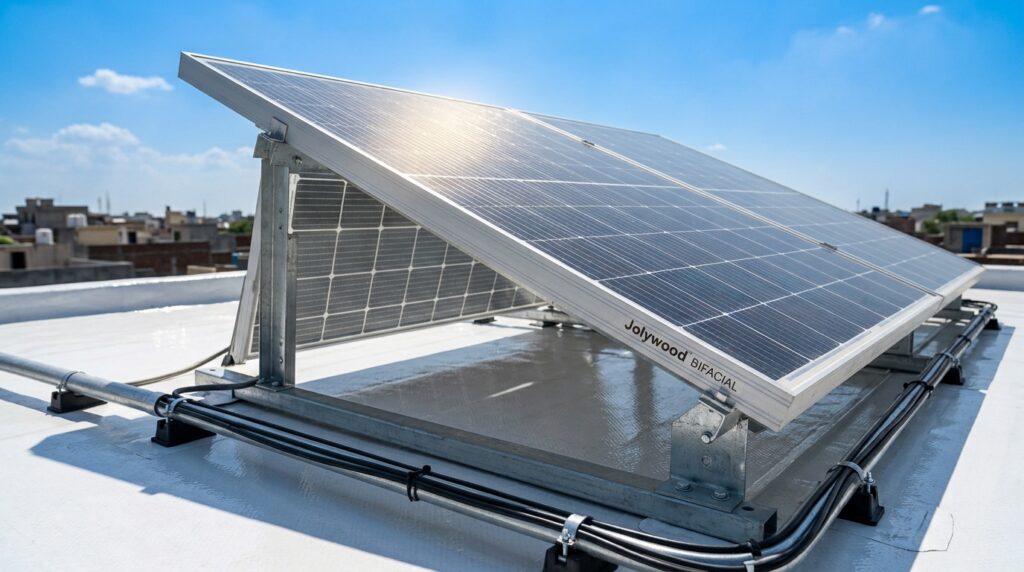
A bifacial solar panel, as the name indicates, generates electricity from both its front and rear surfaces. The rear of the panel is covered with a transparent glass sheet instead of an opaque backsheet, allowing light to pass through and reach a second layer of solar cells that converts this additional light into electricity. The extra electricity generated by the rear surface is called bifacial gain and typically adds five to thirty percent more power output compared to the same panel’s rated front-only output.
The actual bifacial gain achieved in any installation depends on how much light reaches the rear surface, which is determined by the albedo or reflectivity of the surface beneath the panels, the height of the panels above the surface, and the angle and orientation of the installation. Light-coloured or white surfaces like concrete rooftops, which are extremely common in Pakistani cities, reflect significantly more light onto the panel’s rear than dark surfaces. This makes bifacial panels particularly well-suited to typical Pakistani urban rooftop installations.
The bifacial solar panel price in Pakistan in 2025 reflects the technology’s rapid maturation and increasing manufacturing scale. What was once a significant premium over conventional panels has shrunk considerably, making bifacial one of the most cost-effective technology choices available.
For standard bifacial PERC monocrystalline panels from established brands in the five hundred and fifty to six hundred watt range, the bifacial solar panel price in Pakistan sits between forty and forty-six rupees per watt. Compared to equivalent non-bifacial PERC panels of the same brand, bifacial models typically command a premium of three to six rupees per watt.
For N-type bifacial panels using TOPCon or HJT cell technology, including the Longi Hi-MO X10, Jinko Tiger Neo, and Canadian Solar TOPCON series, the bifacial solar panel price in Pakistan ranges from forty-three to fifty-five rupees per watt depending on the specific model and wattage. These panels deliver higher base efficiency and better bifacial gain performance compared to PERC bifacial panels, but at a higher initial cost.
When evaluating the bifacial solar panel price in Pakistan, it is essential to calculate the cost per watt of actual delivered energy rather than just the panel’s front-rated wattage. If a bifacial panel rated at five hundred and eighty watts achieves a bifacial gain of fifteen percent, it effectively delivers the equivalent of six hundred and sixty-seven watts of output. This reframing makes the per-watt cost of a bifacial panel much more attractive than the sticker price suggests. For more context on per-watt pricing across all panel types, visit our solar panel watt price guide at Pakistan Solar Solutions.
Pakistan’s solar market is served by several world-leading manufacturers whose bifacial panels are widely available and genuinely well-supported.
Longi Solar is the most trusted bifacial panel brand in Pakistan and arguably the most technically advanced bifacial manufacturer in the world. Their Hi-MO 6 bifacial PERC panels in the five hundred and fifty to six hundred and ten watt range are priced between forty and forty-four rupees per watt. Their flagship Hi-MO X10 N-type bifacial TOPCon panels, offering up to twenty-three percent efficiency and excellent bifacial gain, are priced at forty-four to forty-nine rupees per watt. Longi backs their panels with a twenty-five year linear performance warranty guaranteeing no more than zero point four percent annual degradation.
Jinko Solar’s Tiger Neo series represents one of the most popular N-type bifacial options in Pakistan. These panels, available in the five hundred and eighty to six hundred and thirty watt range, are priced at forty-three to forty-eight rupees per watt and offer outstanding bifacial gain performance. Jinko Tiger Pro PERC bifacial panels are slightly more affordable at thirty-nine to forty-three rupees per watt and represent an excellent mid-range bifacial option for Pakistani buyers.
JA Solar’s Deep Blue 4.0 and JAM72D series bifacial panels are competitively priced in Pakistan at thirty-eight to forty-three rupees per watt. JA Solar has a strong track record in Pakistan’s market and offers reliable performance at a very accessible bifacial solar panel price in Pakistan, making their panels particularly popular for commercial-scale installations where cost management is critical.
Canadian Solar’s BiHiKu and TOPCON bifacial series command a premium in the Pakistani market at forty-one to fifty rupees per watt, reflecting the brand’s strong global reputation for durability and consistent quality. Canadian Solar panels are a popular choice for buyers who prioritise long-term reliability above lowest upfront cost.
Trina Solar’s Vertex series bifacial panels offer another strong option in Pakistan, typically priced at thirty-eight to forty-four rupees per watt for their PERC bifacial models. Trina is one of the world’s largest panel manufacturers and their Vertex panels are engineered specifically for large-surface, high-wattage applications.
At Pakistan Solar Solutions, we stock bifacial panels from all the above brands and can provide verified pricing, documentation, and after-sales support.
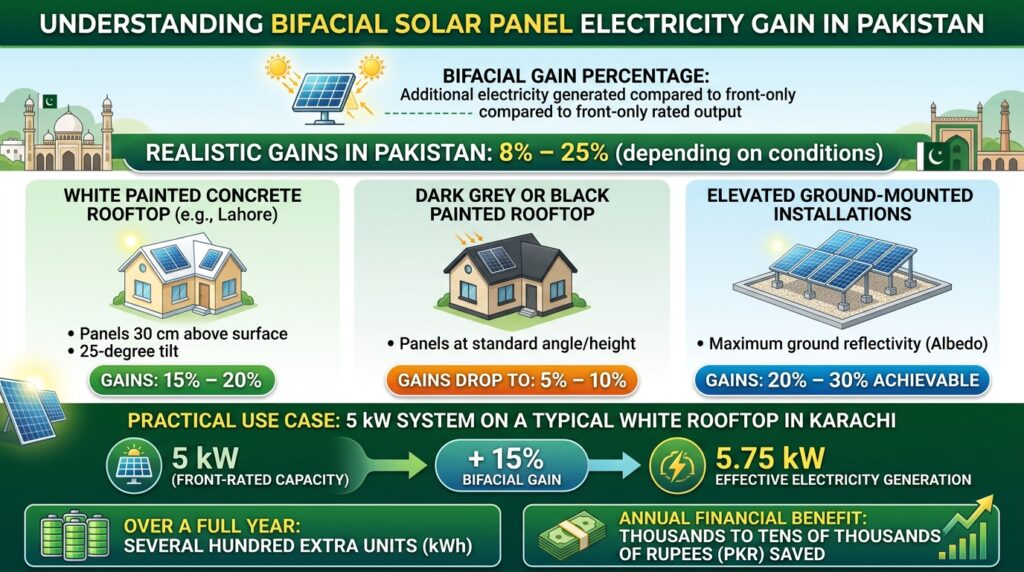
The bifacial gain percentage determines how much additional electricity a bifacial panel generates compared to its front-only rated output. In Pakistan’s conditions, realistic bifacial gains range from eight to twenty-five percent depending on installation conditions.
On a white painted concrete roof in Lahore with panels mounted at thirty centimetres above the surface and tilted at twenty-five degrees, the bifacial gain might be fifteen to twenty percent. On a dark grey or black painted roof, the gain drops to five to ten percent. On elevated ground-mounted installations with light-coloured gravel or concrete beneath, bifacial gains of twenty to thirty percent are achievable.
To put this in practical terms for a Pakistani household with a five kilowatt bifacial solar system on a typical white concrete rooftop in Karachi: the system might achieve a bifacial gain of fifteen percent, effectively generating the equivalent of five point seven-five kilowatts of electricity from five kilowatts of front-rated panel capacity. Over a full year, this additional generation represents several hundred extra units of electricity worth several thousand to tens of thousands of rupees annually at current tariff rates.
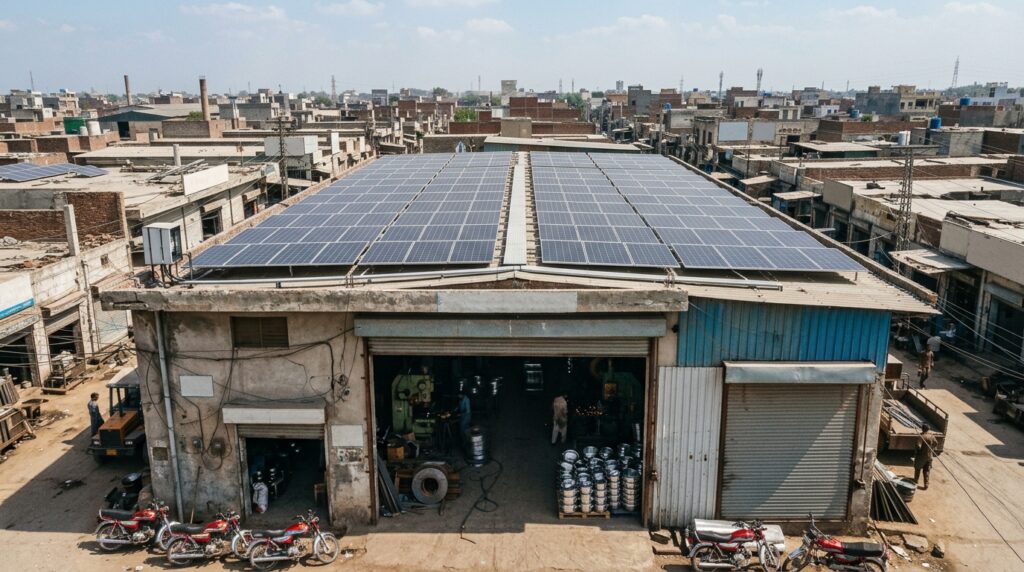
Pakistan’s reflective white rooftops, which are extremely common across urban centres, are one of the best environments for bifacial solar panels in Asia. Pakistani buyers installing on white concrete rooftops are in an ideal position to maximise bifacial gain from their investment.
The question of whether to choose a bifacial panel over a conventional monofacial panel depends on your specific installation conditions, roof type, and budget priorities.
For rooftop installations on white or light-coloured concrete, bifacial panels are clearly superior. The higher cost per watt is more than recovered through the additional electricity generated from the rear surface, and over a twenty-five year period the total lifetime electricity output of a bifacial system significantly exceeds an equivalent monofacial system installed in the same location.
For rooftop installations on dark-coloured roofing materials, terracotta tiles, or bitumen membrane roofs, the bifacial gain is reduced and the financial case for bifacial becomes less clear. In these situations, investing the additional budget in more panels or a better inverter may deliver better overall return.
For ground-mounted installations, bifacial panels are almost always the better choice. Ground-mounted systems can be elevated higher above the reflective surface beneath them, maximising rear-side irradiance and bifacial gain.
For carport and pergola structures where panels are elevated above a concrete or light-coloured surface with light accessible from below, bifacial panels are exceptional performers and the investment premium is easily justified.
Our team at Pakistan Solar Solutions can assess your specific rooftop conditions and calculate the expected bifacial gain for your installation before you commit to a purchase, helping you make the most informed decision.
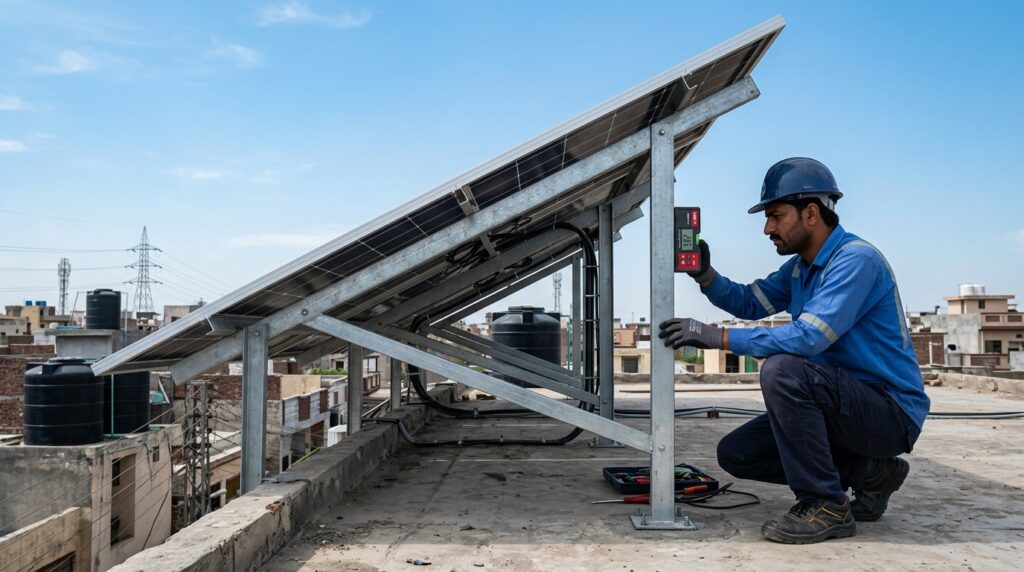
Getting the most from bifacial panels requires specific installation practices that differ from conventional panel installations. These considerations should be discussed with your installation team before work begins.
The mounting height above the roof surface significantly affects bifacial gain. Panels mounted too close to the surface, less than fifteen centimetres, receive limited rear irradiance because the panel itself shadows the roof beneath it. Raising the mounting height to thirty centimetres or more allows more reflected light to reach the rear surface from the sides, improving bifacial gain.
The mounting structure must be compatible with bifacial panels. Since both surfaces of a bifacial panel are active, the mounting clamps or frames must be designed not to shade the rear surface. Opaque clamps across the centre of the panel create a shading line on the rear side that reduces bifacial output. Purpose-designed mounting structures for bifacial panels use minimised contact points or transparent elements to avoid this issue. Our solar mounting structure guide at Pakistan Solar Solutions covers the options available in Pakistan.
Soiling on the rear surface of bifacial panels also reduces their output. Unlike conventional panels where only the front needs cleaning, bifacial panels benefit from cleaning on both surfaces. This is particularly relevant in Pakistan’s dusty environment. Using the right cleaning tools and following a proper cleaning schedule, as detailed in our solar panel cleaning brush article at Pakistan Solar Solutions, is even more important for bifacial installations.
Beyond the bifacial solar panel price in Pakistan itself, the total system cost includes all supporting components. For a complete five kilowatt bifacial solar system in Pakistan in 2025, here is a realistic cost picture.
Ten to eleven bifacial panels of five hundred to five hundred and eighty watts from a quality brand at forty to forty-four rupees per watt cost between two hundred thousand and two hundred and forty-two thousand rupees. A five kilowatt hybrid solar inverter adds one hundred thousand to two hundred and fifty thousand rupees depending on brand and features, which you can research in our hybrid solar inverter guide at Pakistan Solar Solutions. Mounting structure designed for bifacial panels adds fifteen thousand to thirty thousand rupees, slightly more than standard mounting due to bifacial-specific requirements. Cables, protection equipment, and installation labour add another thirty thousand to sixty thousand rupees.
A complete five kilowatt bifacial on-grid solar system in Pakistan therefore costs approximately three hundred and fifty thousand to five hundred and fifty thousand rupees installed. Adding a quality lithium ion battery bank increases this to five hundred and fifty thousand to eight hundred thousand rupees. Given the additional electricity generation from the bifacial rear surface, the effective cost per kilowatt-hour of lifetime electricity generated from a bifacial system is often lower than a cheaper monofacial alternative when the full lifetime picture is considered.
The trajectory of Pakistan’s solar panel market is clearly pointing toward bifacial as the new standard. All five major global panel brands, Longi, Jinko, JA Solar, Canadian Solar, and Trina Solar, have shifted their primary manufacturing focus to bifacial products. Production of conventional monofacial backsheet panels is being phased out at most major facilities. Within the next two to three years, bifacial will likely be the only widely available option from Tier-1 brands in Pakistan.
This means that buyers investing in bifacial today are getting the current best technology that will continue to be supported, warrantied, and serviced by their manufacturers for decades. Buyers who choose older monofacial technology at a slightly lower bifacial solar panel price in Pakistan relative saving may find themselves with a discontinued product category within a few years. For a long-term investment, backing the technology that the industry is moving toward is always the smarter choice.
What is the actual bifacial solar panel price in Pakistan for a quality brand today?
Quality bifacial PERC panels from established brands like Longi, Jinko, and JA Solar are available in Pakistan at approximately thirty-eight to forty-six rupees per watt in 2025. Premium N-type bifacial panels cost forty-three to fifty-five rupees per watt. These prices are for A-grade panels with full documentation and warranty support.
Do bifacial solar panels work better in summer or winter in Pakistan?
Bifacial panels perform relatively better in summer because higher sun angles and more light intensity increase both front and rear irradiance. However, they also perform comparatively better than monofacial panels in winter and low-light conditions because the N-type cell technology used in many bifacial panels has superior low-irradiance performance compared to PERC technology.
How much more electricity does a bifacial panel produce on a typical Pakistani rooftop?
On a white concrete rooftop in Pakistan, which is the most common rooftop type in urban areas, bifacial panels typically achieve a gain of ten to twenty percent additional electricity generation compared to their front-only rated output. In optimal ground-mounted conditions with highly reflective surfaces, this can reach twenty-five to thirty percent.
Are bifacial solar panels more difficult to install in Pakistan?
Bifacial panels require some additional installation considerations including appropriate mounting height, bifacial-compatible clamps, and attention to rear surface cleanliness. However, they are not significantly more difficult to install than conventional panels, and any experienced Pakistani solar installer should be familiar with bifacial installation best practices.
Do bifacial solar panels require special inverters or charge controllers in Pakistan?
No, bifacial solar panels connect to inverters and charge controllers in exactly the same way as conventional panels. They produce standard DC electricity and are fully compatible with all major hybrid and on-grid inverters available in Pakistan, including the models covered in our guides at Pakistan Solar Solutions.