

When Pakistani consumers begin researching solar energy, one of the first questions they ask is not simply about the total cost of a system but specifically about the solar panel watt price in Pakistan. This per-watt pricing model is how the solar industry measures and compares the value of different panels, brands, and technologies against each other. Understanding how watt pricing works, what determines it, and how to use it to your advantage is essential before spending a single rupee on solar equipment.
Pakistan has become one of the world’s fastest-growing solar markets. In 2024 alone, the country imported over seventeen gigawatts of solar panel capacity, more than any other nation on earth. Electricity tariffs have more than doubled since 2021, and load shedding continues to disrupt daily life across urban and rural Pakistan alike. In this environment, understanding the solar panel watt price in Pakistan is not just an academic exercise but a practical financial skill that can save Pakistani buyers tens of thousands of rupees.
At Pakistan Solar Solutions, we help Pakistani consumers decode pricing, compare brands honestly, and make the most cost-effective solar investment decisions. This guide breaks down everything you need to know about solar panel watt pricing in Pakistan for 2025.
The solar panel watt price in Pakistan refers to the cost per watt of peak power output of a solar panel. It is calculated by dividing the total price of a panel by its wattage rating. For example, if a four hundred and fifty watt monocrystalline panel costs eighteen thousand rupees, the per watt price is forty rupees per watt. If a five hundred and fifty watt panel costs twenty-four thousand two hundred rupees, the per watt price is forty-four rupees per watt.
This per-watt metric allows you to compare panels of different sizes and brands on a level playing field. Without it, it would be impossible to determine whether a cheaper smaller panel or a more expensive larger panel gives you better value for money. The solar panel watt price in Pakistan is therefore the single most important number to understand when shopping for solar panels, far more useful than the total panel price alone.
Per watt pricing also helps you calculate the total cost of your planned system. If you need a ten kilowatt system and panels are priced at forty rupees per watt, the panel cost alone will be four hundred thousand rupees. This makes budgeting straightforward and allows you to compare quotes from different suppliers on a consistent basis.
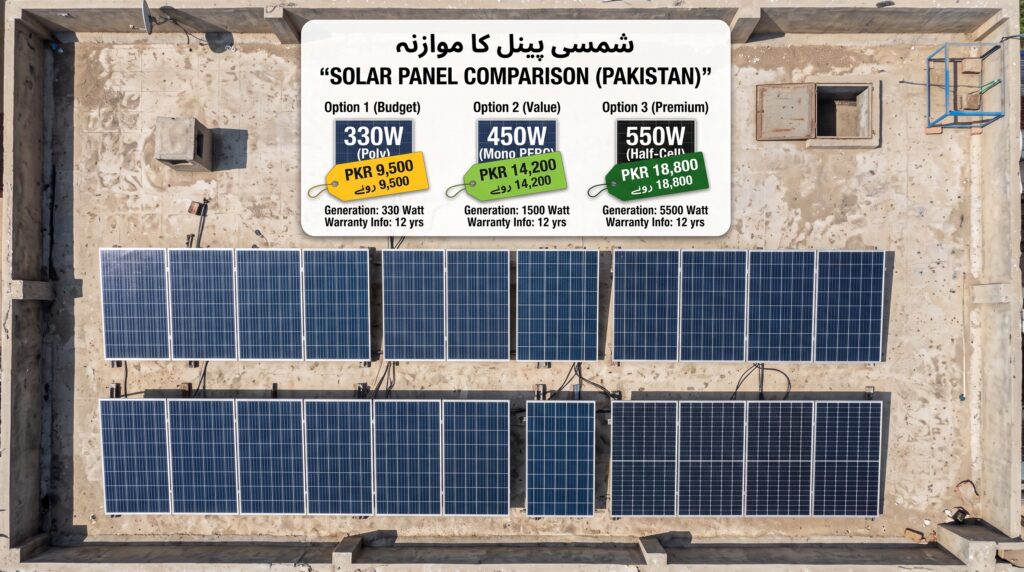
The solar panel watt price in Pakistan in 2025 ranges from approximately twenty-two rupees per watt for budget grade B panels to fifty-five rupees per watt for premium N-type bifacial panels from top-tier international brands. The wide range reflects the enormous diversity in panel quality, technology, and warranty available in Pakistan’s market.
For A-grade monocrystalline PERC panels from established Tier-1 brands like Longi, Jinko Solar, JA Solar, Canadian Solar, and Trina Solar, the solar panel watt price in Pakistan currently sits between thirty-eight and forty-eight rupees per watt depending on the specific model, wattage, and supplier. These are the panels that form the backbone of most quality residential and commercial solar installations across Pakistan today.
For the newer and more advanced N-type bifacial panels, including the Longi Hi-MO X10, Jinko Tiger Neo, and Canadian TOPCON series, the per watt price is slightly higher at forty-two to fifty-five rupees per watt. These panels deliver higher efficiency and better performance in Pakistan’s high-temperature conditions, which we cover in detail in our bifacial solar panel price guide at Pakistan Solar Solutions.
For B-grade or unbranded panels from lesser-known Chinese manufacturers, the solar panel watt price in Pakistan can drop to twenty-two to thirty-two rupees per watt. However, these panels come with significant risks including lower actual output than rated, faster degradation, and no meaningful warranty support. At Pakistan Solar Solutions, we strongly advise against B-grade panels for any investment intended to last twenty-five years.
Several interconnected factors determine the solar panel watt price in Pakistan at any given time, and understanding these factors helps you predict price trends and time your purchase strategically.
The global silicon and solar cell manufacturing market is the primary driver. Since Pakistan imports virtually all its solar panels, international manufacturing costs and supply conditions directly affect local pricing. In 2024, Chinese manufacturers flooded the global market with panels at historically low prices due to massive overcapacity in their factories, which is a key reason why the solar panel watt price in Pakistan reached record lows. This trend has continued into 2025, though price fluctuations occur regularly based on raw material costs, shipping rates, and global demand patterns.
The exchange rate between the Pakistani rupee and the US dollar or Chinese yuan is the second major factor. Solar panels are priced internationally in US dollars, and when the rupee weakens against the dollar, the rupee cost of panels rises even if the dollar price remains unchanged. This is why the solar panel watt price in Pakistan can increase significantly during periods of currency depreciation even when global panel prices are stable.
Government import duties and taxes represent the third factor. Pakistan has applied varying levels of customs duty and regulatory duty on solar panel imports at different times. When duties are low or zero, as they have been for extended periods as a renewable energy incentive, prices are lower. When additional taxes are imposed, they add directly to the consumer price. Monitoring government policy on solar imports is therefore relevant for timing major purchases.
Panel technology and efficiency are the fourth factor. Higher-efficiency panels that generate more electricity per square meter cost more per watt because they deliver more value per unit of roof space. For Pakistani rooftops where space is limited, paying a slightly higher solar panel watt price in Pakistan for a more efficient panel often makes financial sense when the full system cost is calculated.
Understanding how per-watt prices differ across panel technologies helps Pakistani buyers choose the right product for their budget and requirements.
Polycrystalline solar panels are the oldest widely available technology and are increasingly rare in Pakistan’s current market as monocrystalline has become dominant. Their solar panel watt price in Pakistan sits between twenty-five and thirty-five rupees per watt. They are less efficient than monocrystalline panels, meaning more roof space is needed for the same power output, and they perform relatively worse in high-temperature conditions. For Pakistani buyers with ample roof space and a tight budget, they can still represent value.
Monocrystalline PERC panels are the current mainstream choice for Pakistani residential and commercial installations. PERC, which stands for Passivated Emitter and Rear Cell, is a manufacturing enhancement that increases efficiency by capturing light that would otherwise pass through the cell. Monocrystalline PERC panels are available in Pakistan at a solar panel watt price of thirty-five to forty-eight rupees per watt from established brands. They offer the best balance of performance, cost, and availability for most Pakistani buyers.
N-type TOPCon and HJT panels represent the newest mainstream technology. These panels use different cell structures that reduce electron recombination losses, delivering efficiency ratings of twenty-two to twenty-four percent compared to nineteen to twenty-one percent for standard PERC panels. Their higher manufacturing cost translates to a higher solar panel watt price in Pakistan of forty-two to fifty-five rupees per watt, but their superior temperature coefficient means they lose less output on Pakistan’s hottest days, and their better low-light performance means they generate more electricity in the early morning, late afternoon, and on cloudy days.
Bifacial panels, which generate electricity from both the front and rear surfaces, are available across both PERC and N-type technologies. Their pricing and unique advantages are covered in detail in our dedicated bifacial solar panel article at Pakistan Solar Solutions.
Knowing the per-watt pricing of specific brands helps you evaluate supplier quotes and identify fair market prices for the panels you are considering.
Longi Solar’s Hi-MO series panels are among the most widely installed in Pakistan and command strong trust in the market. Their PERC monocrystalline panels in the five hundred and fifty to six hundred watt range are currently priced at thirty-eight to forty-three rupees per watt. Their premium Hi-MO X10 N-type bifacial panels are priced at forty-three to forty-eight rupees per watt. Longi offers a twenty-five year linear performance warranty, making the per-watt price even more valuable when spread over the panel’s operational life.
Jinko Solar’s Tiger Pro and Tiger Neo series are extremely popular in Pakistan for their consistent quality and competitive pricing. Tiger Pro PERC panels are available at thirty-seven to forty-two rupees per watt, while the Tiger Neo N-type panels sit at forty-two to forty-nine rupees per watt. Jinko holds the world record for monocrystalline solar cell efficiency and their panels are known for tight manufacturing tolerances and reliable rated output.
JA Solar’s Deep Blue series offers excellent value for Pakistani buyers seeking quality at a slightly more accessible solar panel watt price in Pakistan. Their five hundred to five hundred and eighty watt PERC panels are available at thirty-six to forty-one rupees per watt, making them a popular choice for cost-conscious buyers who do not want to compromise on panel quality.
Canadian Solar’s HiKu and BiHiKu series are premium offerings with strong brand recognition in Pakistan. Their per-watt pricing ranges from thirty-nine to forty-six rupees for PERC models and forty-four to fifty-two rupees for their TOPCON N-type bifacial panels. Canadian Solar panels are particularly respected for durability in extreme climates, which is directly relevant for Pakistan’s summers.
Trina Solar and Risen Solar are additional established brands with a presence in Pakistan, typically priced at thirty-six to forty-three rupees per watt for their standard PERC offerings.
For the most current pricing from all these brands, visit Pakistan Solar Solutions where we maintain updated per-watt rates for all available models.
Once you know the solar panel watt price in Pakistan, calculating your total panel cost is straightforward. Multiply your planned system size in watts by the per-watt price to get the panel cost. For a five kilowatt system using panels priced at forty-two rupees per watt, the panel cost is two hundred and ten thousand rupees.
However, panels are only one component of a complete solar system. To estimate the total system cost, you also need to budget for the solar inverter, batteries if required, mounting structure, cables, protection equipment, and installation labour. The solar inverter typically accounts for twenty to thirty percent of a residential system cost, which you can research in our hybrid solar inverter guide at Pakistan Solar Solutions. If you are adding battery storage, our lithium ion solar battery guide at Pakistan Solar Solutions covers current battery pricing and selection.
A complete five kilowatt hybrid solar system in Pakistan with quality panels priced at forty to forty-two rupees per watt, a quality hybrid inverter, and a lithium battery bank typically costs between four hundred and fifty thousand and seven hundred and fifty thousand rupees installed. The panels themselves contribute two hundred thousand to two hundred and ten thousand rupees of this total.
Several practical strategies help Pakistani buyers secure the best possible per-watt pricing without compromising on quality.
Buying during off-peak seasons can yield better prices. The solar market in Pakistan typically sees peak demand in spring and early summer as consumers prepare for air conditioning season. Buying in autumn or winter, when demand is lower, sometimes results in better prices and more room for negotiation.
Buying in larger quantities reduces the per-watt price. Suppliers typically offer lower rates per watt for orders of ten or more panels compared to individual panel purchases. If you are planning a system of eight kilowatts or more, negotiate the per-watt price as a total package rather than accepting individual panel rates.
Comparing quotes from multiple suppliers using the per-watt metric ensures you are not overpaying. When requesting quotes, always ask for the price per watt explicitly, not just the total panel cost, so you can compare across different wattage panels on a consistent basis.
Verifying panel documentation protects against purchasing substandard panels at standard prices. Pakistan’s solar market unfortunately has cases of B-grade or even counterfeit panels sold as Tier-1 products. Ask for IEC certification documents, flash test reports, and brand authorisation certificates before purchasing. Authorised dealers like Pakistan Solar Solutions provide full documentation for all panels sold.
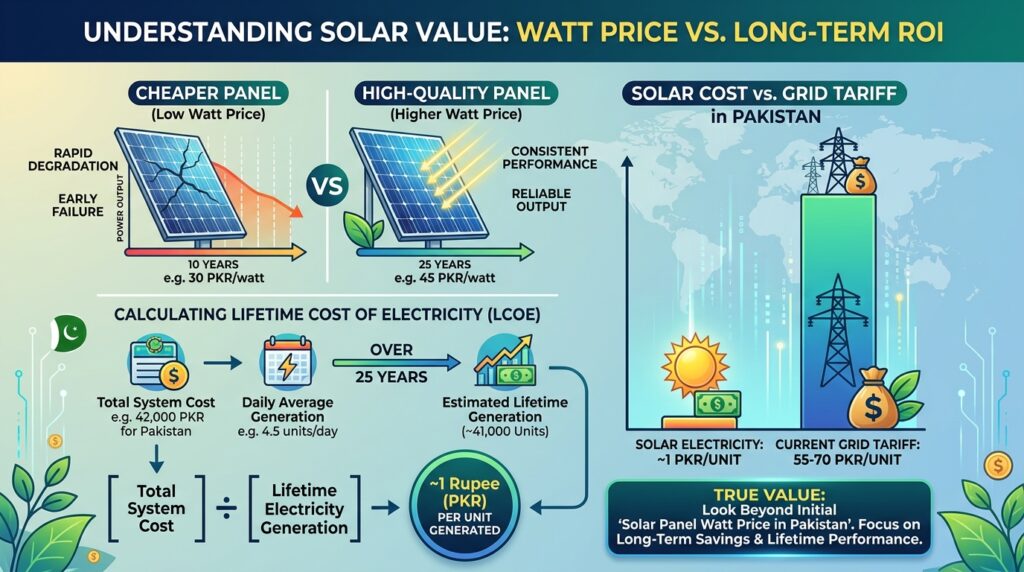
The true value of any solar panel purchase is not just the per-watt price but the cost of electricity generated over the panel’s twenty-five year lifespan. A panel that costs forty-five rupees per watt but delivers consistent output for twenty-five years is fundamentally better value than a panel costing thirty rupees per watt that degrades rapidly or fails within ten years.
To calculate the cost per kilowatt-hour of electricity generated, divide the total panel cost by the estimated lifetime electricity generation. A one kilowatt system of panels costing forty-two thousand rupees in Pakistan generating an average of four and a half units per day over twenty-five years produces approximately forty-one thousand units of electricity over its lifetime. The cost per unit generated is approximately one rupee, compared to the current grid tariff of fifty-five to seventy rupees per unit. This makes solar electricity one of the cheapest forms of energy available to Pakistani consumers regardless of the initial solar panel watt price in Pakistan paid.
For households already paying high monthly electricity bills, particularly those running air conditioners, the return on investment calculation becomes even more favourable, as detailed in our solar panels for AC units guide at Pakistan Solar Solutions.
Pakistan’s solar panel watt price has followed a dramatic downward trend over the last decade. In 2015, the per-watt price in Pakistan exceeded one hundred and fifty rupees. By 2020, it had fallen below eighty rupees. By 2024, Tier-1 panels were available below forty-five rupees per watt, a historic low. The question many Pakistani buyers ask is whether prices will fall further or begin rising.
The global solar manufacturing capacity, particularly from Chinese producers, continues to expand rapidly, suggesting continued downward pressure on international panel prices. However, Pakistani consumers also face currency risk, and if the rupee weakens significantly against the dollar, local rupee prices can rise even as global dollar prices fall. Government tax policy is another variable that can push prices in either direction.
The consensus among solar industry observers in Pakistan is that the solar panel watt price in Pakistan is likely to remain relatively stable or decline slowly through 2025, making now a very good time to invest. Any significant currency depreciation or introduction of new import duties could change this outlook rapidly.
What is the current per watt price of solar panels in Pakistan from top brands?
In 2025, A-grade monocrystalline panels from established brands like Longi, Jinko, JA Solar, and Canadian Solar are available in Pakistan at thirty-six to forty-eight rupees per watt depending on the specific model and technology. N-type bifacial premium panels command up to fifty-five rupees per watt. B-grade panels are cheaper but not recommended for quality installations.
Why does the solar panel watt price in Pakistan change so frequently?
The per-watt price in Pakistan fluctuates due to changes in global solar manufacturing supply and demand, the Pakistani rupee to US dollar exchange rate, government import duty policies, and seasonal demand cycles. Prices can shift by two to five rupees per watt within a single month during volatile periods.
Is a higher watt panel always cheaper per watt in Pakistan?
Generally yes. Higher wattage panels from the same brand and technology tier typically offer a lower per-watt price because the fixed manufacturing costs are spread over more watts of output. A six hundred watt panel is usually cheaper per watt than a four hundred watt panel of the same series, which is why Pakistan’s market has shifted strongly toward five hundred watt and above panels.
How do I verify that the panels I am buying actually deliver their rated wattage?
Ask your supplier for a flash test report or EL test certificate for the specific panels you are purchasing. These documents prove that each panel has been tested and confirmed to deliver its rated wattage within tolerance. Authorised suppliers provide this documentation. Pakistan Solar Solutions provides verified panel documentation for all products.
Should I buy more lower-watt panels or fewer higher-watt panels for the same total system size?
For the same total system capacity, fewer higher-watt panels typically cost less per watt, require fewer mounting points, and involve less wiring, reducing total installation cost. Unless you have specific roof space constraints that make smaller panels advantageous, higher-watt panels generally give better overall system value.