

Net metering is the single most important policy mechanism enabling Pakistan’s solar revolution. Without NEPRA’s net metering framework, on-grid solar systems would simply power your home during the day and waste all surplus generation. With net metering, that surplus flows into the WAPDA or K-Electric grid and earns you bill credits that dramatically reduce or eliminate your monthly electricity bill. Understanding how WAPDA net metering works in Pakistan, who qualifies, what documentation is required, and how to navigate the application process is essential knowledge for every Pakistani property owner investing in solar in 2026.
This comprehensive guide covers everything you need to know about WAPDA net metering in Pakistan in 2026, including the full eligibility criteria, a step-by-step application process breakdown for each major DISCO, the financial impact on your electricity bill, common reasons applications fail and how to avoid them, and how Pakistan Solar Solutions handles the entire net metering process on behalf of clients across LESCO, MEPCO, FESCO, IESCO, PESCO, HESCO, SEPCO, QESCO, and K-Electric.
Net metering is a billing arrangement regulated by NEPRA, the National Electric Power Regulatory Authority, that allows solar system owners connected to any Pakistani distribution company to supply surplus electricity to the national grid and receive a bill credit in return. The technical mechanism involves replacing your standard single-direction electricity meter with a bi-directional green meter that measures electricity flowing both from the grid into your property, which you import, and from your solar system into the grid, which you export.
At each billing cycle, your distribution company calculates the net difference between your imported and exported units. You pay only for the net imported units at your applicable tariff rate. If your exported units exceed your imported units in a given month, the surplus credit carries forward to the following month’s bill. Over a full year, a correctly sized solar system on net metering can reduce a Pakistani household’s annual electricity bill by 70 to 90 percent, transforming what was previously a PKR 20,000 to PKR 40,000 monthly expense into a near-zero annual electricity cost. For homeowners evaluating the specific solar system sizes that work best with net metering, our guides on 5kW solar system price in Pakistan and 10kW solar system price Pakistan provide complete savings calculations for each capacity.
NEPRA’s net metering regulations govern how all distribution companies in Pakistan must handle solar customer applications, meter installations, export tariff calculations, and billing. Understanding the key regulatory provisions protects you from being misled by outdated information or uninformed solar salespeople.
NEPRA net metering is available to residential, commercial, and industrial customers of all Pakistani distribution companies including LESCO, MEPCO, FESCO, IESCO, PESCO, HESCO, SEPCO, QESCO, and K-Electric in Karachi. The primary connection requirement is a three-phase electricity meter. Single-phase connections are not currently eligible for net metering under NEPRA regulations. Properties with single-phase connections must apply to their DISCO for a connection upgrade to three-phase before proceeding with a net metering application.
NEPRA net metering is available for systems as small as 1kW for residential customers. Commercial and industrial customers must install a minimum of 5kW. The maximum eligible system size for residential net metering is currently set at the sanctioned load of your connection, meaning you cannot install a solar system significantly larger than your approved maximum demand. Pakistan Solar Solutions verifies your sanctioned load during the free energy audit and designs systems that fall within NEPRA’s eligible size parameters for your connection type.
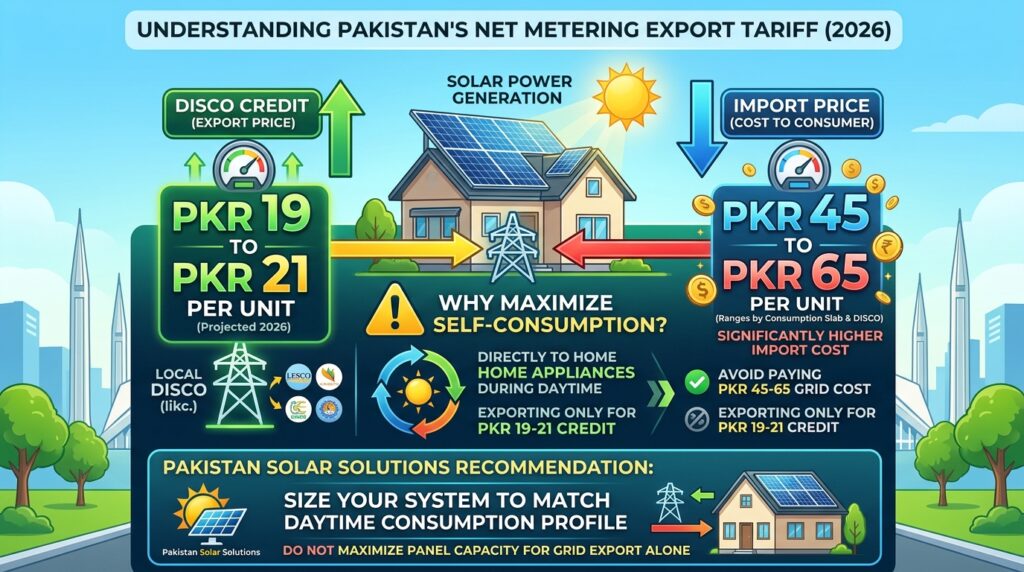
The net metering export tariff, the amount your DISCO credits you per unit of electricity exported to the grid, is set by NEPRA and currently stands at PKR 19 to PKR 21 per unit in 2026. This rate is significantly lower than the import tariff most Pakistani customers pay, which ranges from PKR 45 to PKR 65 per unit depending on consumption slab and DISCO. Because exported units earn less than imported units cost, maximizing direct self-consumption of your solar generation during daylight hours is always more financially beneficial than maximizing grid export. This is why Pakistan Solar Solutions recommends sizing systems to match your daytime consumption profile rather than simply maximizing panel capacity.
One of the most critical regulatory requirements for net metering in Pakistan is that your solar inverter must appear on NEPRA’s approved inverter list. This list is maintained and updated regularly by NEPRA and covers specific models from manufacturers including Huawei, Growatt, GoodWe, Solis, Deye, SMA, Fronius, and others. Any inverter not on this list cannot be approved for net metering regardless of its technical specifications or the installer’s assurances. Pakistan Solar Solutions exclusively installs NEPRA-approved inverter models, which is why our applications are never rejected on equipment grounds.
The WAPDA net metering application process in Pakistan is managed differently by each DISCO but follows a broadly consistent structure governed by NEPRA’s distribution generation and net metering regulations. The following step-by-step process reflects the standard procedure across most WAPDA-affiliated DISCOs in 2026.
Net metering applications can only be submitted after your solar system is physically installed and commissioned. The installation must use a NEPRA-approved inverter, and the complete system must be designed and documented by a PEC-certified engineer. Pakistan Solar Solutions handles installation and all PEC-certified documentation preparation as part of our standard service.
The application package for WAPDA DISCOs requires several documents that must be prepared to exact specifications. These include a complete NEPRA net metering application form specific to your DISCO, PEC-certified load-flow diagrams showing your solar system’s connection to the grid in the format required by your DISCO, a single-line diagram of your electrical installation, equipment certificates and manufacturer documentation for your inverter, proof of property ownership or tenancy agreement, your latest electricity bill, your CNIC copy, and photos of the installation. Pakistan Solar Solutions prepares all of these documents for clients as part of our net metering service, using formats that match exactly what each DISCO accepts for first-submission approval.
Each DISCO has a dedicated net metering processing office where applications must be physically submitted. LESCO’s net metering office is in Lahore. MEPCO handles applications from Multan. FESCO processes applications in Faisalabad. IESCO manages Rawalpindi and Islamabad applications. PESCO covers Peshawar and Khyber Pakhtunkhwa. HESCO handles Hyderabad and interior Sindh. SEPCO covers Sukkur and upper Sindh. QESCO manages Quetta and Balochistan. Pakistan Solar Solutions submits applications directly to the relevant DISCO office, maintaining receipt records and follow-up schedules for every pending case.
After receiving your application, the DISCO schedules a physical inspection of your solar installation. The inspector verifies that the installed system matches the submitted documentation, that the NEPRA-approved inverter is correctly installed, that earthing and protection devices are in place, and that the system is safe for grid interconnection. Pakistan Solar Solutions coordinates inspection scheduling and ensures our installation teams are available to address any technical questions during the inspection visit.
Once the inspection is approved, the DISCO arranges installation of your bi-directional green meter, replacing your existing single-direction meter. This is the final step before net metering billing begins. Your first net metering bill is typically issued at the end of the first full billing cycle after green meter installation. Depending on the DISCO, any generation that occurred during the period between installation and green meter activation may be credited retroactively.
Net metering processing timelines vary significantly between DISCOs. LESCO in Lahore has generally been the fastest DISCO in Pakistan for net metering approvals, with green meter installation typically achieved 2 to 3 months after application submission. IESCO in Rawalpindi typically takes 2.5 to 4 months. MEPCO in Multan and FESCO in Faisalabad average 3 to 4 months. HESCO in Hyderabad and SEPCO in Sukkur have historically taken 3 to 5 months due to lower staffing in their net metering processing divisions. K-Electric in Karachi operates independently of WAPDA and typically takes 2.5 to 3.5 months from application to green meter installation under the process detailed in our net metering Karachi guide.
Pakistan Solar Solutions tracks every pending application and makes regular follow-up communications with DISCO offices to prevent unnecessary delays in the inspection scheduling and green meter installation processes.
The financial impact of net metering on a Pakistani electricity bill is most clearly understood through a practical worked example. Consider a homeowner in Rawalpindi on IESCO’s tariff paying an average of PKR 55 per unit for their monthly consumption of 800 units, resulting in a monthly bill of approximately PKR 44,000.
After installing a 10kW on-grid solar system, the system generates approximately 40 to 45 units per day in Rawalpindi’s climate. Of these, approximately 25 to 30 units are consumed directly by the household during daylight hours, offsetting PKR 55 per unit worth of IESCO imports. The remaining 15 to 20 surplus units per day are exported to IESCO’s grid at the PKR 20 per unit net metering credit rate. Over a 30-day billing period, direct savings from self-consumption reach PKR 41,250 to PKR 49,500, while net metering credits contribute an additional PKR 9,000 to PKR 12,000. Total monthly bill impact reduces the household’s electricity expenditure from PKR 44,000 to near zero, with the system paying for itself within approximately 3 years. For complete solar installation pricing in Rawalpindi, visit our solar system installation Rawalpindi guide.
Understanding why applications fail is as important as understanding how to apply correctly. Pakistan Solar Solutions has reviewed numerous failed or delayed net metering cases from clients who initially attempted the process independently, and the same problems appear repeatedly.
The most common reason for rejection is using an inverter not on NEPRA’s approved list. Some solar companies in Pakistan install cheaper uncertified inverters and fail to inform clients until the inspection reveals the problem. The second most common reason is incorrectly formatted or PEC non-certified load-flow diagrams. DISCO inspectors reject documentation that does not meet the specific format and certification level required. The third reason is application form errors including missing information, incorrect connection details, or mismatched data between the application form and the technical drawings. Pakistan Solar Solutions eliminates all three of these failure modes because our inverter selection is always NEPRA-approved, our documentation is always PEC-certified to DISCO standards, and our documentation team verifies every application package before submission.
Pakistan Solar Solutions has successfully completed net metering applications with IESCO in Rawalpindi, K-Electric in Karachi, HESCO in Hyderabad, and SEPCO in Sukkur across our three office locations. Our net metering documentation team understands the specific requirements of each DISCO and prepares applications to those exact standards rather than using generic templates that often require revision. We handle the entire process on your behalf from post-installation documentation through green meter activation, at no additional charge beyond the standard system installation price. Call 0333-103-1086 or visit pakistansolar.solutions to start your net metering journey today.
NEPRA’s net metering export tariff in Pakistan in 2026 is PKR 19 to PKR 21 per unit. This is the rate at which WAPDA-affiliated DISCOs and K-Electric credit solar system owners for every unit of surplus electricity exported to the grid. This rate is significantly lower than the import tariff most customers pay, which is why maximizing direct self-consumption of solar generation is more financially beneficial than maximizing exports.
All major DISCOs in Pakistan offer NEPRA net metering in 2026, including LESCO, MEPCO, FESCO, IESCO, PESCO, HESCO, SEPCO, and QESCO for WAPDA-affiliated areas and K-Electric for Karachi. Net metering is available to eligible customers with three-phase connections and NEPRA-approved inverters across all of these distribution companies.
Technically you can apply independently, but the application requires PEC-certified load-flow diagrams, NEPRA-format technical documentation, and DISCO-specific forms that require professional engineering input. Most self-prepared applications are either rejected or significantly delayed due to documentation errors. Pakistan Solar Solutions manages the entire process for clients, eliminating the risk of rejection and minimizing the time to green meter installation.
If your annual exported units exceed annual imported units, the situation depends on your DISCO’s specific policy. Most Pakistani DISCOs allow credits to carry forward month to month. Annual settlement policies for very large credit balances vary by DISCO. Pakistan Solar Solutions designs systems sized to match your annual consumption to minimize excessive export at the lower net metering tariff rate.
No. NEPRA net metering regulations currently require a three-phase electricity connection. Customers with single-phase connections must first upgrade to three-phase through their DISCO before applying for net metering. Pakistan Solar Solutions can advise on whether the three-phase upgrade cost is justified by your expected net metering savings given your consumption and system size.