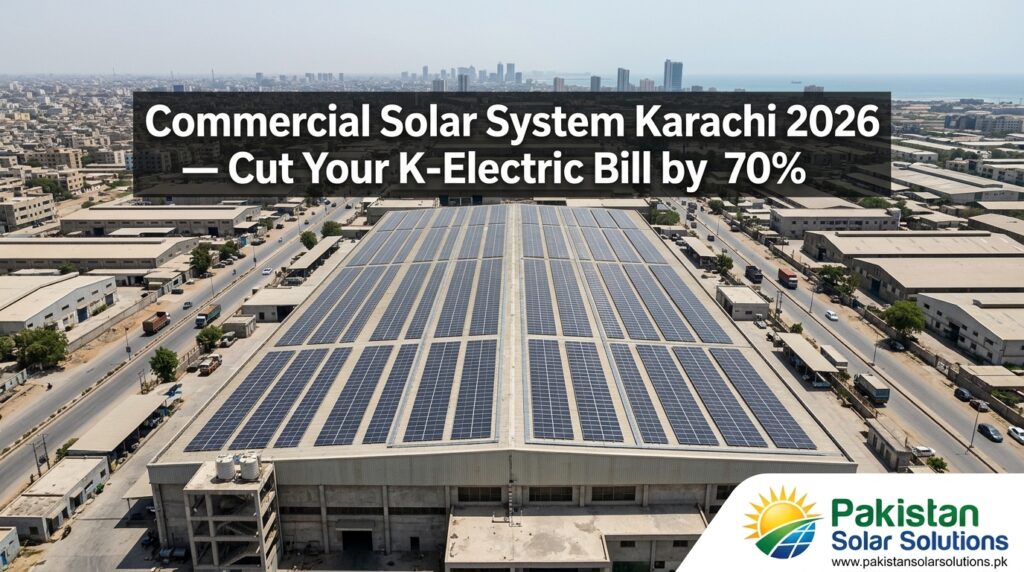


Karachi is Pakistan’s commercial and industrial capital, home to more businesses, factories, hospitals, schools, and offices than any other city in the country. It is also home to some of the highest commercial electricity tariffs in Pakistan, with K-Electric billing commercial customers PKR 55 to PKR 75 per unit or more depending on sanctioned load, time of use, and demand charges. For a small office spending PKR 80,000 per month on K-Electric bills or a manufacturing facility paying PKR 800,000 or more, electricity is one of the largest and fastest-growing operational costs on the balance sheet.
A commercial solar system in Karachi directly attacks this cost centre. With 5.5 to 6.5 peak sun hours daily, over 300 sunny days per year, and K-Electric net metering available for three-phase commercial connections, Karachi offers some of the most favorable conditions for commercial solar ROI in all of South Asia. Pakistan Solar Solutions has been designing and installing commercial solar systems in Karachi since 2017, serving businesses from small retail shops and clinics to large factories and industrial complexes. This comprehensive guide covers everything a Karachi business owner needs to evaluate, decide on, and implement commercial solar correctly.
Commercial electricity customers in Karachi face a triple financial burden that makes solar adoption not just attractive but financially urgent. First, K-Electric’s commercial tariffs are among the highest of any distribution company in Pakistan, consistently exceeding residential rates by 20 to 30 percent and continuing to rise with every annual tariff revision. Second, commercial properties typically operate during daylight hours, meaning they consume electricity precisely when solar panels are generating at their peak, maximizing direct self-consumption and minimizing the lower-valued grid export. Third, commercial load shedding in Karachi affects operations directly, with every unplanned outage translating into lost productivity, customer experience damage, and potential product spoilage or equipment damage.
A commercial solar system addresses all three burdens simultaneously. It reduces K-Electric bills through direct consumption savings and net metering credits. It provides continuous power during load shedding through a hybrid configuration with battery storage. And it converts a perpetually rising operational cost into a fixed capital investment with a 25-year operational lifespan. Pakistan Solar Solutions delivers commercial solar systems across Karachi with full K-Electric net metering management and after-sales support that continues long after the installation is complete.
Commercial solar system prices in Karachi in 2026 vary by system capacity, panel brand, inverter selection, roof or ground mounting conditions, and whether battery backup is included. The following prices represent complete turnkey commercial installations including Tier-1 panels, NEPRA-approved commercial inverters, heavy-duty mounting structures, all electrical work, earthing, protection systems, and K-Electric net metering documentation.
A 10kW commercial on-grid system is suitable for small offices, clinics, pharmacies, and retail shops consuming 800 to 1,200 units per month. In Karachi in 2026, a complete 10kW on-grid commercial installation costs PKR 950,000 to PKR 1,200,000. Monthly savings from a 10kW commercial system in Karachi range from PKR 20,000 to PKR 35,000 given K-Electric’s higher commercial tariff rates. Payback is achieved in 2 to 3 years.
Medium-sized commercial properties including larger offices, restaurants, schools, small hospitals, and commercial plazas consuming 2,000 to 6,000 units monthly are well-served by 20kW to 50kW systems. A complete 20kW on-grid installation costs PKR 1,800,000 to PKR 2,400,000. A 30kW system costs PKR 2,600,000 to PKR 3,400,000. A 50kW system costs PKR 4,000,000 to PKR 5,500,000. Monthly savings scale proportionally, with a 50kW system in Karachi delivering PKR 80,000 to PKR 130,000 in monthly electricity cost reduction. Payback for systems in this size range is typically 1.8 to 2.5 years given K-Electric’s commercial tariffs.
Large commercial properties, factories, textile mills, pharmaceutical plants, and cold storage facilities consuming tens of thousands of units monthly require industrial-scale solar installations. A complete 100kW on-grid industrial installation in Karachi costs PKR 7,500,000 to PKR 10,000,000. A 200kW system costs PKR 14,000,000 to PKR 18,000,000. A 500kW system costs PKR 32,000,000 to PKR 42,000,000. At these scales, the per-unit electricity cost from solar drops to PKR 8 to PKR 12 over the 25-year panel lifespan, compared to K-Electric’s commercial rate of PKR 55 to PKR 75 per unit. Industrial solar clients in Karachi consistently achieve full ROI within 2 to 3 years and reduce electricity expenditure by 50 to 70 percent on an ongoing basis. For national industrial solar pricing context, visit our 10kW solar system price Pakistan guide and our full solar installation Karachi services page.
Designing a commercial solar system is significantly more complex than a residential installation. Commercial properties have variable load profiles throughout the day, peak demand tariff components that require careful management, rooftop structural considerations for large panel arrays, and regulatory requirements that differ from residential net metering applications. Pakistan Solar Solutions approaches every commercial solar project with the engineering rigour that distinguishes a genuine EPC company from an informal installer.
Before designing any commercial solar system in Karachi, Pakistan Solar Solutions conducts a comprehensive energy audit that goes beyond reviewing electricity bills. Our engineers analyse your load profile by hour of day, identify peak demand periods that drive demand charges on your K-Electric bill, assess diversity of loads across different sections of your property, and evaluate opportunities for load shifting that can maximize solar self-consumption. This audit forms the technical foundation of a system design that is optimized for your specific commercial energy consumption pattern rather than a generic size recommendation.
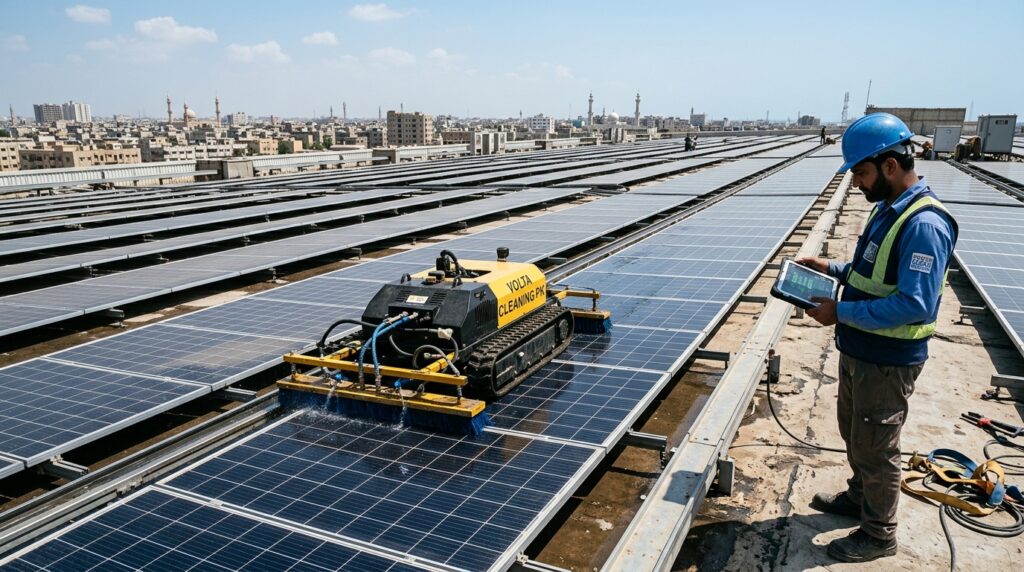
Commercial rooftops in Karachi’s industrial and commercial zones vary enormously in their structural capacity. Industrial sheds with metal sheet roofing, older RCC structures in established commercial areas, and modern reinforced concrete buildings in newer commercial developments all have different panel mounting and load-bearing considerations. Pakistan Solar Solutions conducts a structural assessment for every commercial rooftop installation, verifying that the existing structure can safely carry the additional load of panels, mounting frames, and wind forces without modification or reinforcement. Where structural reinforcement is required, we include this in the project scope and budget rather than ignoring it to quote a lower price.
Commercial solar systems in Karachi almost universally require three-phase inverters or multiple single-phase inverters configured for three-phase balance. Pakistan Solar Solutions specifies commercial inverters from Huawei SUN2000 three-phase series, Growatt MID three-phase series, GoodWe MT series, and Solis commercial three-phase models depending on system size and client preferences. All commercial inverters we specify are on NEPRA’s approved list and are compatible with K-Electric’s commercial net metering requirements.
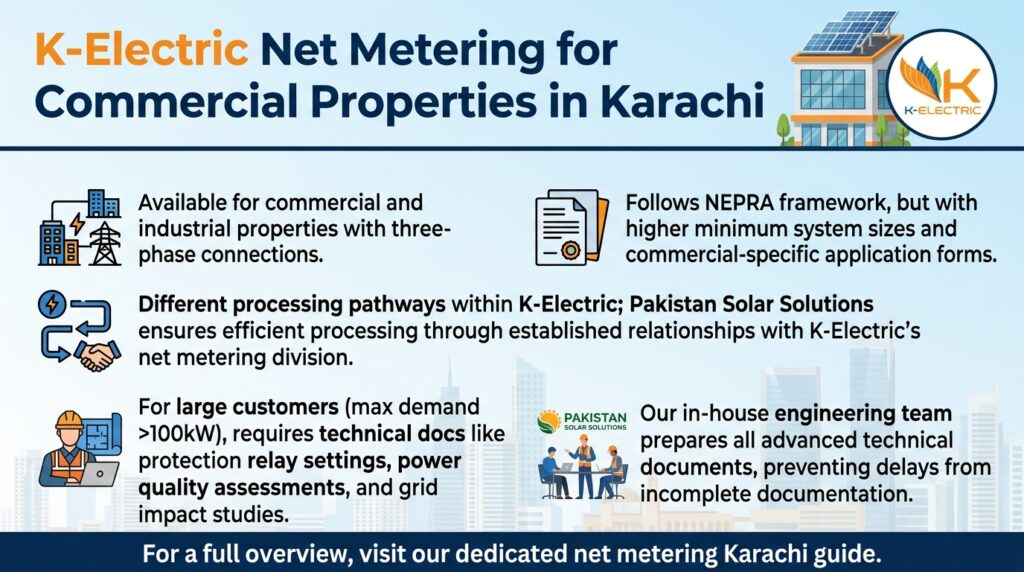
K-Electric net metering is available for commercial and industrial properties in Karachi with three-phase connections. Commercial net metering with K-Electric follows the same NEPRA framework as residential applications but with higher minimum system sizes, commercial-specific application forms, and different processing pathways within K-Electric’s organization. Pakistan Solar Solutions has extensive experience with K-Electric’s commercial net metering process and maintains professional relationships with K-Electric’s net metering division that enable efficient processing of our clients’ applications.
For large commercial and industrial customers with maximum demand above 100kW, K-Electric requires additional technical documentation including protection relay settings, power quality assessments, and grid impact studies. Pakistan Solar Solutions’ engineering team prepares all of these advanced technical documents in-house, ensuring commercial clients’ applications meet K-Electric’s requirements without the delays caused by incomplete documentation. For a full overview of how net metering works with K-Electric in Karachi, visit our dedicated net metering Karachi guide.
Pakistan Solar Solutions has designed and installed commercial solar systems for a diverse range of Karachi businesses and institutions, each with specific energy profiles and requirements.
Karachi’s textile sector is one of the largest industrial electricity consumers in the city. Spinning mills, weaving units, stitching facilities, and garment export factories operate large motor loads, lighting systems, and air conditioning on continuous schedules that make large on-grid solar systems with net metering highly effective. Pakistan Solar Solutions has completed textile industry solar projects in Karachi’s SITE industrial zone ranging from 50kW to over 500kW, delivering consistent ROI within 2 to 2.5 years.
Hospitals and clinics in Karachi cannot afford power interruptions. Critical care equipment, surgical theatres, laboratory instruments, and pharmaceutical refrigeration require 24/7 uninterrupted power. Pakistan Solar Solutions designs hybrid solar systems for healthcare facilities combining large on-grid solar arrays for daytime generation and bill savings with substantial lithium battery banks providing backup coverage during K-Electric outages. Our healthcare solar clients in Karachi have achieved electricity cost reductions of 40 to 60 percent while eliminating generator dependency for routine outages.
Educational institutions in Karachi operate primarily during daylight hours with peak load coinciding with peak solar generation, creating ideal conditions for solar savings. A school or college paying PKR 150,000 to PKR 300,000 per month in K-Electric bills can reduce this to PKR 15,000 to PKR 50,000 per month with a correctly sized on-grid solar system. Pakistan Solar Solutions has delivered solar installations for multiple schools and colleges in Karachi’s DHA, Clifton, and Gulshan areas.
Karachi’s hospitality sector faces intense margin pressure from K-Electric bills driven by commercial kitchen equipment, air conditioning, lighting, and refrigeration operating across extended daily hours. A commercial solar system for a mid-sized restaurant consuming PKR 80,000 to PKR 150,000 per month in K-Electric bills typically pays back within 2 to 2.5 years and then contributes directly to profitability for the remaining 22 or more years of the panel’s lifespan.
Cold storage facilities and food processing plants in Karachi operate continuous refrigeration loads that are perfectly suited to large solar installations. These facilities typically run 24 hours and consume enormous quantities of electricity, making hybrid solar systems with large battery banks the optimal configuration for combining maximum solar savings with cold chain continuity during K-Electric outages.
Understanding the commercial solar ROI calculation for Karachi helps business owners evaluate proposals accurately and compare competing quotations on a financially rigorous basis rather than comparing price tags alone.
A 100kW commercial on-grid solar system in Karachi generates approximately 450 to 550 units per day based on the city’s 5.5 to 6.5 peak sun hours. At K-Electric’s commercial tariff of PKR 65 per unit for direct self-consumption savings and PKR 20 per unit for net metering exports, daily savings total PKR 25,000 to PKR 33,000. Monthly savings reach PKR 750,000 to PKR 990,000. Annual savings exceed PKR 9,000,000. With a 100kW installation cost of PKR 7,500,000 to PKR 10,000,000, full capital recovery is achieved within 1 to 1.3 years at the lower end of the cost range. Over the 25-year panel lifespan and assuming conservative annual tariff increases of only 10 percent, total savings exceed PKR 250,000,000 for a single 100kW commercial installation. This represents one of the highest ROI capital investments available to Karachi businesses in 2026.
For K-Electric commercial net metering eligibility, the minimum system size is 5kW. Pakistan Solar Solutions designs commercial systems starting from 10kW for small offices and clinics, scaling up to 500kW or more for large industrial clients. Our commercial engineering team conducts free energy audits to determine the optimal system size for your specific consumption profile and roof capacity.
Commercial net metering with K-Electric operates under the same NEPRA framework as residential net metering, with the bi-directional green meter recording imported and exported units and K-Electric billing on the net difference. Commercial export credits are currently PKR 19 to PKR 21 per unit. Pakistan Solar Solutions manages the entire K-Electric commercial net metering application process for all clients.
K-Electric commercial net metering approval typically takes 3 to 5 months from application submission to green meter installation for larger commercial systems requiring additional technical documentation. Standard commercial systems in the 10kW to 100kW range are generally approved within 2.5 to 4 months. Pakistan Solar Solutions tracks and follows up on every pending K-Electric application.
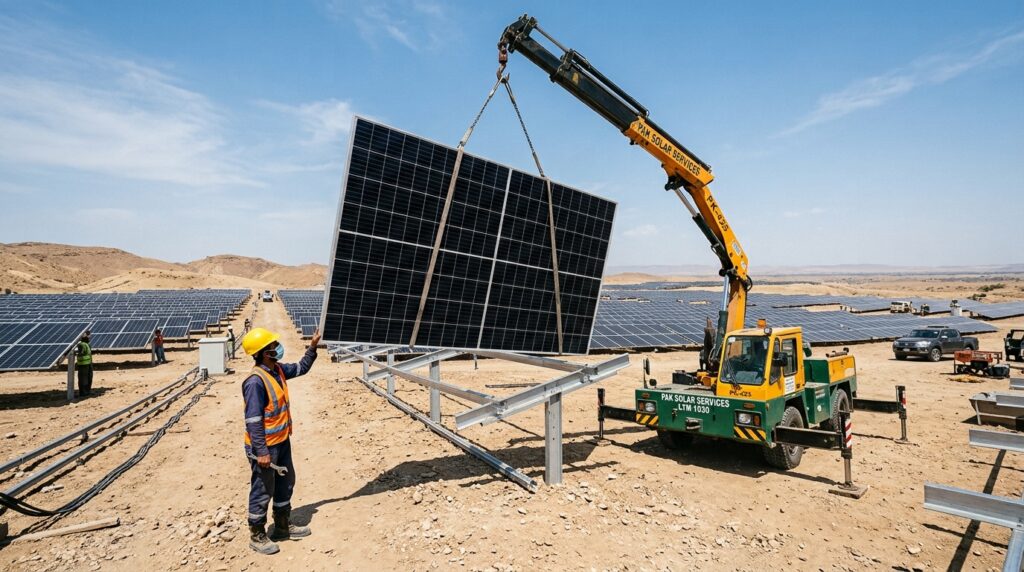
Yes. Pakistan Solar Solutions has a dedicated industrial EPC division capable of managing commercial and industrial solar projects from 50kW to 1MW or more in Karachi. We provide full project management including site feasibility studies, structural assessments, procurement, civil and electrical works, commissioning, and K-Electric net metering documentation. Contact us at pakistansolar.solutions for a free commercial feasibility assessment.
Commercial solar payback in Karachi in 2026 ranges from 1.5 to 3 years depending on system size, K-Electric commercial tariff applied, and self-consumption ratio. Larger industrial systems achieve the fastest payback due to economies of scale in installation cost. Small commercial systems in the 10kW to 50kW range typically pay back in 2 to 3 years. After payback, the system delivers free electricity and direct profitability contribution for the remaining 22 or more years of operation.