

Rawalpindi and its twin city Islamabad form one of Pakistan’s most rapidly growing solar energy markets in 2026. With WAPDA electricity tariffs crossing PKR 60 to 65 per unit and load shedding continuing to disrupt daily life across the Potohar region, Rawalpindi residents and business owners are switching to solar at an unprecedented rate. The combination of strong sunlight averaging 4.8 to 5.5 peak sun hours daily, rising grid electricity costs, and the availability of professional solar EPC companies with local offices has made solar system installation in Rawalpindi one of the most financially rewarding decisions a property owner in the twin cities can make today.
This comprehensive guide covers everything you need to know about solar installation Rawalpindi 2026, including complete system pricing, the installation process, which equipment performs best in the twin cities’ climate, how IESCO net metering works, and why Pakistan Solar Solutions has been the trusted solar EPC partner for Rawalpindi clients since 2017. Whether you own a home in Satellite Town, a factory in I-9, or a commercial plaza in Bahria Town, this guide gives you the full picture before you invest a single rupee.
Rawalpindi’s energy situation has created perfect conditions for solar adoption. IESCO, the Islamabad Electric Supply Company that serves Rawalpindi and Islamabad, has implemented some of the steepest tariff increases in Pakistan over the last three years. Residential customers consuming above 300 units per month now face tariffs of PKR 50 to PKR 65 per unit including all surcharges and taxes, while commercial and industrial customers pay even higher rates under time-of-use pricing structures.
Load shedding in Rawalpindi varies significantly by area. Older residential colonies and suburban areas can experience 6 to 10 hours of daily WAPDA outages during peak summer demand, while newer housing societies and commercial areas closer to Islamabad’s urban core tend to have shorter but still economically damaging outage schedules. For businesses in Rawalpindi’s commercial hubs including Raja Bazaar, Saddar, and Committee Chowk, every hour of load shedding translates directly into lost revenue and customer experience damage.
Rawalpindi also benefits from Pakistan’s federal capital effect. The presence of government offices, embassies, large hospitals, educational institutions, and corporate headquarters in the twin cities creates strong commercial and institutional solar demand that drives a competitive and mature local solar market. Pakistan Solar Solutions has been serving this market from our Rawalpindi office at Shop 4-G, Ground Floor, Sharjah Center, 5th Road, Satellite Town since our establishment in 2017.
Solar system installation prices in Rawalpindi in 2026 are competitive with Karachi and Lahore rates, reflecting the mature and active state of the local market. The following prices represent complete turnkey installations including Tier-1 solar panels, NEPRA-approved inverters, galvanized steel or aluminum mounting structures, all DC and AC cabling, earthing and lightning protection, circuit protection devices, and professional installation labor by PEC-certified engineers.
A 3kW on-grid solar system is the right starting point for smaller homes and apartments in Rawalpindi consuming 250 to 400 units per month. In 2026, a complete 3kW on-grid installation in Rawalpindi costs PKR 350,000 to PKR 500,000. Monthly savings range from PKR 5,000 to PKR 10,000 depending on your IESCO tariff slab and seasonal consumption. Payback is achieved in 3 to 4 years, after which the system produces free electricity for the remaining 21-plus years of the panel’s life.
The 5kW system is the most popular residential choice in Rawalpindi in 2026, matching the energy needs of medium-sized homes consuming 450 to 700 units per month. A complete 5kW on-grid installation costs PKR 650,000 to PKR 850,000. Monthly savings reach PKR 10,000 to PKR 18,000, with payback in 2.5 to 3.5 years. A 5kW hybrid system with lithium battery backup for load shedding protection costs PKR 850,000 to PKR 1,100,000 and is strongly recommended for Rawalpindi areas experiencing 6 or more hours of daily load shedding. For national pricing context, our complete guide on 5kW solar system price in Pakistan covers all cities and configurations in detail.
Larger homes, small commercial offices, clinics, and shops in Rawalpindi consuming 800 to 1,200 units monthly are ideally served by a 10kW solar system. In 2026, a complete 10kW on-grid installation in Rawalpindi costs PKR 950,000 to PKR 1,200,000, while a 10kW hybrid system costs PKR 1,400,000 to PKR 1,700,000. Monthly savings from a 10kW system range from PKR 18,000 to PKR 28,000, making it one of the fastest-payback investments available in the Rawalpindi property market today. Our national guide on 10kW solar system price Pakistan provides detailed ROI calculations for this system size.
Rawalpindi’s active commercial and light industrial sector creates strong demand for larger solar systems. A 20kW on-grid commercial installation costs PKR 1,800,000 to PKR 2,400,000. A 50kW system costs PKR 4,000,000 to PKR 5,500,000. A 100kW installation for large commercial properties or small industrial facilities costs PKR 7,500,000 to PKR 10,000,000. Commercial systems in Rawalpindi achieve payback in 2 to 3 years given the higher commercial tariff rates applied by IESCO, and deliver significant annual electricity cost savings across a 25-year operational period.
Understanding what is covered in a complete solar installation quote protects you from misleading comparisons and hidden costs. A professional turnkey solar installation Rawalpindi 2026 from Pakistan Solar Solutions includes every component and service required to take your system from bare roof to fully commissioned operation.
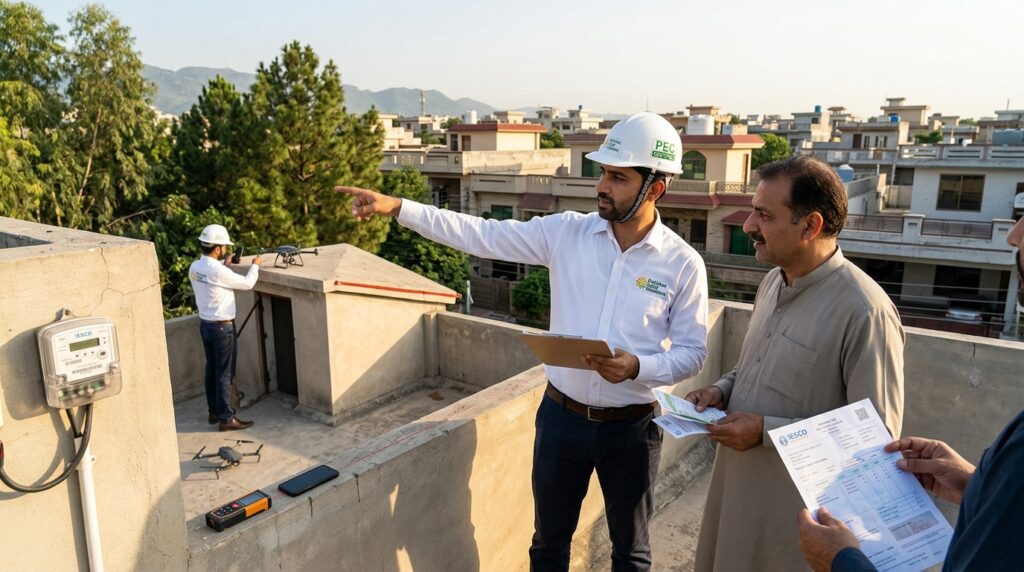
Before any equipment is specified or priced, Pakistan Solar Solutions sends a PEC-certified engineer to your property in Rawalpindi at no charge. The engineer inspects your roof area, orientation, pitch, and shading from surrounding trees or buildings. They assess your IESCO connection type to confirm three-phase availability for net metering eligibility. They review your last six months of electricity bills to understand your consumption pattern, seasonal variation, and peak demand periods. This audit is the foundation of your system design and ensures you invest in a system sized correctly for your actual needs rather than an arbitrary package.
Based on the energy audit, our team designs a system specifically for your property and consumption profile. The proposal specifies every component with manufacturer model numbers, quantities, and individual prices. It includes a month-by-month savings projection, full payback period calculation, and 25-year ROI analysis. You receive a completely itemized document with no hidden charges. The price in the proposal is the price you pay, guaranteed.
Pakistan Solar Solutions procures all components through certified supply channels. Every panel arrives with manufacturer documentation including warranty cards, certificates of conformity, and serial numbers that can be independently verified. Every inverter is sourced from NEPRA-approved manufacturers with official Pakistani distribution. No grey-market or counterfeit equipment enters our supply chain, which is a real risk in Rawalpindi’s rapidly expanding solar market where informal traders outnumber professional installers.
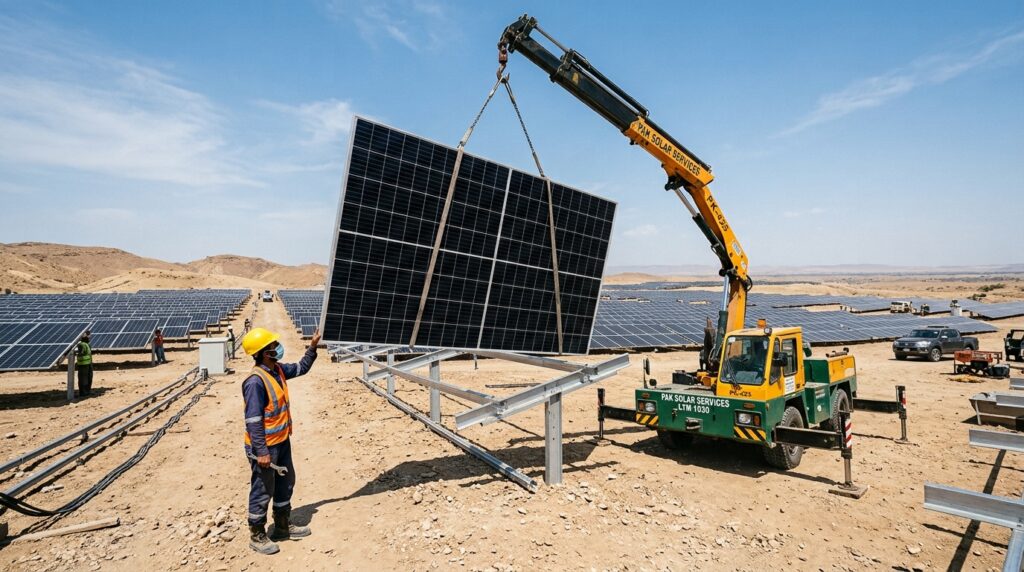
Our Rawalpindi-based installation team completes the physical installation within 1 to 3 days for residential systems. We install mounting structures using proper anchor calculations for your roof type, route cables using appropriate conduit and clip systems, install earthing rods to NEPRA specifications, and complete all electrical connections to your distribution board following IESCO’s safety codes. We protect your roof during installation and clean the site completely at the end of each working day.
After installation, Pakistan Solar Solutions prepares and submits your complete IESCO net metering application on your behalf. This includes PEC-certified load-flow diagrams in IESCO’s required format, NEPRA-standard technical documentation, application forms, proof of ownership, and equipment certificates. We manage all communication with IESCO through the inspection and green meter installation process. Our near-perfect first-submission approval rate in Rawalpindi reflects the depth of our experience with IESCO’s specific requirements.
IESCO, the Islamabad Electric Supply Company, serves Rawalpindi and Islamabad as the local distribution company for WAPDA. Net metering with IESCO operates under the same NEPRA framework that governs all Pakistani DISCOs but with IESCO-specific forms, inspection procedures, and processing timelines.
When your solar system exports surplus electricity to the IESCO grid, your bi-directional green meter records the exported units. At billing time, IESCO deducts your exported units from your imported units and bills you only for the net difference. Export credits are currently valued at PKR 19 to 21 per unit under NEPRA’s 2026 net metering tariff. Because IESCO’s import tariff significantly exceeds the export credit rate, maximizing direct self-consumption of your solar generation during daylight hours is the most financially optimal strategy. Timing appliance-heavy activities like laundry, water heating, and cooking to coincide with peak solar generation hours between 9 AM and 4 PM maximizes savings and minimizes exported units at the lower credit rate.
IESCO net metering approval in Rawalpindi typically takes 2.5 to 4 months from application submission to green meter installation. Pakistan Solar Solutions tracks every pending application and follows up with IESCO proactively to avoid unnecessary delays in the approval process.
For Rawalpindi homeowners and businesses wondering whether on-grid or hybrid is better given IESCO’s load shedding profile, our detailed comparison guide on hybrid solar system Pakistan covers the full economic analysis for both configurations.
Rawalpindi and Islamabad experience a more moderate climate than Karachi and interior Sindh, with summer temperatures reaching 38 to 42 degrees Celsius and winter temperatures dropping to 5 to 10 degrees Celsius in December and January. While cooler winters mean slightly lower solar generation in those months, Rawalpindi’s summer generation profile is strong and its spring and autumn conditions deliver some of the best solar generation in Pakistan.
The cooler winter temperatures in Rawalpindi are actually beneficial for panel efficiency. Solar panels perform at their rated output at 25 degrees Celsius and lose efficiency as temperature increases. Rawalpindi’s moderate spring and autumn temperatures mean panels operate closer to their rated efficiency for a larger portion of the year than in Karachi or Multan.
For Rawalpindi installations in 2026, Pakistan Solar Solutions recommends Longi Hi-Mo X10 N-Type panels as the premium choice for their 22-plus percent efficiency and excellent low-light performance during Rawalpindi’s foggy winter months. Jinko Tiger Neo bifacial panels offer comparable efficiency with strong low-light generation that benefits winter performance. JA Solar N-Type TopCon panels provide excellent value at 21.5 percent efficiency. Canadian Solar HiKu7 mono PERC panels offer reliable performance at a more accessible price point for budget-focused Rawalpindi installations. For brand-specific pricing, our Longi solar panels price Pakistan guide covers current 2026 rates in detail.
Rawalpindi’s slightly cooler climate compared to coastal Pakistan means inverter thermal performance is less critical than in Karachi, but reliability and IESCO compatibility remain paramount considerations. All inverters installed by Pakistan Solar Solutions are on NEPRA’s approved inverter list, which is mandatory for IESCO net metering eligibility.
For on-grid installations in Rawalpindi, Huawei SUN2000 on-grid inverters, Growatt MID series, and GoodWe DNS series are reliable and cost-effective choices with strong NEPRA approval status. For hybrid installations serving Rawalpindi’s load-shedding-affected areas, the Huawei SUN2000 hybrid with FusionSolar monitoring is the premium choice, while the Growatt SPH series offers excellent value for residential hybrid systems. The Deye hybrid inverter has grown significantly in popularity in Rawalpindi in 2026 due to its competitive pricing and reliable performance.
Pakistan Solar Solutions serves every area of Rawalpindi from our Satellite Town office. Our residential installation teams cover Satellite Town, Bahria Town Rawalpindi, DHA Rawalpindi, Chaklala Scheme, Gulraiz Housing Society, Askari, Westridge, Sadiqabad, Adiala Road, and all surrounding areas including Attock, Chakwal, and Jhelum districts. Our local presence ensures fast site survey scheduling, prompt installation completion, and reliable after-sales support without the delays and communication issues that come with using out-of-city contractors.
Rawalpindi’s commercial and light industrial sector presents strong opportunities for solar ROI, particularly for businesses with high daytime electricity consumption. The city’s hospitals, educational institutions, garment factories, food processing units, and commercial plazas all operate primarily during daylight hours, maximizing direct solar self-consumption and delivering the fastest possible payback on commercial solar investments.
Pakistan Solar Solutions has completed commercial solar installations across Rawalpindi’s main commercial areas including I-9 Industrial Estate, Westridge Industrial Area, and various commercial plazas in the twin cities. Our commercial engineering team conducts detailed load analysis, maximum demand assessment, and structural feasibility evaluation before designing any commercial system, ensuring the investment is sized correctly and delivers the projected savings from day one of operation.
Pakistan Solar Solutions has maintained a physical office in Rawalpindi since 2017, predating the solar boom that has flooded Pakistan’s market with inexperienced traders posing as solar companies. Our Rawalpindi team includes PEC-certified engineers, experienced installation technicians, and dedicated documentation staff who understand IESCO’s specific requirements. We have a proven track record of successful net metering approvals, satisfied residential clients, and large commercial projects completed on time and within budget across the twin cities region.
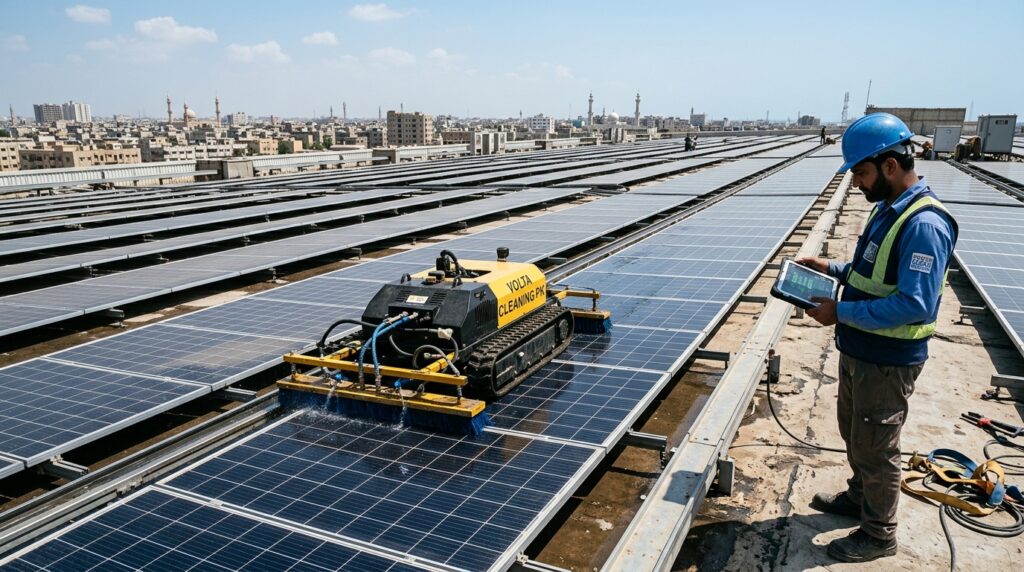
Our after-sales service team in Rawalpindi is available for panel cleaning, inverter inspection, system troubleshooting, and maintenance visits. We offer annual maintenance packages for residential and commercial clients who want scheduled professional maintenance rather than managing it independently. Call 0334-847-1223 or visit pakistansolar.solutions to schedule your free Rawalpindi site survey today.
For a medium-sized home in Rawalpindi consuming 450 to 700 units per month, a complete 5kW on-grid solar installation costs PKR 650,000 to PKR 850,000 in 2026. A 5kW hybrid system with lithium battery backup costs PKR 850,000 to PKR 1,100,000. Monthly savings range from PKR 10,000 to PKR 18,000 depending on your IESCO tariff slab.
IESCO net metering approval in Rawalpindi typically takes 2.5 to 4 months from application submission to green meter installation. Pakistan Solar Solutions manages the entire application process and follows up with IESCO proactively to minimize delays. Your system operates normally during this period and credits are reflected once the green meter is active.
Yes. Modern N-Type monocrystalline panels continue generating electricity during cloudy and foggy conditions, just at reduced output. Winter generation in Rawalpindi is lower than summer but still economically valuable. Jinko Tiger Neo bifacial panels are particularly well-suited to Rawalpindi’s winter conditions due to their enhanced low-light performance characteristics.
Yes. Pakistan Solar Solutions installs solar systems throughout Bahria Town Rawalpindi including all phases and commercial areas. Our Satellite Town office serves the entire Rawalpindi district including Bahria Town, DHA, Gulraiz, and all surrounding housing societies and commercial developments.
Yes. IESCO net metering eligibility requires a three-phase electricity connection. Single-phase customers must upgrade to three-phase before applying for net metering. Pakistan Solar Solutions can advise on the three-phase upgrade process with IESCO and whether the upgrade cost is financially justified given your system size and expected savings.