

An off-grid solar system pakistan is the most self-sufficient energy solution available in Pakistan today. Unlike on-grid systems that rely on the national grid for backup and net metering, or hybrid systems that combine solar generation with grid connectivity and battery storage, an off-grid solar system operates in complete isolation from WAPDA, K-Electric, and every other distribution company in Pakistan. It generates electricity from solar panels, stores it in a battery bank, and powers your loads entirely from these two sources with no grid connection whatsoever.
In 2026, off-grid solar systems are the primary energy solution for Pakistan’s vast rural population, agricultural communities, remote industrial sites, telecom infrastructure, and any property where grid connectivity is unavailable, unreliable, or prohibitively expensive to establish. This comprehensive guide covers everything you need to know about off-grid solar systems in Pakistan, from system design principles and component selection to complete pricing, battery sizing, and real-world applications across the country.
Understanding whether an off-grid solar system is the right choice for your situation begins with honestly assessing your relationship with Pakistan’s national grid. Off-grid solar is the correct solution in several specific circumstances that are extremely common across Pakistan.
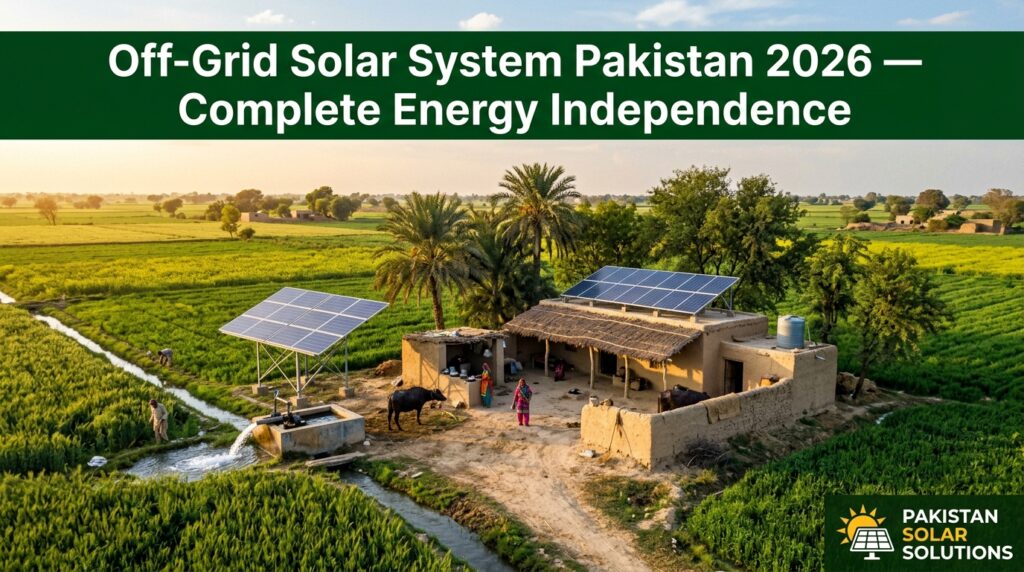
Millions of Pakistani households, farms, and small businesses in rural Sindh, Balochistan, interior Punjab, Khyber Pakhtunkhwa, and Azad Kashmir either have no WAPDA connection at all or face connection costs that are economically prohibitive. For a farm 15 kilometres from the nearest WAPDA pole, the cost of establishing a grid connection can exceed the entire cost of a comprehensive off-grid solar system. In these cases, off-grid solar is not merely a preference, it is the only viable path to reliable electricity.
Pakistan’s agricultural sector consumes enormous amounts of energy for irrigation pumping, and the majority of this demand is met by expensive diesel generators or unreliable grid connections. For farmers operating tube-wells, drip irrigation systems, and livestock watering in Sindh, Punjab, and Balochistan, an off-grid solar water pumping system eliminates diesel costs entirely and provides reliable daily irrigation independent of WAPDA load shedding schedules. Details of solar water pumping specifically are available in our solar water pump Pakistan guide.
Pakistan’s telecommunications industry relies heavily on off-grid solar systems to power base stations and towers in areas beyond grid reach. Solar-battery systems have replaced diesel generators at thousands of tower sites across Pakistan, dramatically reducing operational costs and carbon emissions. Pakistan Solar Solutions designs and supplies off-grid systems for telecom infrastructure applications with the reliability and redundancy specifications required by the industry.
Some urban and peri-urban property owners choose off-grid solar not because they lack grid access but because they want complete independence from WAPDA billing, load shedding, and policy uncertainty. With K-Electric and WAPDA tariffs climbing year after year and net metering policy subject to regulatory revision, an off-grid system eliminates all exposure to grid-side risks entirely.
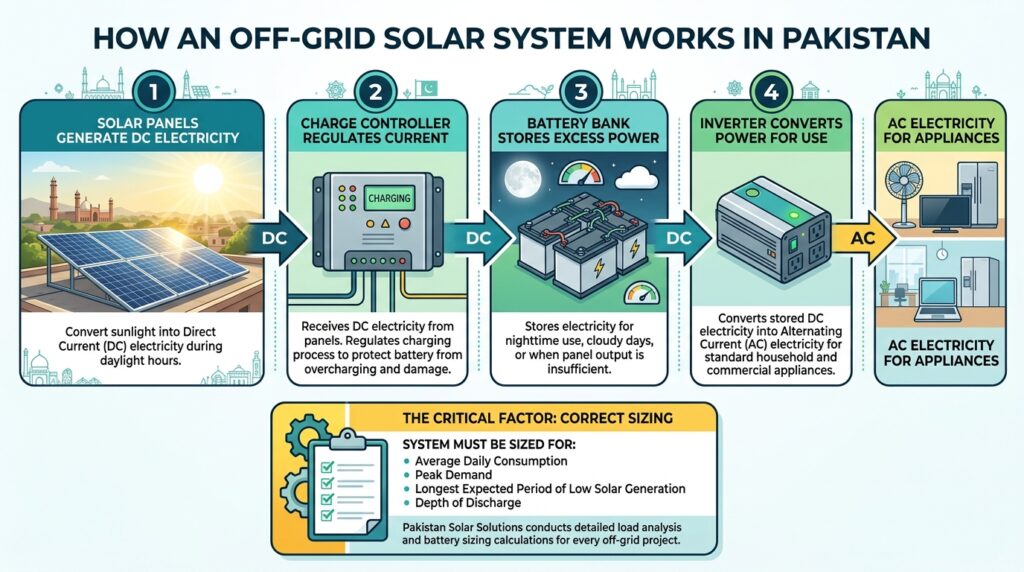
An off-grid solar system consists of four primary components working together to generate, store, manage, and deliver electricity completely independently of the national grid. Understanding how these components interact helps you evaluate system designs and ensure your installer has sized the system correctly for your specific needs.
Solar panels generate DC electricity from sunlight during daylight hours. This electricity flows through a charge controller that regulates the charging process to protect the battery bank from overcharging or damage. The battery bank stores the generated electricity for use during nighttime hours or during cloudy periods when panel output is insufficient to meet demand. The inverter converts the DC electricity stored in the battery bank into AC electricity suitable for standard household and commercial appliances.
An off-grid system must be sized not only for your average daily consumption but also for your peak demand, your longest expected period of low solar generation, and the depth of discharge your battery technology allows. Correct sizing is the most critical factor in off-grid system design. An undersized system will fail to meet your needs during cloudy periods or high-demand days. An oversized system wastes capital investment. Pakistan Solar Solutions conducts detailed load analysis and battery sizing calculations for every off-grid project to ensure the system delivers reliable power year-round.
Off-grid solar system prices in Pakistan in 2026 vary more widely than on-grid or hybrid prices because off-grid systems can range from very small setups powering a few lights and a fan in a rural home to large industrial installations powering heavy machinery 24 hours a day. The following price ranges represent complete turnkey off-grid systems including panels, charge controller, battery bank, inverter, cabling, earthing, and professional installation.
A small residential off-grid system of 1kW to 3kW with 3kWh to 6kWh of LiFePO4 battery storage suitable for basic lighting, fans, and mobile charging in a rural home costs PKR 280,000 to PKR 550,000. A medium residential off-grid system of 5kW to 7kW with 10kWh to 15kWh of battery storage suitable for a full rural or peri-urban household with television, refrigerator, fans, and lighting costs PKR 950,000 to PKR 1,500,000. A large residential or small commercial off-grid system of 10kW to 15kW with 20kWh to 30kWh of battery storage costs PKR 1,800,000 to PKR 2,800,000. Industrial and agricultural off-grid systems above 20kW are priced on a project-specific basis following site feasibility studies.
For comparison with grid-connected options, on-grid and hybrid system pricing is covered in our 5kW solar system price in Pakistan and 10kW solar system price Pakistan guides.
The battery bank is the most expensive and most technically critical component of an off-grid solar system. Correct battery sizing directly determines whether your system provides reliable power or fails you during cloudy days and at night.
In 2026, LiFePO4 lithium iron phosphate batteries are the clear standard for off-grid solar storage in Pakistan. Their 3,000 to 6,000 charge cycle lifespan means a properly maintained LiFePO4 bank will last 10 to 15 years before requiring replacement. Lead-acid batteries, which were the only option for off-grid systems a decade ago, provide only 500 to 800 cycles and require replacement every 3 to 5 years. The higher upfront cost of lithium batteries is almost always recovered within the first 5 years through reduced replacement frequency and better depth of discharge performance.
LiFePO4 batteries can be safely discharged to 80 to 90 percent of their rated capacity without damage, compared to only 50 percent for lead-acid alternatives. This means a 10kWh lithium battery bank delivers 8 to 9kWh of usable energy, while a 10kWh lead-acid bank delivers only 5kWh. Effectively, you need almost twice the lead-acid capacity to match a given lithium bank’s usable output, which dramatically erodes the apparent cost advantage of lead-acid batteries.
The general rule for off-grid battery sizing in Pakistan is to provide enough usable capacity to power your loads through two to three consecutive days of poor solar generation, which accounts for cloudy weather during monsoon season or dust storms. Calculate your daily consumption in kWh, multiply by 2 to 3 for the autonomy period, then divide by 0.85 to 0.90 for the LiFePO4 discharge efficiency. Pakistan Solar Solutions performs this calculation precisely during the free energy audit to ensure your battery bank is correctly sized.
Agriculture is the largest off-grid solar application in Pakistan by installed capacity. Millions of farmers across Sindh, Punjab, and Balochistan rely on tube-wells and surface irrigation pumps to water their crops, and the majority of these pumps currently run on diesel generators or intermittent WAPDA connections. The economic case for solar-powered irrigation in Pakistan is overwhelming.
A solar-powered tube-well system replaces a diesel generator with a solar panel array that powers the pump motor directly during daylight hours, with battery storage enabling morning and evening operation beyond pure daylight hours if needed. Diesel costs for a typical 7.5 horsepower agricultural pump running 8 hours daily can reach PKR 15,000 to PKR 25,000 per month. A solar system of equivalent capacity eliminates this cost entirely after a one-time investment that pays back within 2 to 3 years in most agricultural applications.
Pakistan Solar Solutions designs and installs solar agricultural systems across Sindh and Punjab, working with farmers to size pumping capacity correctly for their specific land area, crop type, and seasonal water requirements. Visit our dedicated solar water pump Pakistan guide for full pricing and technical specifications for agricultural solar pumping systems.
The choice between an off-grid and a hybrid solar system is one of the most important decisions a Pakistani property owner makes when investing in solar energy. The key differences are fundamental and should be understood clearly before committing to a design.
An off-grid solar system has no connection to the national grid whatsoever. It relies entirely on solar generation and battery storage for all energy needs. This delivers complete independence from WAPDA load shedding, tariff increases, and policy changes, but requires a larger and more expensive battery bank to cover periods of low solar generation. It also requires a larger panel array to ensure the battery bank can be fully recharged on an average day while still meeting daily consumption needs.
A hybrid solar system maintains a grid connection while adding battery storage. It can draw from the grid during extended periods of low solar generation, which reduces the required battery size and panel capacity, lowering upfront cost. However, it retains grid dependency and does not provide complete protection from tariff increases or policy changes.
For properties with no grid connection or unstable and unreliable grid access, off-grid is the only viable option. For urban and peri-urban properties with reliable grid access, the hybrid system typically offers better economics because the grid serves as a free backup, eliminating the need for the oversized battery bank that a purely off-grid system requires.
A complete 5kW off-grid solar system with 10kWh to 15kWh of LiFePO4 battery storage costs PKR 950,000 to PKR 1,500,000 in Pakistan in 2026. This price includes solar panels, off-grid inverter, charge controller, battery bank, mounting structure, cabling, and professional installation. Off-grid systems cost more than equivalent on-grid systems primarily because of the battery storage requirement.
Pakistan Solar Solutions designs off-grid systems to provide 2 to 3 days of autonomy, meaning the battery bank stores enough energy to power your essential loads for 2 to 3 consecutive days with minimal solar generation. This accounts for extended cloudy periods during monsoon season in July and August and dust storms in Sindh and Balochistan.
Yes, but the system size and battery bank must be scaled accordingly. Running a 1.5-ton air conditioner for 8 hours daily adds approximately 10 to 12kWh to daily consumption, requiring a proportionally larger panel array and battery bank. Pakistan Solar Solutions sizes off-grid systems to handle air conditioning loads where required, particularly in rural areas where load shedding relief is a primary driver for off-grid investment.
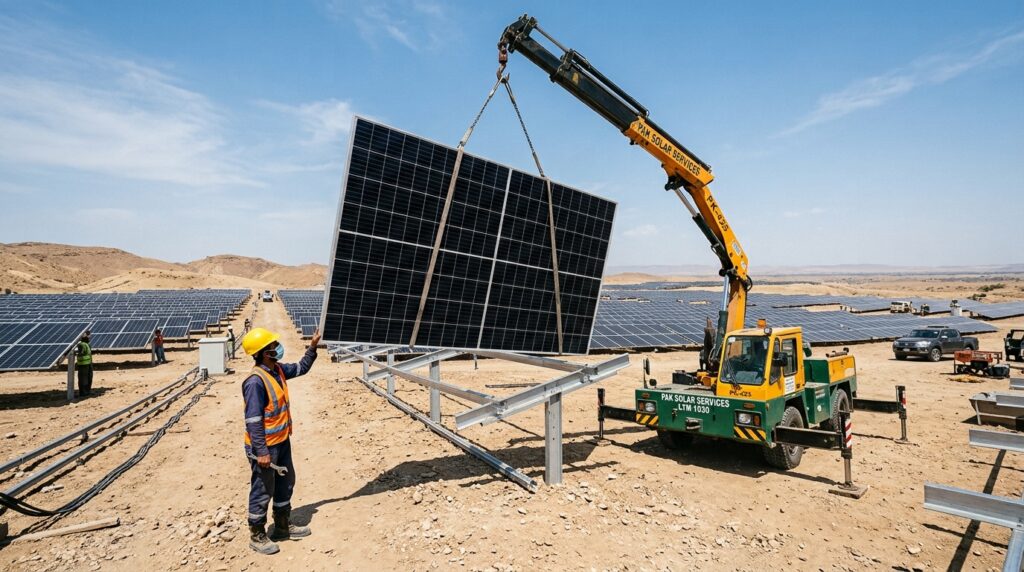
Yes. Pakistan Solar Solutions designs and installs off-grid solar systems for petrol pumps, small factories, brick kilns, cold storage facilities, and other commercial and light industrial applications in areas with unreliable or absent grid connectivity. These systems require detailed load analysis and battery sizing that our engineering team conducts during the free site feasibility assessment.
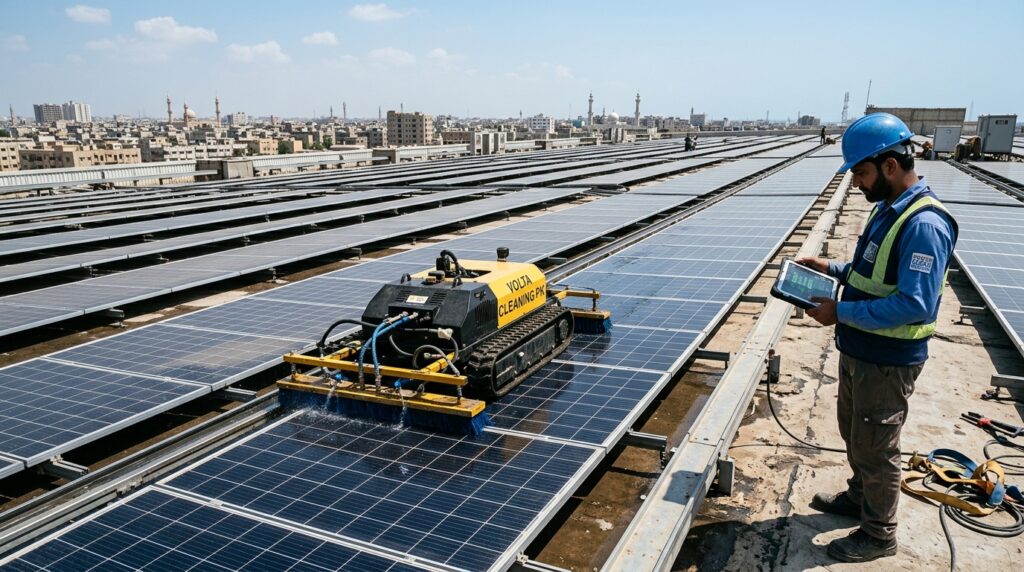
Solar panels require cleaning every 4 to 6 weeks to maintain peak output, especially in dusty rural and agricultural environments. LiFePO4 battery banks require periodic BMS diagnostics and terminal inspection. Charge controllers and inverters are self-monitoring and alert users to faults through indicator lights or app notifications. Pakistan Solar Solutions offers annual maintenance packages for off-grid systems that include all of the above.