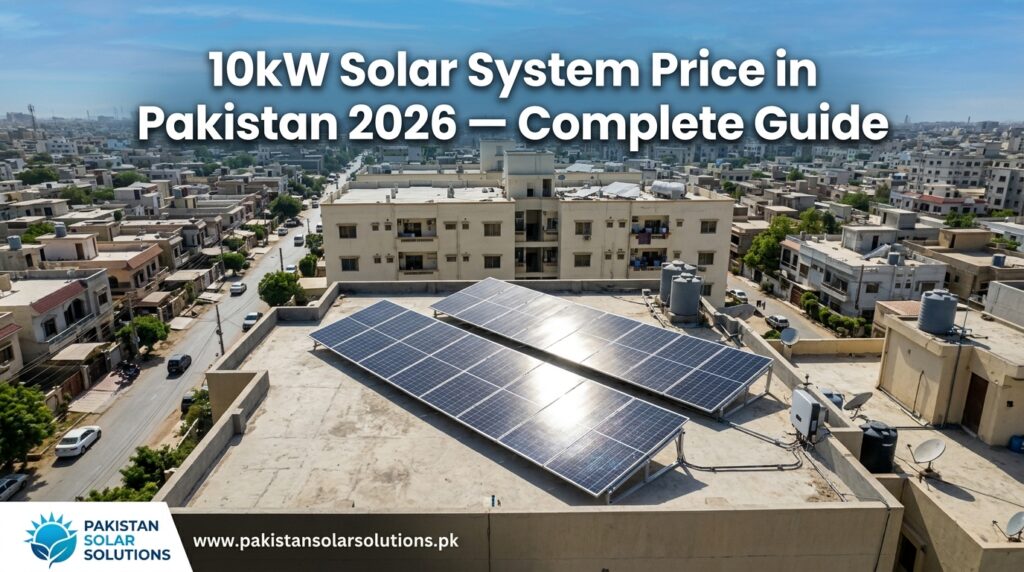


The 10kW solar system has emerged as one of the most installed solar sizes across Pakistan in 2026, particularly among larger households, small businesses, offices, and commercial properties. It sits at the ideal capacity point for properties consuming between 800 and 1,200 units of electricity per month, delivering substantial monthly savings while remaining financially accessible compared to larger commercial installations. With WAPDA and K-Electric tariffs exceeding PKR 60 to 65 per unit in 2026 and load shedding continuing to disrupt daily life across the country, understanding the 10kW solar system price in Pakistan is the first step toward making one of the best financial decisions available to Pakistani consumers today.
This guide covers every aspect of the 10kW solar system in Pakistan, from complete price breakdowns and equipment specifications to monthly savings calculations, ROI timelines, and how to choose the right company for your installation. Whether you are a homeowner in Karachi, a business owner in Lahore, or a factory manager in Rawalpindi, this article gives you everything you need to evaluate whether a 10kW system is right for your energy needs.
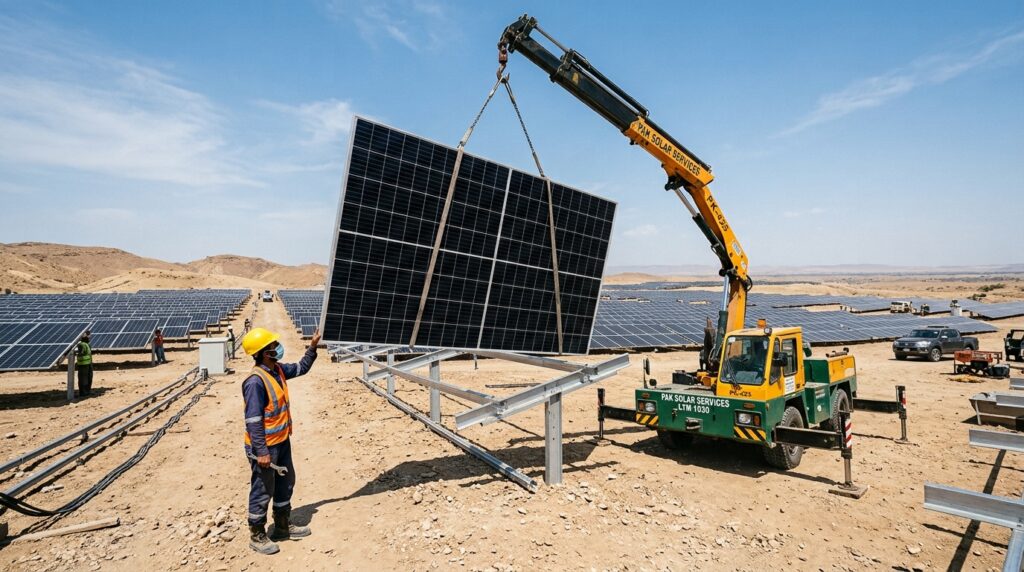
Before comparing prices, it is important to understand exactly what a complete 10kW solar system installation should include. A genuine turnkey 10kW system from a certified solar company like Pakistan Solar Solutions includes Tier-1 solar panels totaling 10,000 watts of peak generation capacity, typically 17 to 23 panels depending on individual panel wattage. It also includes a 10kW on-grid or hybrid inverter, a heavy-duty galvanized steel or anodized aluminum mounting structure designed for your roof type, all DC cables from panels to inverter, all AC cables from inverter to your distribution board, earthing rods and lightning protection, circuit breakers, isolators, and surge protection devices, professional installation labor by PEC-certified engineers, and system commissioning and testing. Net metering documentation preparation and submission assistance is also included for properties with three-phase connections.
Any quote that excludes earthing, cabling, or documentation should be questioned because these components are essential for safety, performance, and regulatory compliance. Pakistan Solar Solutions provides fully itemized proposals so you know exactly what you are paying for before signing anything.
An on-grid 10kW solar system is the most affordable configuration and the most popular choice for Pakistani homeowners and small businesses who want to maximize bill reduction through net metering. In 2026, a complete on-grid 10kW solar system installation costs between PKR 950,000 and PKR 1,200,000 in Pakistan. This price range reflects variation in panel brand, inverter model, roof type, and location across cities like Karachi, Lahore, Islamabad, and Rawalpindi.
Monthly savings from a 10kW on-grid system in Pakistan range from PKR 18,000 to PKR 28,000 depending on your DISCO tariff and local sunlight hours. With WAPDA tariffs above PKR 60 per unit, the system achieves full payback in 2.5 to 3.5 years and then generates free electricity for the remaining 22 or more years of the panel’s 25-year lifespan. Over a full 25-year period, a 10kW system in Pakistan can save a property owner PKR 8 to 12 million in electricity costs at current tariff rates, making it one of the highest-returning investments available in the Pakistani market today.
Several factors influence the final price of a 10kW on-grid installation. Panel brand is a major variable, with premium N-Type bifacial panels from Longi or Jinko costing more than standard PERC panels but delivering measurably better long-term performance especially in Pakistan’s high-temperature climate. Inverter brand and model also play a significant role, with premium brands like Huawei SUN2000 commanding a higher price than mid-range options like Growatt or Solis. Roof type matters too, as RCC concrete roofs are the most straightforward to work with while pitched metal or tile roofs may require specialized mounting hardware. Location within Pakistan affects logistics costs, and urban centers generally have more competitive labor rates than remote areas.
A 10kW hybrid solar system combines the bill savings of on-grid net metering with the load shedding protection of a lithium battery bank. For Pakistani households and businesses experiencing 6 to 12 hours of daily load shedding, the hybrid configuration is often the most sensible investment despite its higher upfront cost.
In Pakistan in 2026, a complete 10kW hybrid solar system with 10kWh to 20kWh of LiFePO4 lithium battery backup costs between PKR 1,400,000 and PKR 1,700,000. Monthly savings from a 10kW hybrid system reach PKR 20,000 to PKR 35,000 because you consume more of your own solar generation directly instead of exporting at the lower net metering rate, and you eliminate generator fuel costs entirely. The payback period for a 10kW hybrid system is 3.5 to 4.5 years. For families spending PKR 10,000 to PKR 20,000 monthly on generator fuel, the hybrid premium pays for itself within 18 to 24 months from fuel savings alone.
The right choice between on-grid and hybrid depends on your load shedding situation and your tolerance for power interruptions. If your area experiences minimal load shedding of 1 to 2 hours daily and your primary goal is bill reduction, an on-grid 10kW system delivers excellent ROI at a lower upfront cost. If you experience 4 or more hours of daily load shedding, run a home business, have family members dependent on medical equipment, or simply want complete energy independence from WAPDA outages, the hybrid configuration justifies its premium price. Pakistan Solar Solutions engineers conduct a detailed economic comparison for every client during the free site survey so you make the decision based on your specific numbers rather than general estimates. You can also explore our hybrid solar system Pakistan guide for a full breakdown of hybrid system costs and benefits across different system sizes.
Daily and annual generation from a 10kW solar system varies by location within Pakistan. Karachi and Sindh province, which receive Pakistan’s highest solar irradiance, produce 45 to 57 units per day from a 10kW system during summer months and 36 to 45 units per day in winter. On an annual basis, a 10kW system in Karachi generates 14,000 to 18,000 units of electricity.
In Lahore and central Punjab, daily generation ranges from 40 to 50 units in summer and 32 to 40 in winter, with annual output of 13,000 to 16,000 units. In Islamabad and northern Pakistan, summer daily output is 36 to 46 units and winter output drops to 28 to 36 units due to shorter days and occasional cloud cover, giving annual output of 12,000 to 15,000 units.
At PKR 60 per unit, a 10kW system in Karachi generates PKR 840,000 to PKR 1,080,000 worth of electricity annually. Even at the lower end of this range, the system pays for itself within 1.5 years in avoided electricity costs alone, making the 10kW system one of the fastest-payback solar investments available in Pakistan.
A 10kW system in 2026 typically uses 17 to 23 solar panels depending on individual panel wattage. With 440W to 600W N-Type panels being the standard in 2026, most 10kW installations use 17 to 23 panels. Choosing the right panel brand has a meaningful long-term impact on system performance, especially in Pakistan’s extreme summer heat.
Longi Hi-Mo X10 panels deliver over 22 percent efficiency with N-Type monocrystalline technology and a temperature coefficient of minus 0.29 percent per degree Celsius. Jinko Tiger Neo bifacial panels reach 22.5 percent efficiency with excellent low-light performance that benefits installations in Punjab and northern Pakistan during cloudy winter months. JA Solar N-Type TopCon panels offer 21.5 percent efficiency with strong durability records in high-humidity coastal environments like Karachi. Canadian Solar HiKu7 mono PERC panels at over 21 percent efficiency provide reliable performance at a slightly lower price point. Trina Vertex N panels also deliver over 21 percent efficiency and have gained a strong reputation in Pakistan for consistent long-term output.
All Tier-1 panels installed by Pakistan Solar Solutions come with authentic 25-year linear power output warranties directly from the manufacturer, guarantee cards, and certificate of conformity documents. We never install panels whose documentation cannot be verified. For those specifically comparing panel brands in Karachi, our Longi solar panels price Pakistan guide provides a detailed brand-specific analysis.
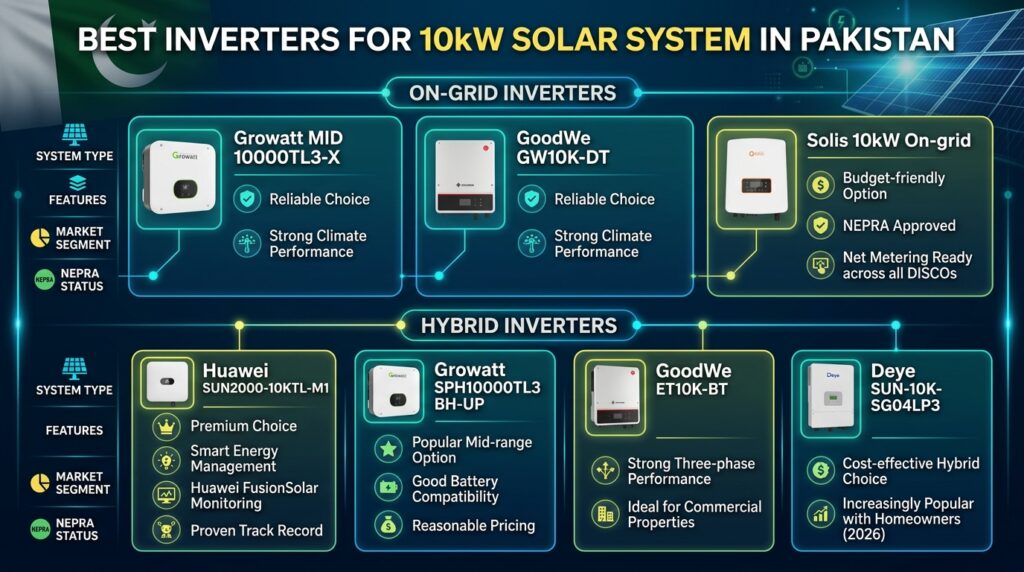
The inverter selection for a 10kW system in Pakistan involves choosing between on-grid and hybrid models from several NEPRA-approved manufacturers. For on-grid 10kW installations, Growatt MID 10000TL3-X and GoodWe GW10K-DT are reliable choices with strong performance records in Pakistan’s climate. Solis 10kW on-grid inverters offer a budget-friendly option with NEPRA approval for net metering across all DISCOs.
For hybrid 10kW installations, the Huawei SUN2000-10KTL-M1 is the premium choice with smart energy management, Huawei FusionSolar monitoring, and a proven track record in Pakistan. The Growatt SPH10000TL3 BH-UP is a popular mid-range hybrid option with good battery compatibility and reasonable pricing. The GoodWe ET10K-BT hybrid inverter offers strong three-phase performance for commercial properties. Deye SUN-10K-SG04LP3 rounds out the options as a cost-effective hybrid choice increasingly popular among Pakistani homeowners in 2026.
A 10kW solar system is appropriate for properties consuming between 800 and 1,200 units of electricity per month. To confirm whether this matches your needs, review your last six electricity bills and calculate your average monthly consumption. If your average is consistently below 700 units, a 5kW system is sufficient and more cost-effective. If your average consistently exceeds 1,200 units, a 15kW or 20kW system would serve you better and deliver a comparable or better ROI.
Typical properties well-suited to a 10kW system in Pakistan include large family homes running 2 to 3 air conditioners, geysers, washing machines, and multiple refrigerators. Small to medium offices with 10 to 30 workstations, servers, and central air conditioning also fall in this range. Small retail shops, clinics, and restaurants with moderate electrical loads are strong candidates, as are farms using electric irrigation pumps for several hours daily. Pakistan Solar Solutions conducts a free energy audit at your site before recommending any system size, ensuring you invest in exactly the capacity that optimizes your return. You can visit pakistansolar.solutions to schedule your free audit today.
A 10kW on-grid or hybrid solar system is fully eligible for NEPRA net metering across all Pakistani DISCOs including LESCO, MEPCO, FESCO, IESCO, PESCO, HESCO, SEPCO, QESCO, and K-Electric in Karachi, provided your property has a three-phase electricity connection. With net metering, surplus electricity exported to the grid earns you bill credits at PKR 19 to 21 per unit, which are deducted from your import charges on your monthly bill.
A 10kW system generating 45 to 55 units daily in a city like Karachi exports roughly 15 to 25 surplus units on a typical day after meeting household consumption. At PKR 20 per unit export credit, these credits accumulate to PKR 9,000 to PKR 15,000 per month, complementing the PKR 15,000 to PKR 20,000 saved through direct solar consumption. Combined, net metering and direct savings bring total monthly bill reduction to PKR 18,000 to PKR 28,000. Pakistan Solar Solutions manages the complete net metering application on your behalf. For Karachi-specific net metering details, visit our net metering Karachi page.
Pakistan Solar Solutions has been delivering certified solar EPC services since 2017, long before the recent solar boom transformed Pakistan’s energy landscape. Our team of PEC-certified engineers has designed and installed 10kW systems across residential, commercial, and industrial properties in Karachi, Sukkur, and Rawalpindi. Every installation we complete meets NEPRA’s technical standards, comes with full manufacturer documentation, and is backed by our workmanship warranty.
We offer a completely free site survey and energy audit with no obligation, a detailed proposal with itemized costs and ROI projections, Tier-1 panel and NEPRA-approved inverter selection, and complete net metering application management. There are no hidden charges and no pressure to proceed. Our three-city presence ensures fast local response for maintenance and after-sales support across Pakistan.
A complete 10kW on-grid solar system including all panels, inverter, mounting structure, cabling, earthing, and professional installation costs PKR 950,000 to PKR 1,200,000 in Pakistan in 2026. A 10kW hybrid system with LiFePO4 lithium battery backup costs PKR 1,400,000 to PKR 1,700,000. Final pricing varies by city, panel brand, inverter model, and roof type.
A 10kW on-grid system in Pakistan saves PKR 18,000 to PKR 28,000 per month depending on your DISCO tariff and location. In high-irradiance cities like Karachi, savings reach the upper end of this range. Over a 25-year panel lifespan, total savings of PKR 8 to 12 million are achievable at current tariff rates.
A 10kW system in Pakistan in 2026 typically requires 17 to 23 panels depending on individual panel wattage. With modern 500W to 600W N-Type panels being standard, most installations use 17 to 20 panels, reducing roof space requirements and structural load compared to older lower-wattage panels.
Yes. A 10kW solar system can fully power a large Pakistani home running 2 to 3 air conditioners, multiple refrigerators, a geyser, washing machine, lighting, fans, and a water pump during daylight hours. With a hybrid configuration and adequate battery bank, the same system continues powering essential loads through the night and during load shedding.
A standard 10kW residential installation by Pakistan Solar Solutions is completed within 2 to 3 working days. Commercial installations at the same capacity may take 3 to 5 days depending on roof complexity and site access. Net metering application and DISCO meter installation follows and typically takes 2.5 to 3.5 months after submission.