

For a small residential rooftop, a simple telescopic brush handles panel cleaning perfectly well, a topic covered in detail in our dedicated guide to the solar panel cleaning brush. But once you are managing a large commercial rooftop, an industrial-scale installation, or a solar farm spanning hundreds or thousands of panels, manual brush cleaning quickly becomes impractical, both in terms of labor time and the physical challenge of safely accessing every panel across a sprawling array. This is where dedicated solar panel cleaning machines come in, ranging from semi-automated water-fed systems to fully robotic cleaning units designed specifically for large-scale commercial and industrial solar installations. This guide covers what these machines actually are, what they cost in Pakistan, and when investing in one genuinely makes sense over manual or contracted cleaning services.
The dust accumulation challenges facing Pakistani solar installations, covered in general terms in our cleaning brush guide, scale up significantly for large commercial and industrial arrays. A factory rooftop or ground-mount solar farm spanning several hundred kilowatts or more can involve hundreds or even thousands of individual panels, making manual brush cleaning, even with an extended telescopic pole, an enormously time-consuming and labor-intensive undertaking that quickly becomes impractical to perform on the regular schedule needed to maintain peak output during Pakistan’s dusty dry season. Dedicated cleaning machines address this scale problem directly, allowing large arrays to be cleaned considerably faster and with less ongoing labor cost than an equivalent manual cleaning operation.
Several categories of cleaning equipment serve different scales and types of solar installations, each with a different balance of automation, cost, and practical suitability.
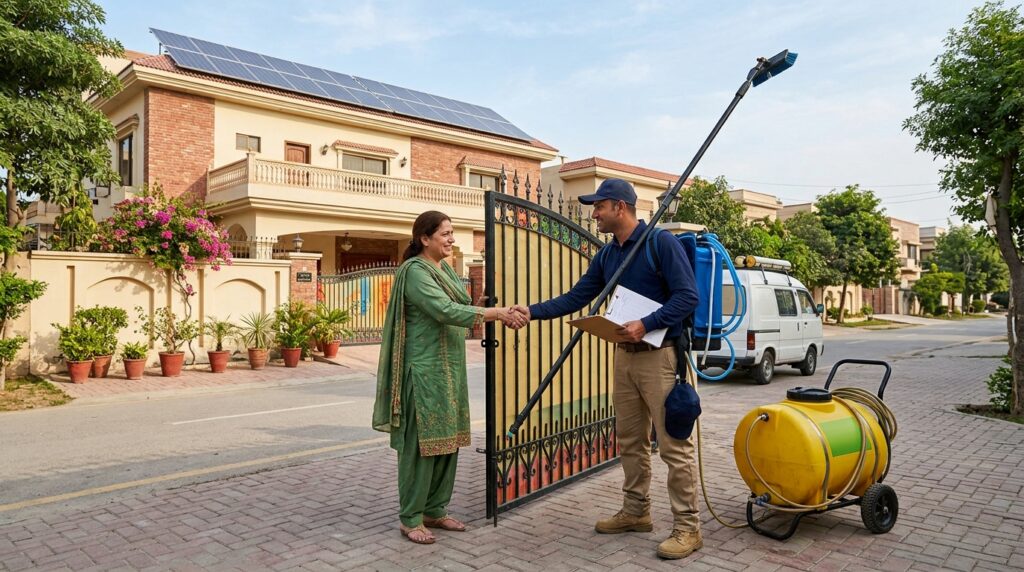
Water-fed pole systems represent the most common step up from basic manual brushes for medium-scale commercial installations, using an extended pole, often reaching twenty feet or more, combined with a rotating or static soft-bristle brush head and a continuous purified water flow through the pole itself. While still requiring an operator to manually guide the system across the array, these units allow a single technician to clean considerably more panel area per hour than a basic handheld brush, making them a practical middle-ground solution for mid-sized commercial rooftops that are too large for basic manual brushes but not yet at the scale that justifies fully automated robotic systems.
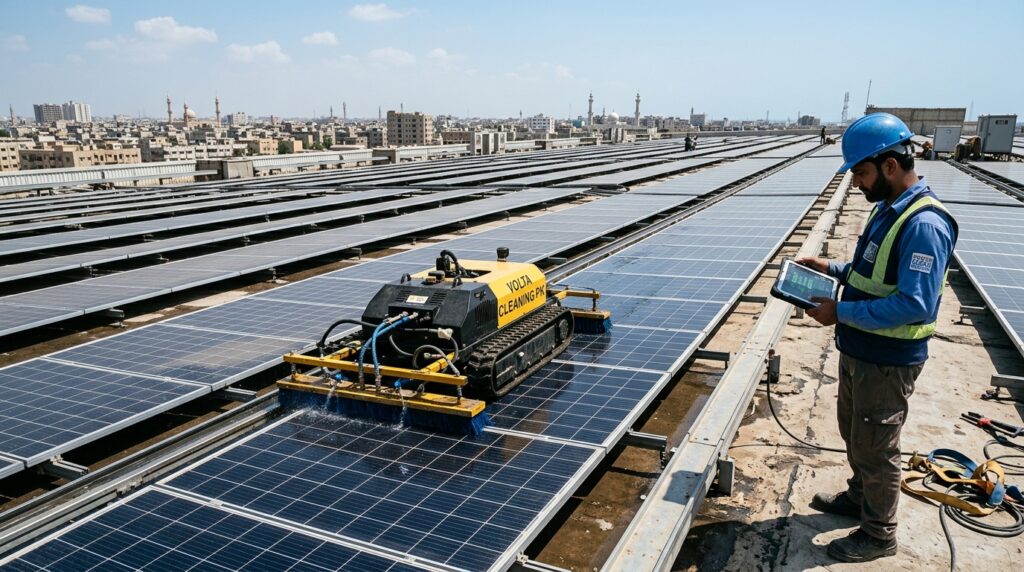
Fully robotic solar panel cleaning machines represent the most advanced and automated option currently available, using a self-propelled unit that moves across the panel surface, typically using soft brush rollers or microfiber pads, cleaning as it travels along pre-programmed or sensor-guided paths across the array. These systems can operate with minimal direct human supervision once properly configured, making them particularly valuable for very large commercial and industrial installations or solar farms where the scale of the cleaning task would otherwise require a substantial dedicated labor force to manage through manual or semi-automated methods.
Some larger commercial installations, particularly in the Middle East and increasingly discussed for large-scale Pakistani projects, use permanently installed spray and rinse systems, essentially a network of fixed nozzles positioned to periodically rinse the entire array on an automated schedule, sometimes combined with a soft brushing mechanism for more thorough periodic deep cleaning. These systems require the most significant upfront infrastructure investment but offer the least ongoing labor requirement, since cleaning can be scheduled and triggered automatically without any technician needing to physically visit the site for routine rinse cycles.
As of 2026, water-fed pole systems suitable for medium commercial installations typically cost between PKR 15,000 and PKR 40,000 depending on pole length, brush quality, and included water filtration attachments. Robotic cleaning systems represent a considerably larger investment, generally ranging from PKR 800,000 to several million rupees depending on the system’s coverage capacity, level of automation, and whether it is designed for rooftop or ground-mount array configurations. Fixed automated spray and rinse infrastructure costs vary enormously based on the specific installation’s scale and complexity, generally requiring a custom quotation based on the array’s total size and layout rather than a standard published price range.
Whether investing in dedicated cleaning equipment makes financial sense depends heavily on your installation’s scale and how much cleaning labor cost you are currently incurring or would otherwise need to budget for.
For standard residential installations and smaller commercial rooftops, discussed throughout our commercial and industrial solar solutions guide, a basic manual brush or occasional professional cleaning service generally remains the more cost-effective approach, since the upfront cost of even a modest water-fed pole system rarely pays for itself against the relatively limited cleaning labor a smaller array actually requires.
For larger commercial and industrial arrays, typically above roughly 100 kW, the calculation shifts meaningfully in favor of dedicated cleaning equipment, since the ongoing labor cost of manually cleaning a large array on a proper bi-weekly schedule during Pakistan’s dry season can accumulate to a substantial recurring expense that a water-fed pole system or, at sufficient scale, a robotic system can meaningfully reduce over the equipment’s operational lifespan.
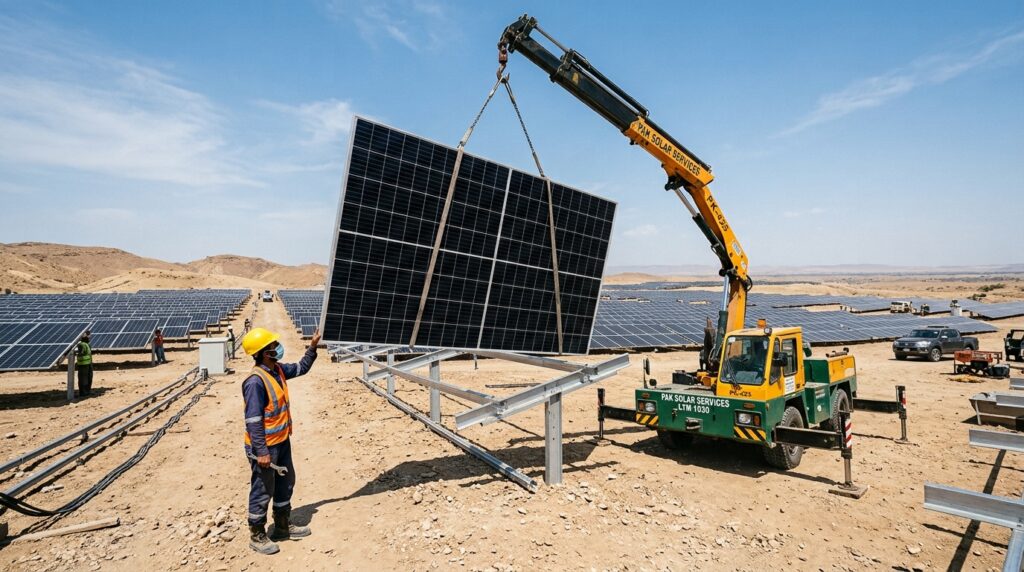
For utility-scale solar farm installations spanning many hundreds of kilowatts or into the megawatt range, dedicated automated cleaning infrastructure, whether robotic systems or fixed spray installations, generally becomes a near-necessity rather than an optional efficiency upgrade, since the sheer scale of manual cleaning labor required to maintain output across such a large array would otherwise represent an impractical and disproportionately expensive ongoing operational cost.
Regardless of which type of cleaning machine is used, water quality significantly affects cleaning effectiveness and long-term panel condition. Using untreated tap water with high mineral content repeatedly through an automated system can gradually leave behind mineral spotting on the panel surface, similar to hard water spots on glass, meaningfully reducing light transmission over repeated cleaning cycles if left unaddressed. Many commercial-grade water-fed and robotic cleaning systems incorporate a water filtration or purification attachment specifically to address this concern, using deionized or reverse-osmosis-treated water that dries without leaving mineral residue, an important consideration when evaluating the total cost and long-term value of any automated cleaning investment, since the filtration component itself adds meaningfully to both upfront cost and ongoing water treatment expense.
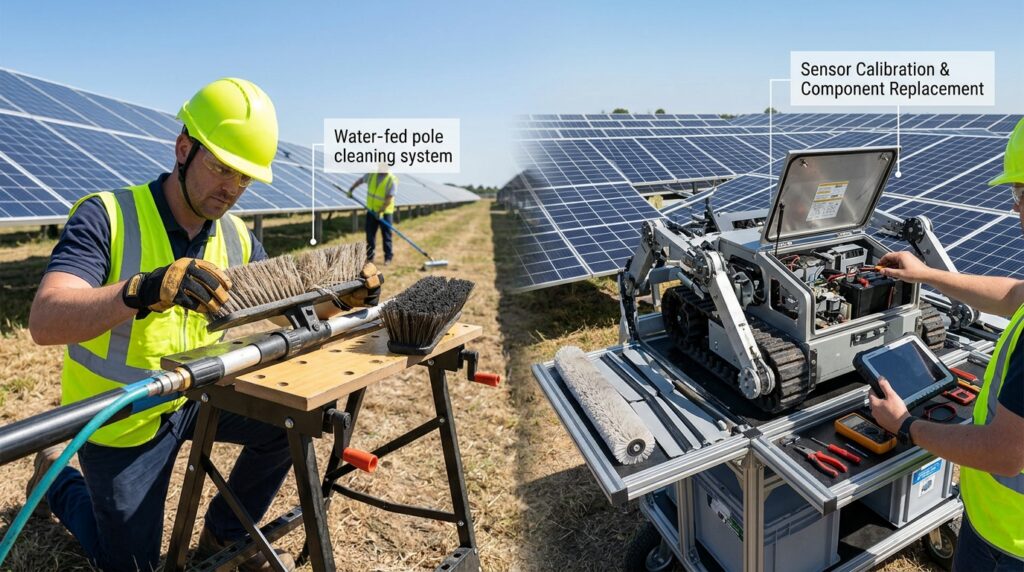
Cleaning machines themselves require their own maintenance to continue operating effectively over time. Water-fed poles need periodic inspection of hose connections and brush head condition, replacing worn bristles before they risk scratching the panel surface. Robotic systems require more involved maintenance, including battery or power supply servicing, periodic calibration of navigation sensors, and replacement of brush or wiping components as they wear from repeated use. Facilities investing in robotic cleaning equipment should factor this ongoing maintenance requirement into their total cost calculation, since a poorly maintained robotic cleaner can itself become a source of panel damage if worn components are not addressed promptly, undermining the very protective purpose the equipment was purchased to serve.
For many Pakistani commercial and industrial solar owners, the most practical approach combines owned cleaning equipment with a professional maintenance service contract, using in-house equipment for routine cleaning cycles while relying on a specialized service provider for periodic deeper cleaning, equipment maintenance, and troubleshooting if the automated system experiences any operational issues. Pakistan Solar Solutions offers ongoing maintenance support for the commercial and industrial systems we install, including guidance on whether dedicated cleaning equipment makes sense for your specific installation scale, and can advise on appropriate equipment specifications if a machine investment is warranted for your facility.
Given how significantly cleaning equipment needs vary based on installation scale, roof configuration, and local dust conditions, a generic recommendation rarely fits every situation well. Our team can assess your specific commercial or industrial installation and advise honestly on whether a basic manual approach, a water-fed pole system, or a more substantial robotic investment genuinely makes sense for your facility’s scale and budget, available through our contact page alongside our broader solar panel price in Pakistan services.
For commercial and industrial buyers evaluating whether a cleaning machine investment makes financial sense, a straightforward return on investment calculation helps clarify the decision. Consider a facility currently paying for manual cleaning labor across a 200 kW rooftop installation, requiring a team of workers a full day to complete a thorough cleaning cycle every two weeks during peak dust season. If this labor cost totals approximately PKR 30,000 per cleaning cycle, and the facility requires roughly ten cleaning cycles annually accounting for both peak and off-peak season frequency, total annual manual cleaning labor cost reaches approximately PKR 300,000. A water-fed pole system costing PKR 35,000 upfront, requiring only a single technician working a fraction of the time compared to a full manual cleaning crew, could realistically reduce this labor cost by sixty to seventy percent, paying for itself well within the first year of operation while continuing to deliver ongoing labor savings for years afterward. This kind of calculation, adjusted for your specific facility’s actual scale and current cleaning costs, provides a much more concrete basis for the cleaning machine investment decision than a generic recommendation based purely on system size alone.
Given Pakistan’s ongoing water scarcity concerns in many regions, water usage deserves consideration when evaluating cleaning machine options, particularly for large-scale installations requiring frequent cleaning cycles throughout the dry season. Dry cleaning robotic systems, using brush rollers or microfiber pads without water, offer a genuine water conservation advantage over water-based cleaning methods, though they may be somewhat less effective at removing more stubborn, caked-on dust and grime compared to water-assisted cleaning, particularly following periods of light rainfall that can create a thin muddy film on panel surfaces rather than simple loose dust. For facilities in water-scarce regions or those specifically prioritizing sustainable operations, evaluating dry cleaning robotic options alongside traditional water-based systems is worthwhile, weighing the water conservation benefit against any potential difference in cleaning thoroughness for your specific local dust and weather conditions.
Water-fed pole systems typically cost PKR 15,000 to PKR 40,000, while fully robotic cleaning systems range from PKR 800,000 to several million rupees depending on coverage capacity and automation level. Fixed automated spray systems require custom quotation based on installation scale.
Generally no. For standard residential installations, a basic manual telescopic brush, covered in our dedicated cleaning brush guide, remains the more cost-effective approach, since the labor and equipment cost of dedicated machines rarely pays for itself at residential scale.
The calculation typically favors dedicated cleaning equipment above roughly 100 kW of installed capacity, where the ongoing labor cost of manual cleaning on a proper schedule becomes substantial enough that automated or semi-automated equipment can meaningfully reduce total operational cost over its lifespan.
Most robotic cleaning systems use either a water-based cleaning method similar to water-fed poles, or a dry brushing and microfiber wiping approach that avoids water entirely, particularly useful in locations where water access is limited. The right choice depends on your specific site conditions and water availability.
This depends on local dust conditions, but many commercial installations schedule automated cleaning cycles every two to three weeks during Pakistan’s dry season between March and June, similar to the recommended manual cleaning frequency, with reduced frequency during the monsoon season when natural rainfall assists with dust removal.
Dry cleaning robots conserve water and work well for routine dust removal, but may be somewhat less effective against more stubborn grime or muddy residue following light rainfall compared to water-assisted cleaning. The right choice depends on your local dust conditions and water availability.
A well-maintained machine using soft bristles or microfiber components, operated correctly, should not damage panels. However, worn brush components or improperly calibrated robotic systems can pose a scratching risk, making regular equipment maintenance an important part of safe long-term operation.