

Every solar buyer eventually runs into the same marketing phrase repeated across brochures, dealer WhatsApp messages and product listings: high efficiency solar panels. It sounds like an obvious upgrade, and in many cases it genuinely is, but very few buyers actually understand what efficiency means in practical terms, how much it truly affects their electricity bill, or whether the extra cost is justified for their specific rooftop and budget. This guide goes deep into what efficiency actually measures, which technologies currently deliver the highest efficiency ratings in the Pakistani market, and how to decide whether paying a premium for a high efficiency panel makes financial sense for your particular situation.
Pakistan Solar Solutions has installed systems using both standard and premium high efficiency panels since 2017, and the perspective in this guide reflects what we have consistently observed in the field across residential, commercial and industrial projects, not just manufacturer specification sheets.
Solar panel efficiency is a percentage figure that describes how much of the sunlight hitting a panel’s surface is actually converted into usable electricity. A panel rated at 22 percent efficiency converts 22 percent of the solar energy striking it into electrical output, while the remaining energy is lost as heat, reflection, or other forms of energy dissipation within the cell structure. This single number has an outsized impact on system design, because it directly determines how much electricity you can generate from a given amount of roof space, which matters enormously in a country like Pakistan where rooftop area is frequently the limiting factor in system size, particularly for urban homes.
Manufacturers measure efficiency under standardized laboratory conditions known as Standard Test Conditions, which assume a cell temperature of 25 degrees Celsius, a specific solar irradiance level, and a defined light spectrum. This is important context because real-world conditions in Pakistan, particularly during summer months when rooftop surface temperatures can exceed 55 to 60 degrees Celsius, rarely match these controlled laboratory conditions. This is precisely why the temperature coefficient of a panel, discussed in more detail later in this guide, matters just as much as the headline efficiency percentage when evaluating real-world performance in Pakistani conditions.
One of the most common misunderstandings among solar buyers is conflating a panel’s wattage rating with its efficiency rating. Wattage describes the total power output of a specific panel at its given physical size, while efficiency describes how effectively that panel converts sunlight per unit of surface area. A larger panel can have a higher wattage rating than a smaller panel while actually being less efficient, simply because it has more physical surface area to work with. When comparing panels, the meaningful efficiency comparison is watts produced per square meter of panel surface, not the total wattage number printed on the specification sheet, since two panels of very different physical sizes can carry identical wattage ratings while having noticeably different efficiency percentages.
Understanding the underlying cell technology helps explain why some panels command a significant price premium over others, and why that premium is often justified for specific applications.
Monocrystalline panels, made from a single continuous silicon crystal structure, consistently deliver higher efficiency than polycrystalline panels, which are manufactured from multiple silicon fragments melted together. This structural difference allows electrons to move more freely through monocrystalline cells, resulting in less internal resistance and higher overall conversion efficiency, typically in the range of 19 to 22.5 percent for modern monocrystalline panels compared to 15 to 17 percent for standard polycrystalline panels. This is why virtually all high efficiency panels marketed in Pakistan today, and indeed globally, are built on monocrystalline cell technology rather than the older polycrystalline design.
The most significant recent advancement driving efficiency gains in the panels now available in Pakistan is N-Type TOPCon technology, which stands for Tunnel Oxide Passivated Contact. This cell architecture reduces electron recombination losses at the cell surface through an ultra-thin oxide layer, allowing more of the generated electrical current to actually reach the panel’s output terminals rather than being lost within the cell structure itself. N-Type TOPCon panels from manufacturers like Longi, Jinko and JA Solar routinely achieve efficiency ratings above 22 percent, representing a meaningful step up from the P-Type PERC technology that dominated the market just a few years ago.
Bifacial panels, which can generate electricity from both their front and rear surfaces, add another dimension to the efficiency conversation that goes beyond the standard front-side rating printed on the specification sheet. While the front-side rating remains the headline efficiency figure, bifacial panels can generate an additional five to twenty percent total energy yield depending on mounting height, ground reflectivity, and installation configuration, since the rear surface captures reflected and diffused sunlight bouncing off the roof, ground, or surrounding surfaces. This makes bifacial technology particularly valuable for elevated commercial and industrial installations, where the mounting structure naturally creates the clearance needed for meaningful rear-side light capture.
Passivated Emitter and Rear Cell technology, commonly known as PERC, improved upon older cell designs by adding a reflective layer to the rear of the cell, allowing previously unused light that passed through the cell to bounce back and be captured on a second pass. Half-cut cell design, now standard across most Tier-1 panels regardless of whether they use PERC or newer TOPCon technology, physically cuts each cell in half, reducing internal resistance losses and improving performance particularly in partial shading conditions, where a portion of the panel might be shaded by a nearby wall, water tank, or antenna, a common scenario on Pakistani rooftops.
Several Tier-1 manufacturers currently supply high efficiency panels to the Pakistani market, each with slightly different strengths depending on the specific application.
Longi’s Hi-Mo X10 series represents the company’s flagship N-Type monocrystalline offering, consistently achieving efficiency ratings above 22 percent, with the top-tier variants approaching 22.8 percent under standard test conditions. Longi panels have built a strong reputation in Pakistan for consistent manufacturing quality, meaning the actual measured output of installed panels tends to closely match their laboratory-rated efficiency, an important consideration since some lower-tier manufacturers show more variance between labeled and actual field performance.
Jinko’s Tiger Neo series combines N-Type technology with bifacial cell design, achieving efficiency ratings around 22.5 percent on the front surface alone, with additional energy capture from the rear surface pushing effective total yield noticeably higher in appropriate mounting configurations. This combination makes Jinko Tiger Neo panels particularly popular for commercial and industrial projects in Pakistan where elevated mounting structures allow the bifacial advantage to be fully realized.
JA Solar’s N-Type TopCon panels deliver efficiency above 21.5 percent while typically sitting at a slightly lower price point than Longi or Jinko’s flagship offerings, making them a popular choice for buyers who want genuine high efficiency technology without paying the absolute premium price commanded by the very top-tier brands. This positions JA Solar as something of a value leader within the high efficiency segment specifically.
Canadian Solar’s HiKu7 series and Trina’s Vertex N panels round out the high efficiency options widely available in Pakistan, both delivering efficiency ratings above 21 percent while bringing decades of established global manufacturing experience and strong warranty support. These brands are often favored by buyers who prioritize a long, proven track record over squeezing out the absolute maximum efficiency percentage available in the market.
The practical value of high efficiency technology becomes most apparent when working with limited rooftop space, a scenario extremely common across Pakistan’s urban housing stock, particularly in older city neighborhoods and smaller residential plots. Consider two households needing the same 5 kW system size, one using standard 18 percent efficiency panels and another using premium 22.5 percent efficiency panels. The household with higher efficiency panels can achieve the identical 5 kW capacity using meaningfully less roof area, since each panel produces more watts per square meter of surface. For a homeowner with an already crowded rooftop, shared with a water tank, satellite dish, and perhaps a small rooftop room, this difference can mean the choice between fitting the full desired system size or having to compromise on capacity due to insufficient space, making efficiency a genuinely practical rather than purely academic consideration.
This is the question every buyer ultimately needs to answer for their own situation, and the honest answer is that it depends heavily on how constrained your roof space actually is. If you have abundant, unshaded roof area well beyond what your target system size requires, the financial case for paying a premium for high efficiency panels weakens considerably, since standard efficiency panels can simply be installed in slightly greater quantity to reach the same total system capacity at a lower overall cost. However, if your available roof space is a genuine constraint, meaning you cannot comfortably fit your desired system capacity using standard panels, high efficiency panels effectively become the only way to achieve your target capacity at all, making the price premium a practical necessity rather than an optional upgrade. There is also a secondary consideration worth factoring in: higher efficiency panels from premium manufacturers like Longi and Jinko often come from more rigorous manufacturing processes overall, meaning buyers frequently get better build quality and more consistent long-term performance alongside the efficiency gain itself, even setting aside the pure watts-per-square-meter calculation.
Every solar panel loses some efficiency as its operating temperature rises above the 25-degree standard test condition, a property captured in the panel’s temperature coefficient, usually expressed as a percentage loss per degree Celsius above this baseline. In Pakistan’s punishing summer heat, where rooftop surface temperatures regularly climb well past 55 degrees Celsius during peak afternoon sun, this coefficient has a real and measurable impact on daily energy output. Modern N-Type panels typically carry a temperature coefficient around negative 0.29 to negative 0.34 percent per degree Celsius, meaning they lose roughly a third of a percentage point of output for every degree above the standard 25-degree baseline. Older P-Type panels often carry a less favorable coefficient closer to negative 0.40 to negative 0.45 percent per degree, meaning that over a full Pakistani summer, a P-Type panel can lose noticeably more of its rated output compared to an equivalent N-Type panel simply due to heat, independent of the base efficiency rating itself. This compounding effect is one of the strongest arguments for choosing N-Type high efficiency technology specifically for installations in Pakistan’s hottest regions, including Multan, interior Sindh, and southern Punjab generally.
Beyond initial efficiency, how gracefully a panel’s output declines over its operational lifespan matters just as much for long-term value. Premium high efficiency panels from Tier-1 manufacturers typically carry a first-year degradation of around one to two percent, followed by an annual degradation rate of roughly 0.4 to 0.5 percent in subsequent years, guaranteeing at least 85 to 87 percent of original rated output by year 25 under the manufacturer’s linear performance warranty. Lower-tier, budget panels often carry less favorable degradation profiles, sometimes dropping to 80 percent of original output by year 25 or even sooner if manufacturing quality control has been inconsistent. Over a 25-year investment horizon, this difference compounds meaningfully, since a panel maintaining higher output later in its life continues generating more total electricity across the system’s full lifespan, directly translating into greater cumulative savings even if the initial purchase price was somewhat higher.
The right decision on whether to invest in high efficiency technology varies considerably depending on the type of property and its specific constraints.
For homes in dense urban neighborhoods across Karachi, Lahore, and other major cities, where rooftop area is genuinely scarce and often shared with other household infrastructure, high efficiency panels are usually the right call, since they allow the homeowner to maximize system capacity within a fixed, limited footprint. This is particularly relevant for smaller plot sizes common in areas like Nazimabad in Karachi or the older sections of inner Lahore, where a five-marla or smaller plot leaves comparatively little usable rooftop area after accounting for water tanks, stairwells, and other structures.
Commercial buildings, particularly in dense business districts where rooftop area must also accommodate HVAC equipment, water tanks, and sometimes signage or communication infrastructure, similarly benefit from high efficiency panels, allowing a larger effective system capacity within a constrained footprint. For businesses where every square meter of usable roof space carries an opportunity cost, the efficiency premium often pays for itself through the additional generation capacity captured within the same physical area.
For rural and agricultural applications, where land or roof space is typically far less constrained, the financial case for premium high efficiency panels weakens somewhat, since standard efficiency panels can simply be deployed across a slightly larger area to reach the same total system capacity, often at a meaningfully lower total cost. This is particularly true for ground-mounted systems supporting tube wells or livestock operations, where abundant open land makes efficiency per square meter a much less pressing constraint than it is on an urban rooftop.
To evaluate whether the premium for high efficiency panels makes sense for your specific project, start by calculating your available roof area and comparing it against the total panel area required to reach your target system size using both standard and high efficiency panel options. If a standard efficiency configuration comfortably fits your available space with room to spare, the efficiency premium likely will not deliver proportional financial value, since you are not actually roof-space constrained. If a standard efficiency configuration does not fit your available space, or fits only with significant compromise, calculate the additional system capacity, and therefore additional lifetime electricity generation, that high efficiency panels would allow within the same footprint, and compare that additional generation value against the price premium over a 25-year horizon. In most genuinely space-constrained scenarios across Pakistan’s urban housing stock, this calculation favors high efficiency panels, particularly once the improved temperature performance and lower long-term degradation are factored in alongside the pure square-meter efficiency gain.
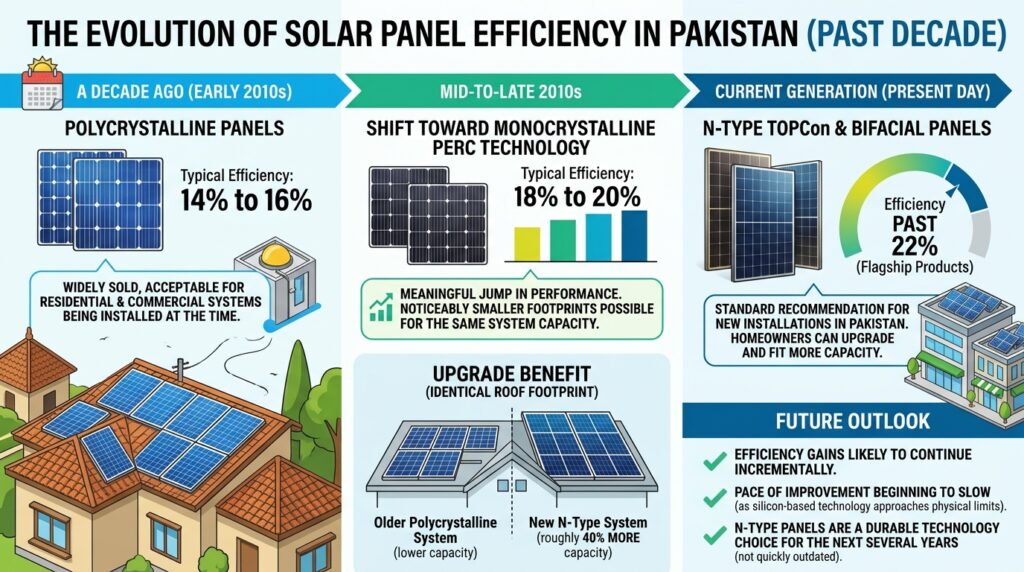
Understanding how quickly efficiency has improved helps explain why panels purchased even five or six years ago now look noticeably outdated compared to what is available in Pakistan today. Standard polycrystalline panels sold widely across Pakistan a decade ago typically delivered efficiency in the 14 to 16 percent range, and were considered perfectly acceptable for the residential and commercial systems being installed at the time. The shift toward monocrystalline PERC technology through the late 2010s pushed typical efficiency up to the 18 to 20 percent range, representing a meaningful jump that made noticeably smaller panel footprints possible for the same system capacity. The current generation of N-Type TOPCon and bifacial panels, now the standard recommendation for new installations in Pakistan, has pushed efficiency past 22 percent for flagship products, meaning a homeowner replacing an older polycrystalline system today could realistically fit roughly forty percent more capacity within the identical roof footprint simply by upgrading to current-generation technology. This trajectory also means efficiency gains are likely to continue incrementally in coming years, though the pace of improvement has begun to slow as silicon-based photovoltaic technology approaches certain physical limits, making the current generation of N-Type panels a reasonably durable technology choice for the next several years rather than something likely to be quickly outdated.
Because efficiency claims directly affect purchasing decisions and pricing, understanding how these figures are verified helps buyers separate genuine Tier-1 performance data from inflated marketing claims common among smaller, less established manufacturers. Reputable manufacturers submit their panels for independent third-party testing and certification through internationally recognized bodies, with the resulting efficiency figures published on an official datasheet that includes not just the headline efficiency percentage but also detailed electrical characteristics including open-circuit voltage, short-circuit current, and performance under varying temperature and irradiance conditions. When evaluating a high efficiency panel in the Pakistani market, buyers should always request this full datasheet rather than relying on a single efficiency number quoted verbally by a dealer, since a genuine Tier-1 datasheet will show consistent, verifiable figures that can be cross-referenced against the manufacturer’s own published international specifications. Panels from less established manufacturers occasionally advertise efficiency figures that do not hold up under independent testing, or that reflect best-case laboratory conditions rarely achieved in actual field deployment, which is one of several reasons buying through an established, PEC-certified installer with direct manufacturer relationships offers meaningful protection against this risk.
To make the efficiency conversation more concrete, consider a practical example based on a common residential scenario across Pakistan. A homeowner with approximately 400 square feet of usable, unshaded rooftop space wants to install as much solar capacity as possible within that footprint. Using standard 18 percent efficiency polycrystalline panels, this rooftop area could accommodate roughly 6.5 kW of installed capacity. Using premium 22.5 percent efficiency N-Type monocrystalline panels within the identical footprint, the same homeowner could fit closer to 8.1 kW of capacity, a difference of approximately 1.6 kW purely attributable to the efficiency gain rather than any change in available roof space. Over a 25-year system lifespan, that additional 1.6 kW of capacity, generating electricity every sunny day across a quarter century, represents a substantial amount of additional lifetime electricity generation and corresponding bill savings, often more than justifying the incremental cost of choosing the higher efficiency panel technology in the first place. This example illustrates why the efficiency conversation becomes financially meaningful specifically when roof space is the binding constraint on system size, which describes a large share of urban residential installations across Pakistan.
For homeowners planning a system specifically to maximize net metering benefits under NEPRA’s regulatory framework, efficiency plays an additional strategic role beyond simply fitting more capacity on a limited roof. Since net metering credits are earned based on total electricity exported to the grid during periods of surplus generation, a higher efficiency system installed within the same footprint as a standard efficiency alternative will generate more exportable surplus during peak sunlight hours, directly increasing the net metering credits earned each month. This effect compounds over the life of the system, since a higher-capacity installation continues exporting more surplus electricity year after year compared to a lower-capacity system occupying the identical roof space. For homeowners specifically trying to maximize their return from net metering, discussed in more detail through our net metering services page, this represents another concrete financial argument in favor of high efficiency technology whenever roof space constraints would otherwise limit total installed capacity.
While efficiency deserves careful consideration, it should never be evaluated entirely in isolation from the rest of the system design. An inverter that is undersized relative to the panel array, a poorly angled mounting structure, or inadequate cable sizing can all erode the real-world benefits of even the highest efficiency panels available. This is why Pakistan Solar Solutions approaches every project, whether using standard or premium high efficiency panels, through a complete system design process rather than simply specifying a panel model in isolation. Proper string sizing to match inverter input specifications, correctly calculated mounting angles suited to your specific city and roof orientation, and appropriately rated cabling to minimize resistive losses between the panels and the inverter all work together with panel efficiency to determine the actual electricity your system delivers month after month. A high efficiency panel installed as part of a poorly designed overall system will underperform relative to its rated specifications, which is why our engineering team treats efficiency as one important input among several when designing a complete solar solution for each customer’s specific roof and consumption profile.
Given the meaningful price difference between genuine high efficiency Tier-1 panels and lower-cost alternatives marketed with inflated or unverified efficiency claims, sourcing panels through an established, PEC-certified installer matters significantly in this premium category. Pakistan Solar Solutions works exclusively with globally certified manufacturers including Longi, Jinko Tiger Neo, JA Solar, Canadian Solar and Trina, and every high efficiency panel we install comes with manufacturer datasheet documentation verifying the actual tested efficiency rating rather than relying purely on marketing claims. Our full breakdown of current panel options and pricing is available on our best solar panels in Pakistan guide, and our team can conduct a free site survey to determine whether your specific roof space genuinely benefits from the high efficiency premium or whether a standard configuration would serve your needs just as effectively. You can review our complete solar panel price in Pakistan overview or reach out directly through our contact page for a tailored recommendation.
Several misconceptions circulate among buyers researching high efficiency panels in Pakistan, and clearing these up helps set realistic expectations before making a purchase decision. One common myth is that a higher efficiency percentage automatically means a panel will produce dramatically more electricity than a standard panel of the same wattage rating, when in reality, two panels with identical wattage ratings will produce essentially the same total electricity regardless of efficiency, since wattage already accounts for the panel’s actual power output. The efficiency advantage shows up specifically in physical footprint, not in output per watt of installed capacity. Another common misconception is that high efficiency panels are inherently more fragile or prone to failure because of their more advanced cell technology, when in practice, N-Type TOPCon panels from established Tier-1 manufacturers undergo the same rigorous quality testing and carry the same, or often better, warranty terms compared to standard panels. A third myth worth addressing is the belief that efficiency ratings are universally standardized and directly comparable across every brand and dealer claim, when in reality, only figures verified through proper third-party testing and published on an official manufacturer datasheet should be trusted, since marketing claims without this backing can vary significantly from actual field performance.
Ultimately, the efficiency conversation connects directly back to return on investment, which is the metric that matters most to the majority of Pakistani solar buyers evaluating whether a system is worth the upfront cost. A higher efficiency system, whether achieved through premium panels or simply a larger standard efficiency array where roof space allows, generates more total electricity over its lifetime, which translates directly into faster payback and greater cumulative savings across the full 25-year system life. For buyers evaluating multiple quotes that differ in panel efficiency, it is worth asking each installer to provide not just the upfront system cost but also a projected annual generation figure based on the specific panels being proposed, since a lower upfront cost paired with meaningfully lower generation capacity may actually represent worse long-term value than a slightly higher upfront cost paired with a higher efficiency configuration. This is particularly relevant for space-constrained properties, where the choice is often not between a cheaper and more expensive version of the same system size, but between fitting a smaller system with standard panels or a larger system with high efficiency panels within the identical roof footprint, a distinction that changes the entire financial comparison.
While the fundamentals of solar panel efficiency remain consistent nationwide, certain regional factors across Pakistan make the efficiency conversation more or less pressing depending on where a system is being installed. In dense urban centers such as Karachi, Lahore and Islamabad, where residential plot sizes have generally shrunk over the past two decades due to rising land costs and increased subdivision of larger properties, rooftop space constraints make high efficiency panels a particularly relevant consideration for a large share of homeowners. In smaller cities and rural areas across Punjab, Sindh and Khyber Pakhtunkhwa, where plot sizes tend to be larger and roof space less constrained, the efficiency premium becomes a more optional consideration weighed primarily against pure cost efficiency rather than space efficiency. Climate also plays a role in this regional picture, since the hottest regions of the country, including Multan, interior Sindh and southern Punjab, benefit disproportionately from the improved temperature coefficient that typically accompanies high efficiency N-Type technology, adding an additional performance argument beyond the pure space-saving benefit that applies more universally across the country.
Panels rated above 21 percent efficiency are generally considered high efficiency in the current Pakistani market. The top-tier N-Type panels from brands like Longi and Jinko now exceed 22 percent, representing the current ceiling of commercially available technology.
It depends heavily on your available roof space. If your roof space is genuinely limited, high efficiency panels allow you to fit more system capacity within that footprint, making the premium worthwhile. If you have abundant unshaded roof area, standard efficiency panels installed in slightly greater quantity often achieve the same result at a lower total cost.
High efficiency N-Type panels typically cost roughly ten to twenty percent more per watt than standard P-Type panels, though this gap has narrowed considerably in recent years as N-Type manufacturing has scaled up across the industry.
Yes. Most high efficiency N-Type panels also carry a more favorable temperature coefficient than older P-Type panels, meaning they lose less output as temperatures rise, which is particularly valuable during Pakistan’s intense summer heat when generation demand and grid tariffs are typically highest.
Not necessarily on its own. Efficiency should be considered alongside temperature coefficient, degradation rate, warranty terms and manufacturing quality. A panel with a slightly lower efficiency rating but better overall build quality and heat performance can sometimes deliver better real-world results than a marginally higher-rated panel from a less established manufacturer.