

When Pakistani buyers research solar systems, the conversation almost always centres on solar panels, inverters, and batteries. The solar mounting structure, the physical framework that holds every panel in its correct position on the roof or ground, rarely gets discussed until it fails or causes problems. And when it does fail, the consequences can be devastating: panels falling from rooftops, systems destroyed by monsoon winds, and water ingress into homes caused by improperly anchored structures damaging roofing membranes.
The solar mounting structure price in Pakistan represents a relatively small percentage of the total solar system cost, typically five to fifteen percent of the overall budget. Yet this is the component that physically bears the weight of every panel for twenty-five years through Pakistan’s summer heat, winter cold, monsoon storms, and seasonal temperature extremes. Choosing the wrong mounting structure or installing a good structure incorrectly can compromise the safety and performance of an entire solar system that costs several times more than the structure itself.
At Pakistan Solar Solutions, we treat mounting structure selection with the same seriousness as every other system component. This guide explains the different types of solar mounting structures available in Pakistan, their prices, the technical requirements for Pakistani conditions, and how to avoid the dangerous mistake of cutting corners on this foundational component.
Pakistan’s geographic and climatic diversity creates a wide range of structural challenges for solar mounting. In the coastal areas of Karachi and Balochistan, salt-laden sea air accelerates corrosion of poorly protected metal structures. In the monsoon belt covering Punjab and KPK, wind speeds during storm events can reach sixty to one hundred kilometres per hour or more, creating significant uplift forces on panel arrays. In the northern regions including Gilgit-Baltistan and Azad Kashmir, snow loads must be accounted for in structure design. In the arid interior regions, temperature cycling between near-zero winter nights and forty-five-plus degree summer days creates thermal expansion stresses in all structural materials.
A solar mounting structure in Pakistan must be designed for local wind and snow loads, must use corrosion-resistant materials appropriate for the local environment, must allow for proper panel tilt angles for maximum solar energy capture, and must be installed in a way that does not damage the roof structure or allow water to enter the building.
Unfortunately, Pakistan’s solar market has seen many cases of inadequate mounting structures failing within a few years of installation, particularly budget structures installed by inexperienced contractors using substandard materials. The solar mounting structure price in Pakistan for a quality system is not significantly higher than for a substandard one, but the difference in performance and safety over twenty-five years is enormous.
Pakistan’s solar installations use four main categories of mounting structure, each suited to different installation contexts and structural requirements.
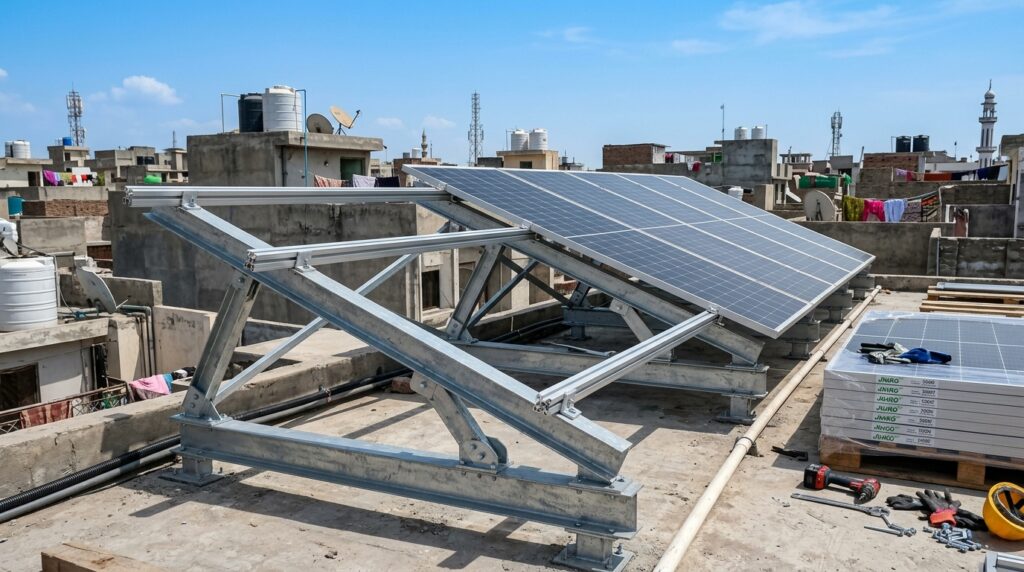
Fixed tilt rooftop mounting structures are the most common type for Pakistani urban homes. They consist of aluminium or galvanised steel rails mounted at a fixed angle on the roof surface, with panel clamps holding the solar panels to the rails. The tilt angle is set during installation and does not change. For Pakistani rooftops, the optimum fixed tilt angle is approximately fifteen to thirty degrees facing south, depending on the specific city and latitude. Fixed tilt structures are simple, cost-effective, and reliable. The solar mounting structure price in Pakistan for a standard fixed tilt rooftop system for ten to twelve panels ranges from fifteen thousand to forty-five thousand rupees depending on material quality and supplier.
Ballasted rooftop mounting structures are used on flat concrete rooftops that are common across Pakistani cities. Instead of penetrating the roof surface with bolts, which can create water ingress points, ballasted structures use concrete blocks or heavy bases to hold the mounting frame in place by weight. This approach preserves the rooftop waterproofing membrane but requires calculating the appropriate ballast weight for local wind conditions. Improperly ballasted structures have been known to shift or overturn in strong winds in Pakistan. Quality ballasted mounting systems for Pakistani flat rooftops are priced between twenty thousand and sixty thousand rupees for a standard residential system.
Ground-mounted structures are used for solar systems installed at ground level in open land, which is common for agricultural solar systems and large commercial installations in Pakistan. They consist of vertical steel piles driven or concreted into the ground, with horizontal beams and aluminium rails supporting the panel array. Ground-mounted structures allow for optimal tilt angle and orientation, are easily accessible for cleaning and maintenance, and can be designed for bifacial panels with appropriate height above ground. The solar mounting structure price in Pakistan for ground-mounted systems is typically higher than rooftop systems due to the foundation requirements, starting from thirty thousand rupees for small residential ground systems and reaching several hundred thousand rupees for large agricultural or commercial arrays.
Adjustable tilt mounting structures allow the panel angle to be changed seasonally or manually, capturing more sunlight in winter when the sun is lower in the sky and adjusting in summer for optimal capture at higher sun angles. While more expensive than fixed tilt systems, they can increase annual energy generation by five to ten percent compared to a fixed tilt optimised for a single season. The solar mounting structure price in Pakistan for adjustable tilt systems is typically thirty to fifty percent higher than equivalent fixed tilt systems.
The material choice for solar mounting structures has a major impact on their longevity and performance in Pakistan’s diverse climate zones.
Hot-dip galvanised steel is the most widely used material for solar mounting structures in Pakistan. In the galvanisation process, steel is coated with a thick layer of zinc by immersion in molten zinc, providing a barrier against rust that lasts twenty to thirty years in most environments. Hot-dip galvanised structures are strong, widely available from local steel fabricators in Pakistan, and very cost-effective. For most Pakistani rooftop and ground-mounted applications, hot-dip galvanised steel represents the best balance of strength, corrosion resistance, and cost. The solar mounting structure price in Pakistan for hot-dip galvanised systems is the most accessible of all material options.
Aluminium alloy mounting structures are lighter than steel and inherently corrosion-resistant without requiring additional protective coatings. They are particularly popular for rooftop installations where weight is a consideration and for coastal installations where the salt-air environment accelerates corrosion of even galvanised steel. Aluminium mounting systems from established manufacturers like Esdec, Schletter, K2 Systems, and Chinese equivalents are available in Pakistan. Their solar mounting structure price in Pakistan is higher than equivalent galvanised steel, typically by twenty to forty percent, but their maintenance-free longevity in corrosive environments justifies the premium for coastal and humid climates.
Stainless steel fasteners, bolts, and clamps should always be used with aluminium or galvanised structures to prevent galvanic corrosion at connection points. Using dissimilar metals in direct contact in Pakistan’s wet monsoon environment creates galvanic cells that accelerate corrosion at exactly the points where structural integrity matters most.
Powder-coated steel or aluminium offers an aesthetic improvement over bare galvanised or raw aluminium, with colour options that blend with the rooftop environment. Powder coating adds a durable epoxy or polyester coating over the base metal that resists UV degradation, chipping, and chemical attack. The solar mounting structure price in Pakistan for powder-coated systems is typically slightly higher than bare galvanised equivalent, but the improved appearance and additional corrosion protection can be worthwhile for visible residential installations.
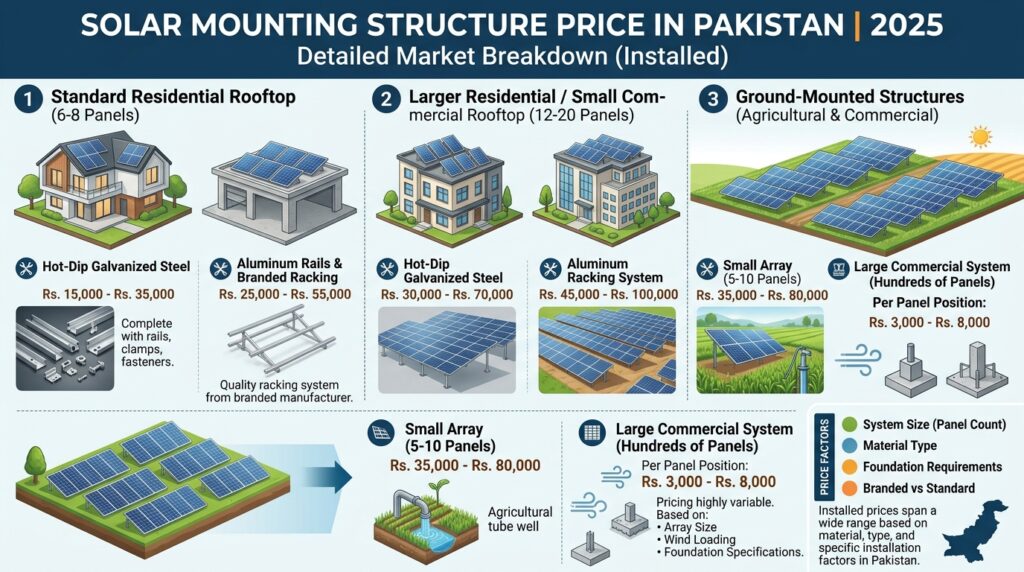
Current solar mounting structure prices in Pakistan in 2025 span a wide range based on material, type, and system size.
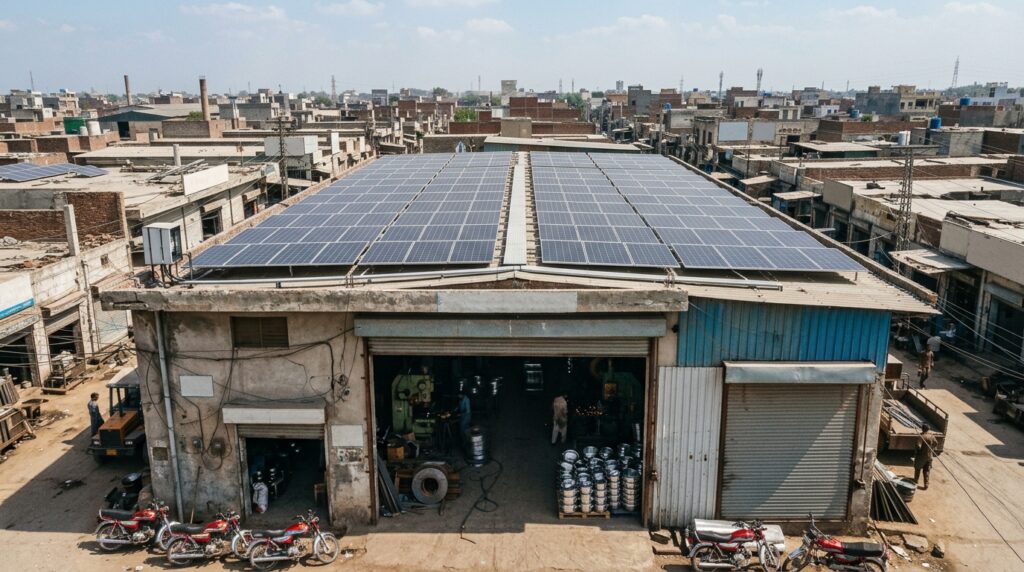
For a standard residential rooftop installation of six to eight panels on a flat concrete roof using hot-dip galvanised steel, complete with rails, clamps, and all fasteners, the solar mounting structure price in Pakistan is between fifteen thousand and thirty-five thousand rupees installed. For the same system using aluminium rails and a quality racking system from a branded manufacturer, prices range from twenty-five thousand to fifty-five thousand rupees.
For a larger residential or small commercial installation of twelve to twenty panels, hot-dip galvanised rooftop structures are priced between thirty thousand and seventy thousand rupees, while aluminium racking systems for the same size cost forty-five thousand to one hundred thousand rupees.
For ground-mounted structures designed for agricultural solar systems or commercial installations, pricing is highly variable based on the array size, wind loading requirements, and foundation specifications. Small ground-mounted structures for five to ten panel arrays are priced from thirty-five thousand to eighty thousand rupees. Large commercial ground-mounted systems covering hundreds of panels are typically priced per panel position, with per-panel structural costs ranging from three thousand to eight thousand rupees depending on specifications.
Custom-fabricated structures for unusual rooftop geometries, high-rise buildings, or carport applications are priced based on specific engineering requirements and cannot be quoted generically. At Pakistan Solar Solutions, we provide customised mounting structure design and quotation for all non-standard installation scenarios.
The tilt angle at which solar panels are mounted significantly affects how much electricity they generate over the course of a year. Choosing the right tilt angle for your Pakistani city is a decision made at the time of mounting structure installation and cannot be easily changed afterward.
In Pakistan, the optimal annual average tilt angle is roughly equal to the site’s geographic latitude. For Karachi at twenty-five degrees north latitude, a tilt of twenty-five degrees facing south maximises annual generation. For Lahore at thirty-one degrees north, a tilt of thirty to thirty-two degrees is optimal. For Islamabad at thirty-three degrees north, thirty-three degrees is ideal. For Peshawar at thirty-four degrees north, thirty-four to thirty-five degrees gives maximum annual yield.
However, the optimum tilt angle changes by season. In summer, a flatter tilt angle captures more energy because the sun is higher in the sky. In winter, a steeper tilt captures more energy from the lower sun angle. For Pakistani households where summer electricity consumption is highest due to air conditioning, a slightly flatter-than-optimal annual average tilt angle biases generation toward summer months. For households where maximum annual generation for net metering purposes is the priority, the true annual optimum tilt is the better choice.
For bifacial panels, the tilt angle also affects how much reflected light reaches the rear surface. Higher tilt angles allow more light to reach the rear of the panel from the roof surface beneath, improving bifacial gain. This is an additional consideration when designing mounting structures for bifacial installations, which our team at Pakistan Solar Solutions addresses in every bifacial system design.
A commonly asked question in Pakistan’s solar community is whether mounting structure installation can be done by the homeowner or must be done by professionals. The answer depends on the scale and complexity of the installation.
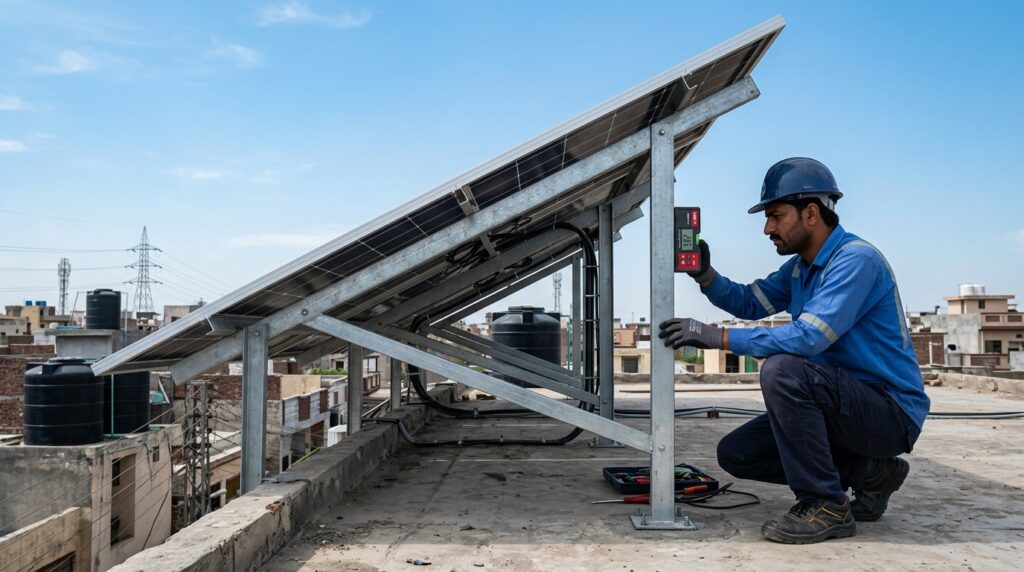
For very small systems of two to four panels on a ground-level structure, a technically capable homeowner with basic metalworking knowledge can install a simple mounting structure safely. However, for rooftop installations, professional installation is strongly recommended for both safety and quality reasons.
Working on rooftops is inherently hazardous and falls from heights are a serious risk. Professional installation teams have safety equipment, experience working at height, and insurance that individual homeowners lack. Beyond personal safety, professional installers understand local roof construction enough to identify where bolts can be safely anchored without damaging the structural integrity of the roof, how to seal penetrations to prevent water ingress, and how to calculate whether the existing roof structure can bear the weight of the solar array.
Improper mounting can also void your panel and inverter warranties. Most solar equipment manufacturers require professional installation as a warranty condition. At Pakistan Solar Solutions, our installation team handles all mounting structure work to the standards required for full warranty compliance.
What is the solar mounting structure price in Pakistan for a five kilowatt residential system?
For a five kilowatt residential system of ten to twelve panels on a flat concrete rooftop, the complete mounting structure including rails, clamps, and all hardware typically costs between twenty-five thousand and sixty thousand rupees in Pakistan depending on whether galvanised steel or aluminium racking is used and the supplier’s quality level.
How long does a solar mounting structure last in Pakistan’s climate?
A properly hot-dip galvanised steel mounting structure in Pakistan’s inland climate should last twenty-five years or more with no maintenance. In coastal areas near the sea, fifteen to twenty years is more realistic due to salt-air corrosion. Aluminium structures are essentially maintenance-free for the full panel lifespan in all Pakistani climate zones.
Does the mounting structure tilt angle matter much for electricity generation in Pakistan?
Yes, significantly. A panel mounted at the correct tilt angle for its latitude in Pakistan generates five to fifteen percent more electricity annually than the same panel mounted flat or at a greatly incorrect angle. The mounting structure installation is the only opportunity to set this correctly, making the tilt angle decision at installation time very important.
Can a solar mounting structure damage my Pakistani home’s roof?
Improperly installed mounting structures can cause roof damage in two ways: structural damage from bolts anchored into non-structural roof elements, and water damage from unsealed penetrations. Professional installation using appropriate anchoring methods and waterproof sealants prevents both issues. Always use a professional installer for rooftop mounting structures.
Is it cheaper to use locally fabricated mounting structures in Pakistan versus imported systems?
Locally fabricated hot-dip galvanised steel structures are generally thirty to fifty percent cheaper than imported aluminium racking systems from international brands. For inland Pakistani climates without extreme corrosion risk, locally fabricated galvanised structures represent excellent value. For coastal areas or premium installations where aluminium’s corrosion resistance is valued, imported systems justify the premium.