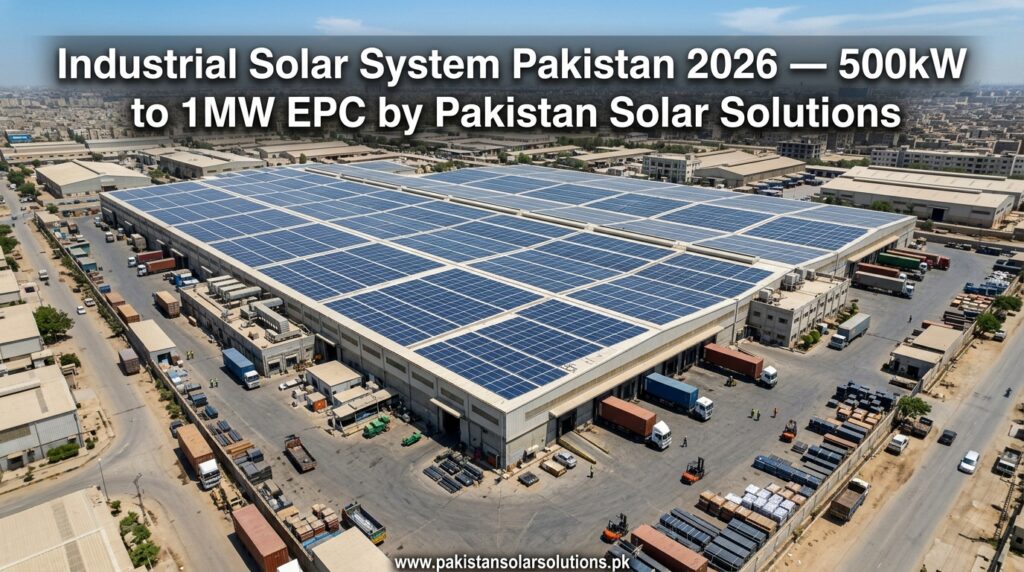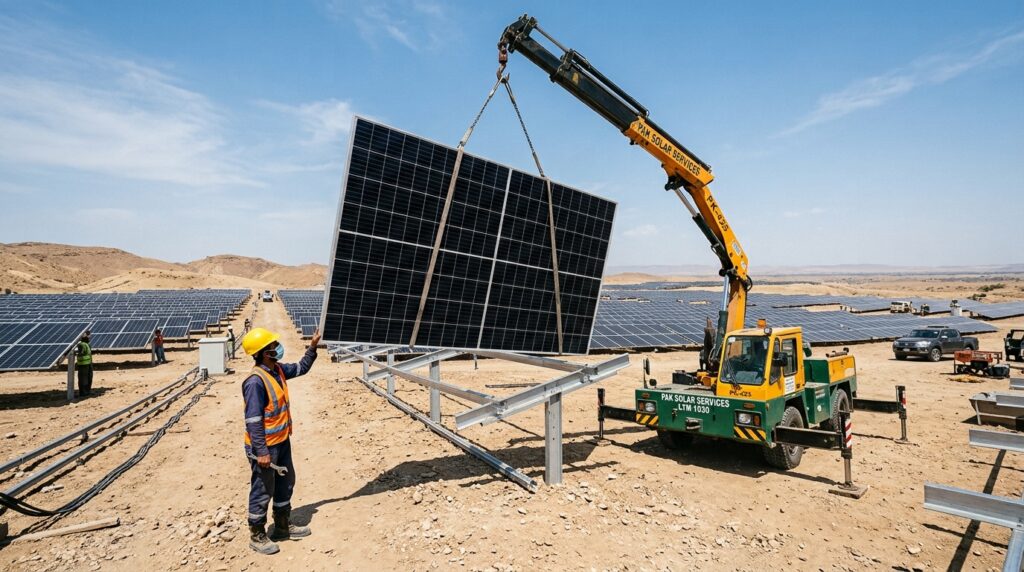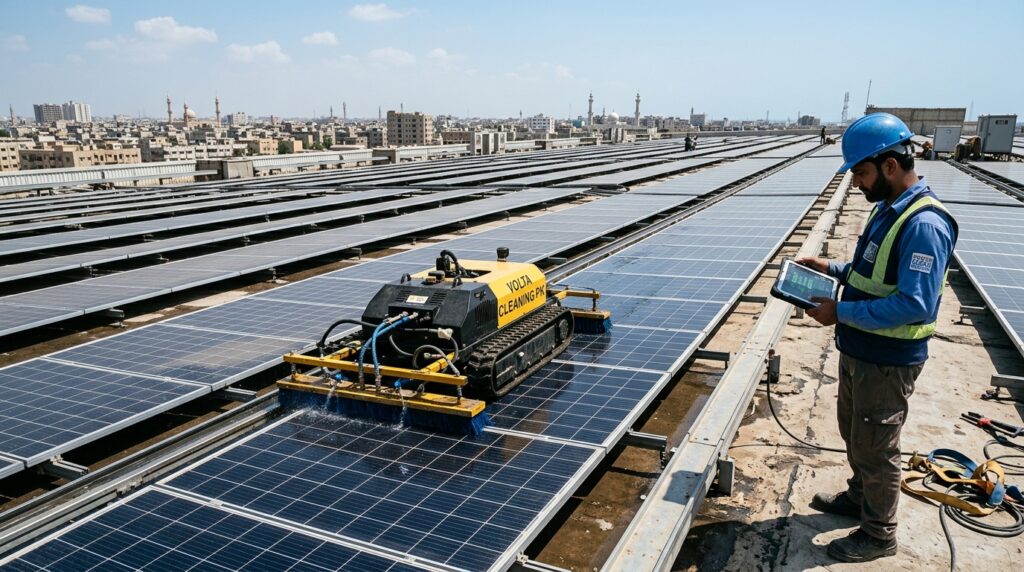


Pakistan’s industrial sector is the country’s largest single consumer of electricity and simultaneously the sector most severely impacted by the twin crises of rising electricity tariffs and unreliable grid supply. Industrial electricity in Pakistan sits in the highest tariff category across all WAPDA DISCOs and K-Electric, with large industrial customers paying PKR 55 to PKR 80 per unit or more under time-of-use pricing structures that include maximum demand charges, fuel adjustment surcharges, and quarterly tariff revisions that have consistently moved in one direction across the last five years.
For a textile mill consuming 5,000,000 units annually, a pharmaceutical plant consuming 3,000,000 units, or a food processing facility consuming 2,000,000 units, electricity is not a utility cost. It is one of the largest single line items on the profit and loss statement, directly affecting competitiveness, export pricing, and operational viability. An industrial solar system pakistan does not merely reduce this cost. It transforms electricity from a volatile, uncontrollable operational expense into a fixed, predictable capital investment with a defined payback period and a 25-year operational lifespan delivering free electricity after payback is achieved.
This comprehensive guide covers everything Pakistani industrial operators need to know about industrial solar systems in Pakistan in 2026, including complete EPC cost structures, ROI calculations for large systems, NEPRA net metering for industrial customers, which equipment performs best at industrial scale in Pakistan’s climate, and how Pakistan Solar Solutions delivers industrial solar EPC contracts from 50kW to 1MW or more across Pakistan’s major industrial zones.
Pakistani industrial operators have access to one of the most favorable solar ROI environments anywhere in the global manufacturing sector. Three factors combine to create this exceptional investment case. First, Pakistan’s electricity tariff for industrial customers is among the highest in South Asia on a purchasing power parity basis, meaning the economic value of every solar-generated unit is extraordinarily high. Second, Pakistan receives 5 to 7 peak sun hours daily across most industrial zones, with Karachi’s SITE and Korangi areas, Multan, and Sukkur’s industrial belt receiving among the highest irradiance in the region. Third, industrial facilities operate primarily during daylight hours with high and consistent electrical loads that align perfectly with solar generation profiles, maximizing direct self-consumption and minimizing the lower-valued grid export.
The combination of high electricity tariff, strong solar resource, and daytime operation creates industrial solar payback periods in Pakistan of 2 to 3 years for well-designed systems, compared to 4 to 7 years in most European and North American markets. After payback, the system generates electricity at a cost of PKR 8 to PKR 15 per unit over its 25-year lifespan, compared to WAPDA and K-Electric industrial tariffs of PKR 55 to PKR 80 per unit that will only increase with future tariff revisions. The total lifetime savings from a 500kW industrial solar installation in Pakistan’s 2026 environment, accounting for conservative annual tariff increases, can exceed PKR 500,000,000 over 25 years.
Industrial solar EPC costs in Pakistan are quoted on a per-kilowatt-peak basis that includes all engineering, equipment, civil works, electrical installation, commissioning, and NEPRA net metering documentation. Complete turnkey industrial solar system prices in Pakistan in 2026 reflect Tier-1 panel pricing, industrial-grade three-phase inverters, heavy-duty mounting structures for industrial rooftops or ground-mount configurations, high-capacity cable trays and cable management systems, industrial-grade earthing and lightning protection, and PEC-certified engineering documentation.
A 50kW industrial on-grid solar system in Pakistan costs PKR 3,900,000 to PKR 5,400,000 as a complete turnkey EPC. A 100kW system costs PKR 7,200,000 to PKR 9,800,000. A 200kW system costs PKR 13,500,000 to PKR 18,000,000. A 300kW system costs PKR 19,500,000 to PKR 26,000,000. A 500kW system costs PKR 31,000,000 to PKR 41,000,000. Systems above 500kW are priced on a project-specific basis following comprehensive site feasibility studies that account for specific roof structure, load characteristics, grid connection capacity, and NEPRA compliance requirements. Pakistan Solar Solutions provides detailed EPC proposals for all industrial projects with itemized cost breakdowns, comprehensive ROI analysis, and 25-year electricity savings projections based on actual site data.
On a per-watt basis, industrial solar EPC pricing in Pakistan in 2026 ranges from PKR 78 to PKR 108 per watt for on-grid systems depending on project size, equipment selection, and site conditions. Larger projects benefit from economies of scale in both equipment procurement and installation labor, with 500kW-plus projects achieving the lowest per-watt costs. Industrial hybrid systems with large lithium battery banks for load shedding protection carry a premium of PKR 20 to PKR 45 per watt over equivalent on-grid systems depending on battery capacity.
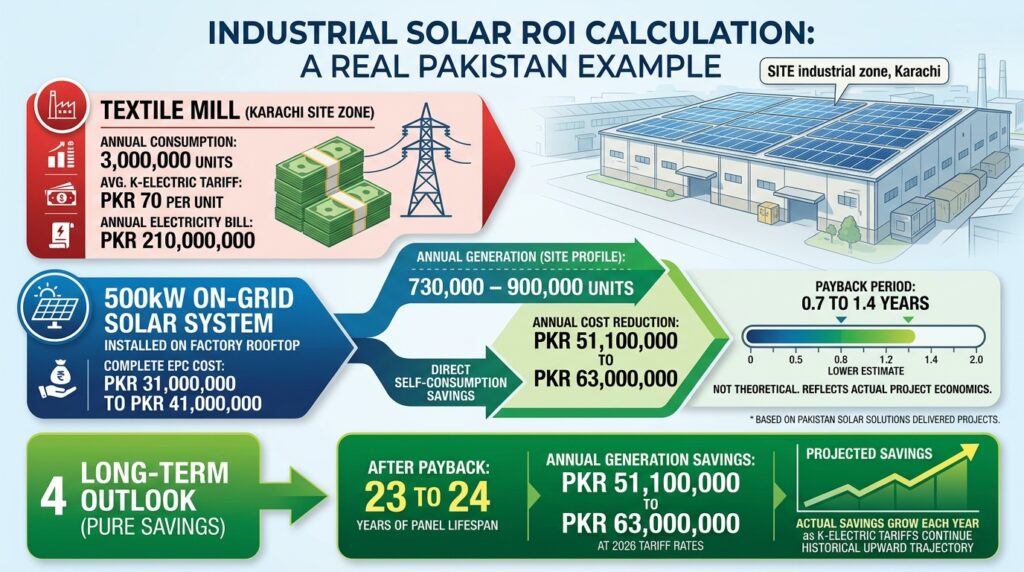
Understanding the ROI mechanics for a specific industrial solar project in Pakistan helps manufacturing and commercial operators evaluate proposals with confidence. Consider a textile mill in Karachi’s SITE industrial zone consuming 3,000,000 units annually at an average K-Electric industrial tariff of PKR 70 per unit, resulting in an annual electricity bill of PKR 210,000,000.
A 500kW on-grid solar system installed on the factory’s rooftop generates approximately 730,000 to 900,000 units annually based on SITE’s irradiance profile. At PKR 70 per unit for direct self-consumption savings, annual electricity cost reduction reaches PKR 51,100,000 to PKR 63,000,000. The 500kW system costs PKR 31,000,000 to PKR 41,000,000 as a complete EPC. Dividing the installation cost by the annual savings gives a payback period of 0.7 to 0.8 years at the upper savings estimate and 1.3 to 1.4 years at the lower estimate. This is not a theoretical calculation. It reflects the actual project economics that Pakistan Solar Solutions has delivered for industrial clients in Karachi and Rawalpindi. After payback, the remaining 23 to 24 years of the panel’s lifespan generate electricity savings of PKR 51,100,000 to PKR 63,000,000 per year at 2026 tariff rates, with actual savings growing each year as K-Electric industrial tariffs continue their historical upward trajectory.
Industrial solar installations in Pakistan require panels that deliver maximum energy yield over the long term in harsh outdoor conditions while minimizing installation area per watt, reducing structural load on industrial rooftops, and maintaining consistent output across the system’s 25-year operational life. Pakistan Solar Solutions specifies only Tier-1 N-Type bifacial panels for industrial projects in 2026, with panel selection from Longi Hi-Mo X10, Jinko Tiger Neo bifacial, JA Solar N-Type, and Trina Vertex N series depending on project-specific requirements and budget.
High-wattage N-Type bifacial panels in the 580W to 620W range deliver the best watts per square metre of industrial rooftop, reducing installation area requirements and mounting hardware costs while delivering superior temperature performance for Pakistan’s industrial zones. Bifacial panels in industrial elevated-tilt mounting configurations can achieve 8 to 15 percent additional energy yield compared to monofacial panels of the same front-side wattage rating, further improving ROI for large industrial installations. For detailed panel specifications and pricing, our Longi solar panels price Pakistan and Jinko solar panels price Pakistan guides provide comprehensive 2026 market data.
Industrial solar systems above 50kW require three-phase string inverters or central inverters capable of managing high DC input currents from large panel arrays and delivering three-phase AC output to industrial distribution systems. Pakistan Solar Solutions specifies industrial inverters from Huawei SUN2000 commercial three-phase series, Growatt MID three-phase series, GoodWe MT series, and Solis commercial series for industrial projects in Pakistan.
For the largest industrial installations above 500kW, Pakistan Solar Solutions also specifies central inverters in 250kW to 500kW ratings that reduce inverter count and installation complexity while maintaining high system efficiency. All industrial inverters specified by Pakistan Solar Solutions are on NEPRA’s approved inverter list, which is mandatory for industrial net metering eligibility across all Pakistani DISCOs. For detailed Huawei inverter pricing across commercial and industrial system sizes, our Huawei solar inverter price Pakistan guide covers all SUN2000 commercial models in detail.
NEPRA net metering is available for industrial customers across all Pakistani DISCOs subject to the same three-phase connection requirement that applies to residential and commercial customers. Industrial net metering applications require additional technical documentation compared to residential applications, including protection relay settings, power quality assessments for facilities with variable speed drives or large motor loads, and in some cases a grid impact study coordinated with the DISCO’s planning department.
Pakistan Solar Solutions’ engineering team prepares all advanced technical documentation required for industrial net metering applications in-house. We have successfully completed industrial net metering applications with K-Electric in Karachi and IESCO in Rawalpindi for factory clients in SITE, Korangi, and I-9 Industrial Estate. For factories consuming above 1MW of grid electricity annually and installing solar systems of 200kW or more, net metering combined with direct consumption savings delivers the fastest and most certain return on the solar investment. For national net metering process details, our WAPDA net metering Pakistan guide covers industrial application procedures for all major DISCOs.
Pakistan Solar Solutions has delivered industrial solar EPC contracts across the following key manufacturing and industrial sectors in Pakistan, each with specific energy profile characteristics and solar integration requirements.
Pakistan’s textile sector is the largest industrial electricity consumer in the country and the sector with the most compelling solar ROI. Spinning, weaving, stitching, and dyeing processes operate continuous high-power loads during daylight hours, creating ideal direct self-consumption conditions for large on-grid solar installations. Pakistan Solar Solutions has completed textile industry solar projects in Karachi’s SITE industrial zone ranging from 100kW to over 500kW, consistently delivering ROI within 1.5 to 2.5 years.
Pharmaceutical manufacturing plants and chemical processing facilities require consistent, high-quality electrical supply for cleanroom environments, precision manufacturing equipment, and cold chain infrastructure. Pakistan Solar Solutions designs pharmaceutical industrial solar systems that prioritize power quality alongside energy cost reduction, using premium inverters with tight voltage and frequency regulation characteristics.
Food processing plants and cold storage facilities in Pakistan operate continuous refrigeration loads that are perfectly suited to large solar installations. These facilities’ electricity costs are among the highest in the industrial sector on a per-unit-of-output basis, and solar payback is correspondingly rapid. Hybrid solar with large battery banks adds cold chain continuity during grid outages to the primary bill reduction benefit.
Cement, brick, tile, and building materials manufacturers across Pakistan have large industrial rooftops and outdoor areas suitable for substantial solar installations. The continuous daytime operation of kilns, presses, conveyors, and dust extraction systems creates high and consistent solar self-consumption rates that maximize savings and ROI.
A complete 100kW on-grid industrial solar EPC in Pakistan costs PKR 7,200,000 to PKR 9,800,000 in 2026 including Tier-1 panels, industrial three-phase inverters, mounting structure, cabling, earthing, and NEPRA net metering documentation. Annual savings from a 100kW industrial system in Karachi or Sukkur reach PKR 7,500,000 to PKR 10,000,000 depending on industrial tariff and irradiance, delivering full payback in approximately 1 to 1.5 years.
Industrial NEPRA net metering approval typically takes 3 to 5 months from application submission to green meter installation for systems under 200kW. Larger industrial systems requiring grid impact studies and protection relay settings may take 4 to 7 months. Pakistan Solar Solutions manages the entire industrial net metering process and follows up proactively with DISCO offices to minimize delays.
Yes. Pakistan Solar Solutions has a dedicated industrial EPC division capable of managing projects from 50kW to 1MW or more in Karachi’s industrial zones including SITE, Korangi, Landhi, and Bin Qasim. We provide complete project management including site feasibility, structural engineering, procurement, civil and electrical works, commissioning, and K-Electric net metering documentation. Contact us at pakistansolar.solutions for a free industrial feasibility assessment.
Industrial solar payback in Pakistan in 2026 ranges from 1 to 3 years depending on system size, industrial tariff rate, and self-consumption ratio. Larger systems in the 200kW to 1MW range consistently achieve the fastest payback due to economies of scale in installation cost. After payback, industrial solar systems deliver free electricity for the remaining 22 or more years of the panel’s operational life.
Yes. Pakistan Solar Solutions provides ongoing maintenance services for all industrial solar systems under our EPC contracts, including scheduled panel cleaning, inverter inspection and performance verification, protection relay testing, string-level monitoring review, and annual energy yield assessment. Annual industrial maintenance packages are available across our Karachi, Sukkur, and Rawalpindi service areas.