

The solar battery has become one of the most searched and most misunderstood solar products in Pakistan’s rapidly expanding energy market. As hybrid solar systems grow from a premium option to the standard recommendation across Pakistan’s load-shedding-affected cities, the battery bank has moved from an optional add-on to a core system component for millions of Pakistani households and businesses. Yet solar battery prices in Pakistan vary enormously depending on battery chemistry, capacity, brand, and quality, with price differences of PKR 100,000 or more between genuinely comparable products leaving buyers confused and vulnerable to misleading sales pitches.
This comprehensive guide covers everything Pakistani solar buyers need to know about solar battery prices in 2026, including a complete LiFePO4 lithium battery price list, why LiFePO4 has become the only sensible choice over lead-acid alternatives, how to calculate the right battery capacity for your home or business, which brands offer genuine quality versus inflated marketing, and how Pakistan Solar Solutions specifies and installs battery systems that deliver the promised performance and lifespan throughout the hybrid system’s operational life.
Load shedding is the primary driver of solar battery demand in Pakistan. Unlike grid-connected countries where an on-grid solar system with net metering meets most homeowners’ energy needs, Pakistani households face 4 to 14 hours of daily WAPDA or K-Electric outages in many cities and towns. An on-grid solar system, despite its lower cost and faster payback on paper, provides zero power during these outages because grid-tied inverters are designed to shut down automatically when the grid goes offline as a safety requirement.
For a Karachi household spending PKR 8,000 to PKR 15,000 per month on generator fuel to cover load shedding hours, or a Rawalpindi business losing productive working hours to daily WAPDA outages, the solar battery’s value extends far beyond electricity bill savings. It eliminates generator noise, fumes, maintenance, and fuel procurement logistics. It provides instant, seamless power transition without the 30-second startup delay of a generator. It powers sensitive electronics, air conditioning compressors, and medical equipment without the voltage instability associated with generator operation. And it does all of this silently, safely, and at essentially zero marginal cost once the initial investment is made.
The solar battery market in Pakistan in 2026 still contains a mix of LiFePO4 lithium iron phosphate batteries and various lead-acid battery types including flooded lead-acid, sealed AGM, and gel batteries. Understanding why LiFePO4 has become the correct choice for virtually every new solar installation in Pakistan is essential before reviewing prices, because the apparent cost difference between battery chemistries is deeply misleading when lifecycle costs are properly calculated.
Cycle life refers to the number of complete charge-discharge cycles a battery can complete before its capacity degrades below a usable threshold, typically 80 percent of original rated capacity. LiFePO4 batteries from quality manufacturers deliver 3,000 to 6,000 cycles at 80 percent depth of discharge. Lead-acid batteries deliver 500 to 800 cycles at only 50 percent depth of discharge, meaning they must be replaced 4 to 8 times over the same period that a single LiFePO4 bank remains in service.
A 10kWh LiFePO4 battery bank at PKR 450,000 lasting 10 to 15 years costs PKR 30,000 to PKR 45,000 per year of service. An equivalent-capacity lead-acid bank at PKR 180,000 lasting 3 years costs PKR 60,000 per year of service and requires three replacement purchases over the same 10-year period, totaling PKR 540,000 in battery expenditure versus PKR 450,000 for a single LiFePO4 bank. The lithium battery is cheaper in total cost of ownership even at 2.5 times the upfront price, and this calculation does not account for the deeper discharge advantage, faster charging, or better heat tolerance of LiFePO4.
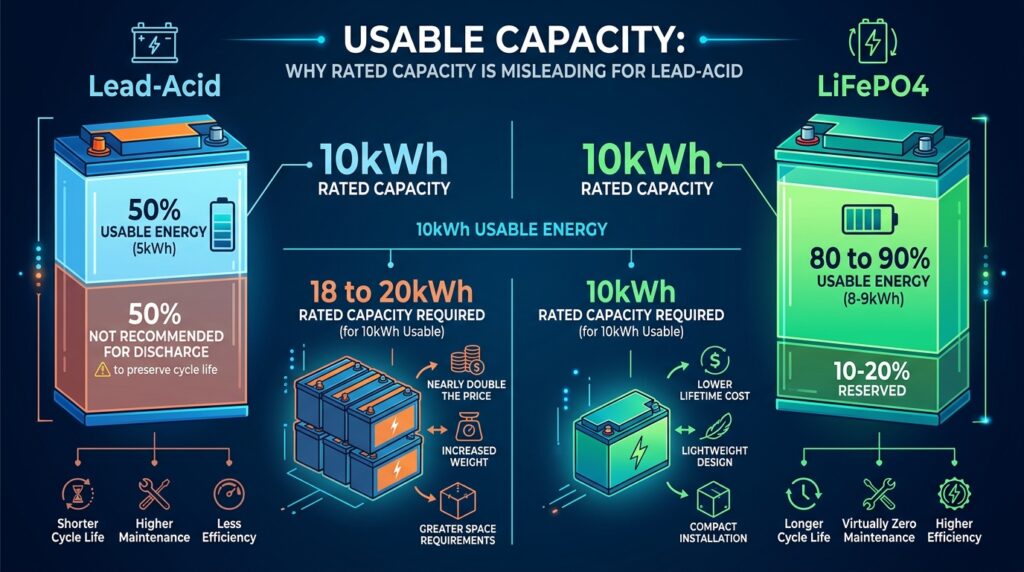
A 10kWh lead-acid battery should only be discharged to 50 percent of rated capacity to preserve cycle life, giving 5kWh of usable energy. A 10kWh LiFePO4 battery can safely discharge to 80 to 90 percent depth of discharge, giving 8 to 9kWh of usable energy. To match the usable capacity of a 10kWh LiFePO4 bank, a lead-acid installation requires 18 to 20kWh of rated capacity, nearly doubling the lead-acid price comparison and dramatically increasing the weight and space requirements of the battery installation.
Solar battery prices in Pakistan in 2026 are primarily driven by battery capacity in kWh, cell quality, BMS sophistication, brand reputation, and whether the battery is sold as a standalone unit or as part of a complete hybrid system package. The following prices represent genuine LiFePO4 lithium battery systems from quality manufacturers sold through certified distributors and installed by professional companies.
A 5kWh LiFePO4 battery bank provides 4 to 4.5kWh of usable energy at 80 to 90 percent depth of discharge, sufficient to power a basic household load of fans, lighting, a small refrigerator, and phone charging for 4 to 6 hours during load shedding. In Pakistan in 2026, a quality 5kWh LiFePO4 battery system costs PKR 220,000 to PKR 320,000 for the battery unit alone, or is included in a 5kW hybrid system package costing PKR 850,000 to PKR 1,100,000.
A 10kWh LiFePO4 battery bank provides 8 to 9kWh of usable energy, sufficient to power a medium household load including a 1.5-ton air conditioner, refrigerator, lighting, fans, and electronics for 4 to 6 hours. In Pakistan in 2026, a quality 10kWh LiFePO4 battery system costs PKR 420,000 to PKR 600,000 for the battery unit alone. This is the most commonly specified battery capacity for residential hybrid systems in Pakistani cities with 6 to 8 hours of daily load shedding.
A 15kWh LiFePO4 battery bank delivers 12 to 13.5kWh of usable energy, providing 6 to 9 hours of coverage for a household running 2 air conditioners, a refrigerator, full lighting, fans, and a television simultaneously. In Pakistan in 2026, a quality 15kWh LiFePO4 battery system costs PKR 620,000 to PKR 880,000. This capacity is recommended for homes in areas with 8 to 12 hours of daily load shedding or for businesses requiring extended backup coverage.
For large homes, small commercial offices, clinics, and light industrial applications requiring full-day backup coverage, 20kWh to 30kWh LiFePO4 systems provide 16 to 27kWh of usable energy. In Pakistan in 2026, a 20kWh LiFePO4 battery system costs PKR 820,000 to PKR 1,150,000 and a 30kWh system costs PKR 1,200,000 to PKR 1,700,000. At these capacities, the battery system combined with a 10kW to 15kW solar array provides near-complete energy independence from WAPDA or K-Electric.
The quality gap between solar battery brands is more significant than in almost any other solar product category. A low-quality LiFePO4 battery may fail to deliver its rated cycle life, exhibit thermal management issues in Pakistan’s heat, or carry a BMS that does not communicate properly with your hybrid inverter. Pakistan Solar Solutions installs only branded LiFePO4 battery systems from manufacturers with verified quality certifications and established warranty enforcement processes in Pakistan.
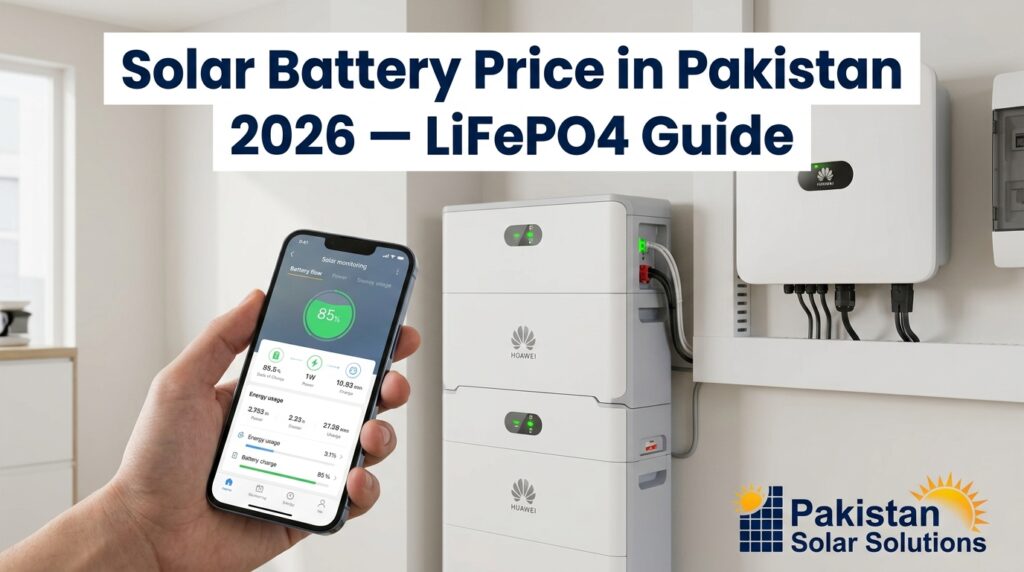
The Huawei LUNA2000 is the premium LiFePO4 battery option for Huawei SUN2000 hybrid inverter systems, which are the most installed hybrid inverters in Pakistan in 2026. The LUNA2000 integrates seamlessly with the SUN2000 through Huawei’s proprietary battery management protocol, delivers advanced thermal management performance in Pakistan’s heat, and is monitored through the FusionSolar app alongside the inverter. LUNA2000 modules are available in 5kWh stacking units that can be combined to reach 5kWh to 30kWh of total capacity. In Pakistan in 2026, LUNA2000 systems cost PKR 240,000 to PKR 290,000 per 5kWh module.
The Growatt ARK LiFePO4 battery series is designed for compatibility with Growatt SPH hybrid inverters and offers reliable performance at a price point below the premium Huawei LUNA2000. ARK batteries are modular, allowing expansion of battery capacity without replacing existing modules. In Pakistan in 2026, Growatt ARK batteries are priced at PKR 200,000 to PKR 260,000 per 5kWh module, making them a cost-effective choice for Growatt SPH hybrid system owners.
The GoodWe Lynx series is a modular LiFePO4 battery designed for compatibility with GoodWe hybrid inverters. It offers solid BMS performance and a competitive price in Pakistan’s 2026 market at PKR 190,000 to PKR 250,000 per 5kWh module. GoodWe Lynx is Pakistan Solar Solutions’ recommended battery for GoodWe hybrid inverter installations where Huawei or Growatt integration is not required.
For hybrid inverters with open battery communication protocols including certain Deye and Solis models, Pakistan Solar Solutions also installs quality third-party LiFePO4 battery modules from certified manufacturers. These offer slightly lower prices than brand-matched battery systems at PKR 180,000 to PKR 230,000 per 5kWh module but require careful BMS compatibility verification before specification.
Choosing the right battery size requires knowing three things about your situation. First, how many hours of daily load shedding does your area experience? Second, what is your average power consumption in kilowatts during load shedding hours? Third, what is your budget for battery storage relative to the rest of your solar system?
The battery sizing formula Pakistan Solar Solutions uses is straightforward. Multiply your average load in kilowatts during outage hours by the number of outage hours you want to cover, then divide by 0.85 to account for LiFePO4 discharge efficiency. For example, a household with a 2kW average load during load shedding wanting 6 hours of coverage requires 2kW multiplied by 6 hours divided by 0.85, giving 14.1kWh of LiFePO4 battery capacity. A 15kWh battery bank would be the appropriate specification.
Pakistan Solar Solutions performs this calculation precisely for every hybrid system client during the free energy audit, ensuring your battery bank is sized to your actual load profile and outage duration rather than an arbitrary standard package. Visit pakistansolar.solutions or call 0333-103-1086 to schedule your free energy audit and battery sizing consultation. For homeowners evaluating whether a hybrid system is right for them, our hybrid solar system Pakistan guide covers the complete cost and benefit analysis including battery sizing at different system capacities.
Solar battery installation quality has a direct impact on battery safety, lifespan, and performance. LiFePO4 batteries are the safest lithium chemistry available for residential and commercial applications, but improper installation can still create electrical and thermal hazards.
Pakistan Solar Solutions follows strict installation standards for all battery systems. We install batteries in ventilated, shaded locations away from direct sunlight to prevent thermal stress. We use appropriately rated DC cabling between battery and inverter to minimize resistance losses and heating. We verify BMS communication compatibility between battery and inverter before installation. We earth battery enclosures to NEPRA standards and install appropriate overcurrent protection in all DC circuits. Our installation teams are trained in lithium battery handling and commissioning procedures specific to each battery brand we work with.
A quality 10kWh LiFePO4 solar battery system in Pakistan costs PKR 420,000 to PKR 600,000 in 2026 for the battery unit alone. The price varies by brand, with Huawei LUNA2000 at the premium end and compatible third-party modules at the more accessible end. All quality LiFePO4 batteries carry 10-year manufacturer warranties.
Quality LiFePO4 batteries carry 10-year manufacturer warranties and deliver 3,000 to 6,000 charge-discharge cycles. At one full cycle per day during load shedding season and partial cycles during grid-available periods, a LiFePO4 battery bank realistically lasts 10 to 15 years in Pakistani usage conditions before requiring replacement.
Yes. LiFePO4 is the safest lithium battery chemistry available for residential and commercial indoor installation. Unlike older lithium cobalt or lithium manganese chemistries, LiFePO4 does not release hazardous gases during normal operation and has excellent thermal stability. Pakistan Solar Solutions installs all LiFePO4 battery systems in appropriate ventilated locations following manufacturer installation guidelines.
In some cases, yes. If your existing inverter is a hybrid-compatible model, a battery bank can be added. However, most standard on-grid inverters cannot accept batteries. Pakistan Solar Solutions can assess your existing system and advise whether battery addition is feasible or whether a hybrid inverter replacement is needed. Contact us at pakistansolar.solutions for an assessment.
For a 5kW hybrid system in Pakistan, the recommended battery capacity is 5kWh to 10kWh depending on your daily load shedding duration and consumption during outages. A 5kWh battery covers 3 to 4 hours of modest load coverage. A 10kWh battery covers 5 to 7 hours of moderate household load. Pakistan Solar Solutions sizes battery banks precisely to your load profile during the free energy audit.