

Every solar energy system installed on a Pakistani home has one component that sits at the absolute centre of the entire setup, managing every watt of electricity that flows through the system and making thousands of decisions per second to keep your home powered. That component is the solar inverter. Getting the right solar inverter for home use in Pakistan is arguably the most consequential single decision in building a home solar system, more important than the panel brand, more important than the battery chemistry, and more impactful on day-to-day performance than any other component choice.
Yet the solar inverter for home in Pakistan is also the most complex component to evaluate, with more types, technologies, brands, features, and price points than any other element of a solar system. Pakistani buyers frequently make inverter decisions based on price alone or on installer recommendations without understanding the implications of different inverter types, and the results can be deeply frustrating when the chosen inverter does not behave as expected in Pakistan’s specific grid conditions.
This guide cuts through the complexity and gives Pakistani homeowners a clear, honest framework for choosing the right solar inverter for home installation in Pakistan. At Pakistan Solar Solutions, we have designed and installed solar systems for hundreds of Pakistani homes, and the knowledge accumulated through that real-world experience forms the foundation of this guide.
The solar inverter for home in Pakistan performs several functions simultaneously that no other component replicates. It converts the DC electricity generated by your solar panels into the AC electricity that your home appliances use. It manages the flow of energy between solar panels, batteries, the national grid, and your home loads in real time. It protects your home appliances from power quality problems including voltage surges, frequency deviations, and harmonic distortion. And it communicates with monitoring systems to give you visibility into your system’s performance.
In Pakistan’s specific context, the inverter’s role is even more demanding than in countries with stable electricity grids. Pakistan’s national grid is characterised by voltage fluctuations, frequency deviations, regular outages, and in many areas, poor power quality. A solar inverter for home use in Pakistan must handle these grid anomalies gracefully, switching seamlessly between grid power, solar power, and battery power without causing disruption to sensitive home electronics.
When a solar inverter fails in Pakistan, the entire solar system becomes non-functional. Unlike a failed panel, which reduces output by a small amount, a failed inverter stops electricity generation completely. The inverter is therefore also the component where reliability and after-sales support matter most. A cheap inverter with no local service support that fails within two years is a far worse investment than a quality inverter that operates reliably for ten years with responsive warranty service.
Pakistani homeowners encounter three distinct types of solar inverters and choosing the wrong type for their situation is one of the most common and costly solar mistakes made in Pakistan today.
An on-grid solar inverter, also called a grid-tie inverter, connects your solar panels directly to the national electricity grid. During daylight hours, it feeds solar electricity into your home’s electrical system, reducing the amount drawn from the grid and lowering your electricity bill. When solar generation exceeds your home’s consumption, the surplus is exported to the grid and credited through net metering. When solar generation is insufficient, the inverter seamlessly pulls from the grid.
The critical limitation of an on-grid inverter for Pakistani homes is that it automatically shuts down when the grid fails. This is a mandatory safety requirement to prevent solar electricity from back-feeding into grid lines being worked on by WAPDA technicians. In practice, it means your solar system provides zero benefit during load shedding, which is precisely when Pakistani families most need power. For homes in areas with very little load shedding and stable grid supply, an on-grid inverter is a valid choice due to its lower cost and simplicity. For the vast majority of Pakistani households, it is an inappropriate choice.
An off-grid solar inverter operates completely independently of the national grid, relying entirely on solar panels and batteries. It is the right choice for rural areas or locations where grid access is unavailable or where the grid supply is so unreliable as to be useless. Off-grid inverters require a substantial battery bank to cover periods when solar generation is insufficient, making the complete off-grid system more expensive than a grid-connected alternative of the same capacity.
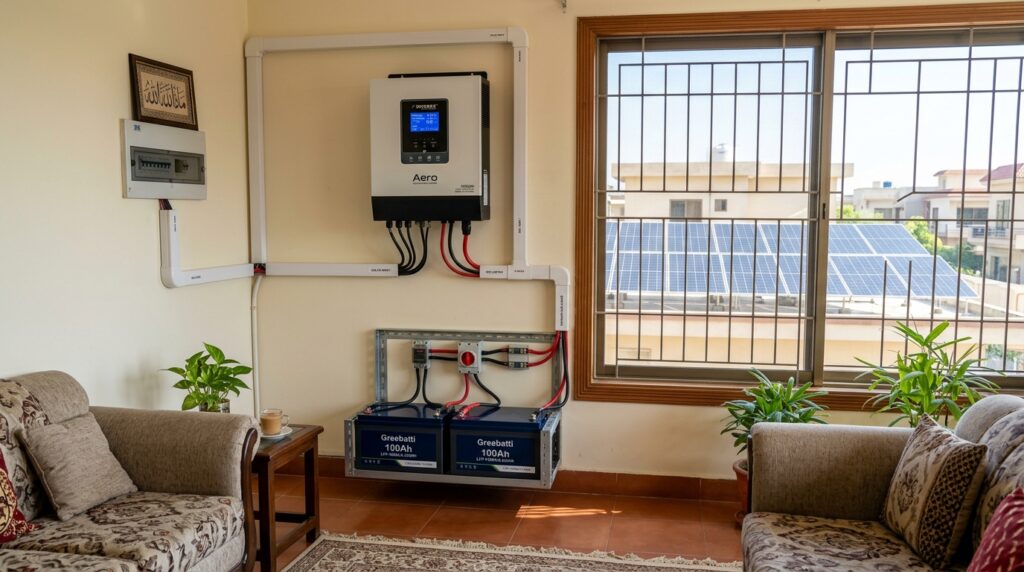
A hybrid solar inverter combines the advantages of both on-grid and off-grid designs. It connects to the grid for net metering and bill reduction benefits, incorporates battery backup so the home remains powered during load shedding, and manages all three energy sources, solar panels, batteries, and the grid, automatically and intelligently. For the vast majority of Pakistani urban and semi-urban homes, the hybrid solar inverter for home use is overwhelmingly the right choice, as we discuss in comprehensive detail in our hybrid solar inverter guide at Pakistan Solar Solutions.
Selecting the right inverter capacity is as important as selecting the right inverter type. An undersized inverter cannot handle your home’s total load and will trip repeatedly under heavy use. An oversized inverter operates at very low efficiency and represents wasted investment.
The starting point for sizing a solar inverter for home use in Pakistan is calculating your simultaneous load, meaning the total wattage of all appliances you want to run at the same time. Add up the power consumption of every appliance you might conceivably run simultaneously on the hottest summer day. For a typical Pakistani home this might include a one-ton air conditioner at nine hundred watts, two fans at one hundred and twenty watts total, a refrigerator at one hundred watts, LED lighting at sixty watts, a television at sixty watts, and a water pump at three hundred and seventy-five watts. This simultaneous load totals approximately one thousand six hundred and fifteen watts, suggesting a minimum two kilowatt inverter capacity. Adding a thirty percent safety margin gives a minimum recommended inverter size of approximately two point one kilowatts, meaning a three kilowatt inverter is appropriate.
For Pakistani homes with multiple air conditioners, the calculation changes significantly. Two one-ton AC units alone can draw two thousand watts of continuous load, making a five kilowatt inverter the minimum appropriate size for a home with two ACs and other normal household loads. For the specific considerations around sizing solar systems for air conditioning loads, our solar panels for AC units guide at Pakistan Solar Solutions provides detailed guidance.
The solar panel array size should also be considered when selecting the inverter. The inverter’s maximum solar input capacity, measured in watts, must accommodate your panel array. If you plan to install a six kilowatt panel array, you need an inverter capable of accepting at least six kilowatts of DC solar input. Most quality inverters accept one hundred to one hundred and thirty percent of their rated output capacity as solar input, providing some oversizing flexibility.
Pakistan’s solar inverter market has become richly competitive, with both international premium brands and value-focused alternatives available to homeowners at different budget levels.
Growatt is the single most popular solar inverter brand for home use in Pakistan today. Their MIN and SPH series hybrid inverters offer excellent functionality, reliable performance, good Wi-Fi monitoring through the ShinePhone app, and lithium battery compatibility at a price point that Pakistani middle-class buyers find accessible. A five kilowatt Growatt hybrid inverter for home use in Pakistan is typically priced between one hundred and thirty thousand and one hundred and eighty thousand rupees. Growatt also offers a local service network in Pakistan’s major cities, which is critical for warranty support.
Deye inverters have rapidly gained market share in Pakistan over the last two years. Their five kilowatt hybrid models feature dual MPPT inputs, sophisticated energy management, and competitive pricing between one hundred and forty thousand and two hundred thousand rupees. Deye inverters are particularly popular among Pakistani solar professionals for their reliability and comprehensive feature set.
Solis inverters offer outstanding inverter efficiency of up to ninety-seven point seven percent and a clean, professional feature set. Their five kilowatt hybrid models are available in Pakistan for one hundred thousand to one hundred and seventy thousand rupees and are a favourite among quality-conscious buyers who want dependable performance without paying for brand premium.
Huawei’s SUN2000 series is the premium choice for Pakistani homes where smart energy management and the best monitoring capability matter most. Huawei inverters use AI-based energy optimisation and offer the most sophisticated monitoring dashboard of any inverter brand in Pakistan. Their five kilowatt model is priced between one hundred and eighty thousand and two hundred and fifty thousand rupees. For buyers who also own other Huawei smart home products, the integration between systems is seamless.
Voltronic Power’s Axpert and Infini series remain extremely popular for the Pakistan market because of their long track record, wide availability of spare parts, and strong presence across all major Pakistani cities. They are particularly popular in the lower-budget segment, with five kilowatt models available from ninety thousand rupees.
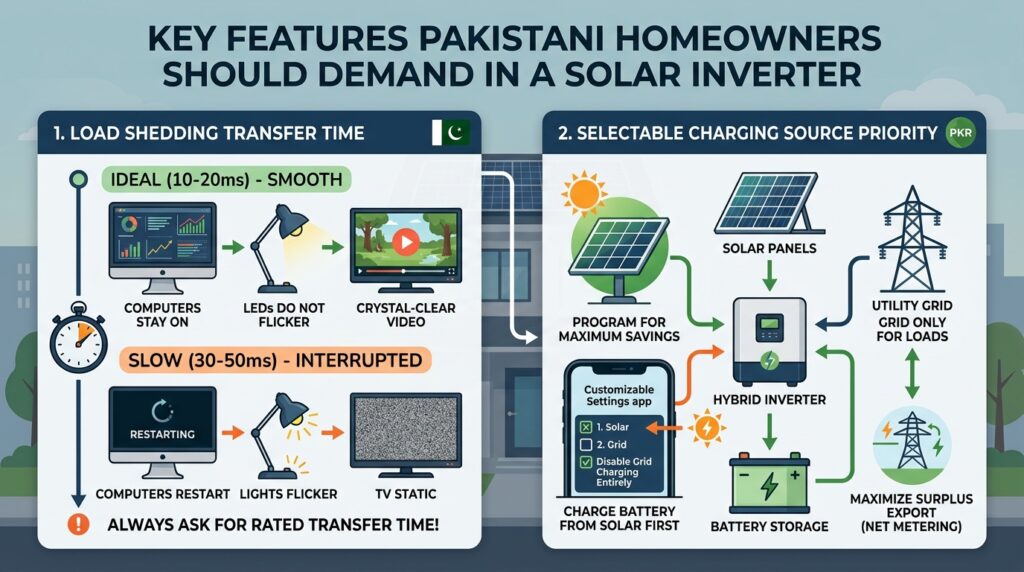
Beyond brand and price, several specific technical features make a dramatic difference to the daily experience of living with a solar inverter for home use in Pakistan.
Load shedding transfer time is how quickly the inverter switches from grid to battery power when the grid fails. An inverter that takes ten to twenty milliseconds switches fast enough that computers, televisions, and sensitive electronics do not notice the transition. An inverter that takes thirty to fifty milliseconds may cause computers to restart and LED lights to flicker. Always ask for the rated transfer time when evaluating inverters for Pakistani conditions.
Selectable charging source priority is important for managing your electricity costs under Pakistan’s net metering policy. Quality hybrid inverters allow you to set whether the battery is charged first from solar panels, then from the grid, or whether grid charging is disabled entirely. Programming the inverter to charge batteries exclusively from solar and to draw from the grid only for loads avoids paying grid electricity rates for battery energy while still maintaining the grid connection for net metering surplus export.
Generator compatibility is increasingly relevant for Pakistani homes in areas where load shedding is very long and battery backup is insufficient for extended outages. Some hybrid inverters can accept input from a diesel or gas generator as a third charging source alongside solar and grid. If you rely on a generator during extended outages, verify generator compatibility before purchasing.
Wide input voltage range tolerance is important for Pakistan’s voltage-fluctuating grid. An inverter that accepts grid input only within a narrow voltage band, such as two hundred and ten to two hundred and fifty volts, will disconnect from the grid frequently in areas where voltage swings are wide. Inverters that tolerate one hundred and eighty to two hundred and seventy volts or wider maintain grid connectivity through Pakistan’s typical voltage fluctuations.
For battery connection, verify that your chosen solar inverter for home in Pakistan supports the specific lithium battery brand you are planning to use. Inverter and battery BMS communication protocols must match for proper charging management. Our lithium ion solar battery guide at Pakistan Solar Solutions covers battery-inverter compatibility in detail.
The physical installation of your solar inverter for home use in Pakistan significantly affects its performance, lifespan, and safety. Several Pakistan-specific considerations apply.
The inverter must be installed indoors in a ventilated, cool location away from direct sunlight. Pakistan’s summer heat is the single biggest threat to inverter longevity. An inverter in a hot, unventilated outdoor enclosure or in direct sunlight can experience internal temperatures exceeding sixty to seventy degrees Celsius, triggering thermal derating or accelerating component degradation. Installing in an air-conditioned room, a shaded indoor wall, or at minimum a well-ventilated indoor space dramatically extends inverter lifespan.
The wall mounting must be structurally adequate. Quality five kilowatt inverters weigh fifteen to thirty kilograms, and the wall bracket must be properly anchored into concrete or structural masonry, not just plaster. Falls cause expensive and irreparable damage to inverter electronics.
Clearance around the inverter for ventilation is specified by each manufacturer and must be respected. Most inverters require at least twenty to thirty centimetres of clearance on all sides for adequate airflow. Cramming an inverter into a tight cabinet or between other equipment compromises cooling and triggers thermal derating.
DC isolator switches must be installed between the solar panels and the inverter for safe maintenance access. These are a mandatory safety requirement and should be included in every professional solar installation. At Pakistan Solar Solutions, every home solar inverter installation includes all mandatory safety equipment installed to professional standards.
What is the best solar inverter for home use in Pakistan for a medium-sized family?
For a medium Pakistani family home with one air conditioner, fans, lights, a refrigerator, and standard household loads, a five kilowatt hybrid solar inverter from Growatt, Deye, Solis, or Voltronic is the most popular and appropriate choice. These brands offer reliable performance, good warranty support in Pakistan, and the load capacity to handle all standard household requirements.
How does a solar inverter for home protect my appliances from Pakistan’s voltage fluctuations?
A quality hybrid solar inverter acts as a voltage regulation buffer between the Pakistani grid and your home appliances. When the grid voltage falls outside acceptable limits, the inverter switches to battery power automatically, protecting appliances from the damaging effects of low voltage, high voltage, and sudden surges. This protection function is one of the less discussed but very valuable benefits of home solar inverters in Pakistan.
Can I install a solar inverter for home use myself in Pakistan without a professional?
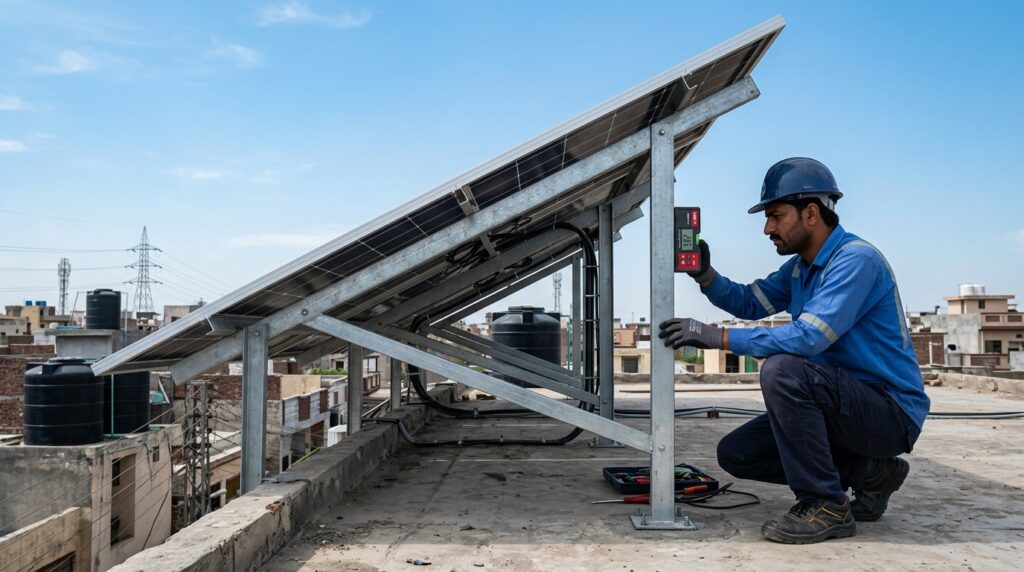
Solar inverter installation involves working with high-voltage DC electricity from the solar panels, mains AC electrical connections, and battery systems that store large amounts of energy. This work should always be carried out by a qualified solar installation professional. Incorrect wiring can cause fire, electric shock, equipment damage, and void warranties. Pakistan Solar Solutions provides professional installation for all systems supplied.
How do I monitor my home solar inverter’s performance in Pakistan?
Most modern hybrid solar inverters for home use in Pakistan include Wi-Fi connectivity and dedicated smartphone apps. Growatt uses the ShinePhone app, Huawei uses FusionSolar, and Solis uses SolarmanPV. These apps show real-time generation, consumption, battery state, and historical data, allowing you to track savings and identify any performance issues remotely.
What happens to my home solar inverter when there is a storm or lightning in Pakistan?
Quality solar inverters include internal surge protection for DC and AC connections. However, for comprehensive protection in Pakistan’s monsoon lightning season, additional external surge protection devices, also called SPDs, should be installed on both the DC solar input and the AC grid connection. Pakistan Solar Solutions includes surge protection in all complete system installations.